
Home » Services » Billing Services » Laboratory Billing
Laboratory billing sits at the intersection of high claim volume, dense coding rules, and some of the most aggressive payer scrutiny in healthcare. A single lab can run thousands of tests a month, each mapped to specific CPT and HCPCS codes, each subject to medical-necessity edits and frequency limits that vary by payer. Capture RCM manages that complexity end to end — from charge capture and coding through claim submission, denial management, and payment posting — so your lab collects what it earns without drowning in rework. We bring particular depth in toxicology and urine drug screen (UDS) billing for behavioral health and substance use programs, a category where miscoded panels and medical-necessity denials quietly erode revenue.
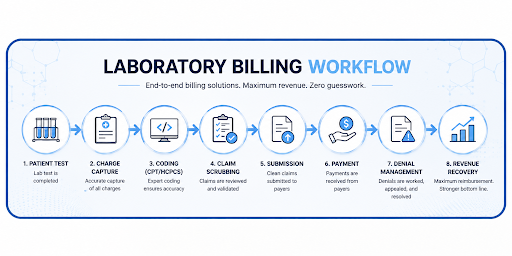
Laboratory billing is the process of translating completed lab tests into clean, coded insurance claims and managing those claims through to full payment. It covers eligibility verification, CPT/HCPCS coding, claim scrubbing, submission, payment posting, and appeals on anything denied. Because labs bill high volumes of relatively low-dollar claims, small error rates compound fast: a 3% denial rate across 5,000 monthly claims is 150 reworks every month. Accurate coding and disciplined denial management are what separate a lab that collects 97% of expected revenue from one that leaks 20–40% to preventable write-offs.
Lab billing carries risks that most physician-office billing never touches. Understanding them is the difference between a compliant revenue cycle and an audit exposure.
Our coders work across the full range of diagnostic testing, matching each test category to its correct codes, panel rules, and documentation requirements.
Clinical Chemistry & Blood Testing
Metabolic panels, lipid panels, liver and kidney function, glucose, and therapeutic drug monitoring. We handle panel-versus-component billing correctly so bundled chemistry tests aren’t unbundled into denials.
Hematology
Complete blood counts (CBC), coagulation studies, and related blood analysis. These are high-frequency tests where accurate coding and medical-necessity support keep recurring claims paid.
Urinalysis & Urine Drug Screening (UDS)
Routine urinalysis alongside presumptive and definitive urine drug testing. UDS is one of the most denial-prone categories in behavioral health billing — payers scrutinize frequency, medical necessity, and presumptive-versus-definitive coding closely. We build the documentation and coding discipline that keeps legitimate testing reimbursed.
Molecular & PCR Testing
PCR-based infectious disease testing — including COVID-19, respiratory panels, and STI panels — plus other molecular diagnostics. Molecular claims frequently trip MolDX registration and Z-code requirements, and we manage those prerequisites before claims go out.
Toxicology
Definitive drug testing and confirmation panels for substance use and pain-management programs. This is where our behavioral health specialization matters most: toxicology billing combines complex code sets with heavy medical-necessity review, and getting it right protects a major revenue stream for treatment centers.
Anatomic Pathology & Genetic Testing
Pathology specimen billing and genetic/genomic test claims, including the prior-authorization and documentation steps these high-dollar tests typically demand.
Most lab denials trace back to a coding decision made before the claim ever left the building. These are the code families where accuracy matters most, and where our coders spend their attention.
Codes and edits shift as CMS updates NCCI and the AMA revises CPT, so we keep coding current rather than relying on last year’s crosswalk. Accurate coding on the front end is far cheaper than appeals on the back end.
Most laboratory billing companies treat toxicology as one line item among many. For substance use and mental health programs, it’s often the difference between a profitable lab and a compliance headache. Recurring drug testing draws payer attention faster than almost any other service — audits focus on whether testing frequency is justified, whether presumptive and definitive tests are coded and documented separately, and whether medical necessity is clearly established in the record.
The presumptive-versus-definitive distinction is where a lot of revenue is won or lost. Presumptive screens tell you whether a substance class is likely present; definitive testing confirms exactly which drug and at what concentration. Payers expect definitive testing to be ordered based on a clinical reason, not run reflexively on every sample, and they expect the medical record to show that reasoning. When a program bills both without documenting why the definitive test was medically necessary, the definitive claim is the one that gets denied.
Capture RCM has spent years billing across detox, residential, PHP, IOP, and outpatient settings, so our team understands both the clinical rationale for testing and the coding rules payers apply to it. We coordinate lab billing with the rest of your revenue cycle — utilization review, documentation, and compliance — rather than treating it as an isolated claim stream. That alignment is what keeps toxicology revenue defensible when a payer asks questions.
Most lab denials fall into a handful of recurring categories, and nearly all are preventable with the right front-end discipline.
When a denial does occur, we don’t automatically rebill. We investigate the root cause and submit a documented appeal, accessing payer portals within three days of submission to track status through adjudication — the same proactive approach that has helped our clients recover over $100 million in previously unclaimed revenue.
Many labs start by billing in-house and reconsider once volume grows or denials climb. Handling it internally gives you direct control and keeps billing staff close to lab operations, but it also means carrying the cost of specialized coders, staying current on CMS and MolDX changes, and covering for turnover and PTO without letting the A/R slip. For a high-volume, low-dollar operation, a small dip in first-pass rate or a lag in denial follow-up erases any savings quickly.
Outsourcing to a partner built for lab billing shifts that burden. You get coders who work these code sets daily, denial management that runs continuously rather than when someone has time, and reporting that shows net collections instead of just claims sent. The right question isn’t which model is cheaper on paper — it’s which one collects more of what you’re owed after denials, write-offs, and staffing costs are counted. For most growing labs, and especially behavioral health programs with heavy toxicology volume, a specialized partner nets more revenue than an in-house team can.
We manage the full revenue cycle so your team can focus on running the lab, not chasing claims.
Laboratory billing is one of the most audited areas in healthcare, and toxicology sits at the top of the list for federal scrutiny. Compliance isn’t a separate task here — it’s built into how claims are coded and documented from the start. We align billing with CMS and Medicare rules, MolDX requirements for molecular testing, CLIA certification scope, and medical-necessity standards, so your lab’s revenue can withstand an audit rather than invite one. For programs already working with Capture RCM on compliance management, lab billing folds directly into your broader regulatory posture.
We’ve been improving healthcare revenue cycles since 2001, managing more than $2 billion in revenue with a 99% collection rate, a 98% first-pass claim ratio, and days-sales-outstanding held to 15–20 days. What sets us apart for laboratories is the behavioral health specialization behind that track record: we understand toxicology and UDS billing at the level of clinical rationale and payer rules, not just claim mechanics. Your lab gets a partner that codes accurately, defends claims strategically, and integrates billing with credentialing, utilization review, and compliance across your organization.
Toxicology billing involves separate presumptive and definitive testing codes, per-drug-class billing rules for confirmation tests, and far heavier medical-necessity and frequency scrutiny from payers. Recurring drug testing in SUD programs is audited more closely than most lab work, so documentation and coding discipline matter more than in routine clinical billing.
The most common reasons are frequency limits being exceeded, missing medical-necessity documentation, and presumptive and definitive tests being coded incorrectly or without justification for the definitive test. Preventing these denials is mostly front-end work: verifying coverage, confirming the clinical reason for testing, and coding to each payer’s rules before submission.
Yes. We bill PCR-based infectious disease testing including COVID-19, respiratory panels, and STI panels, along with other molecular diagnostics. Because many molecular tests require MolDX registration and Z-codes, we handle those prerequisites before claims are submitted rather than appealing after a denial.
Yes. We integrate with your existing lab and practice systems to capture orders, demographics, and results, so charge capture and coding flow into billing without duplicate manual entry.
We support labs across the volume spectrum, from smaller behavioral health program labs running routine UDS and chemistry to higher-volume clinical and molecular operations. Our process scales with claim volume while keeping first-pass rates high.
Talk to a Capture RCM billing specialist about your lab’s testing mix, denial rates, and payer challenges — and see how much revenue you can recover.