

For billing managers in behavioral health organizations, claim denials can quickly become one of the largest barriers to financial stability. Every denied claim represents delayed revenue, additional administrative effort, increased accounts receivable, and lost productivity.
While denials are often viewed as an unavoidable part of healthcare reimbursement, the reality is different. Most denial categories are predictable. More importantly, many are preventable.
Organizations that systematically identify denial trends, strengthen front-end processes, improve documentation quality, and monitor performance metrics often achieve significant improvements in reimbursement outcomes.
Strong mental health billing services can support these efforts by helping organizations reduce preventable denials, improve clean claim rates, and create more efficient revenue cycle operations.
This guide provides a practical framework for billing managers seeking to reduce denials while strengthening overall revenue cycle performance.
Why Claim Denials Have a Bigger Financial Impact Than Most Organizations Realize
Many billing departments focus on denial volume.
The greater concern is denial cost.
Every denied claim creates multiple layers of expense:
- Staff time spent researching issues
- Additional payer communication
- Documentation review
- Appeals processing
- Payment delays
- Increased accounts receivable balances
Industry studies frequently estimate that reworking a denied claim can cost between $25 and $100 or more depending on complexity.
Consider a behavioral health organization submitting 3,000 claims each month.
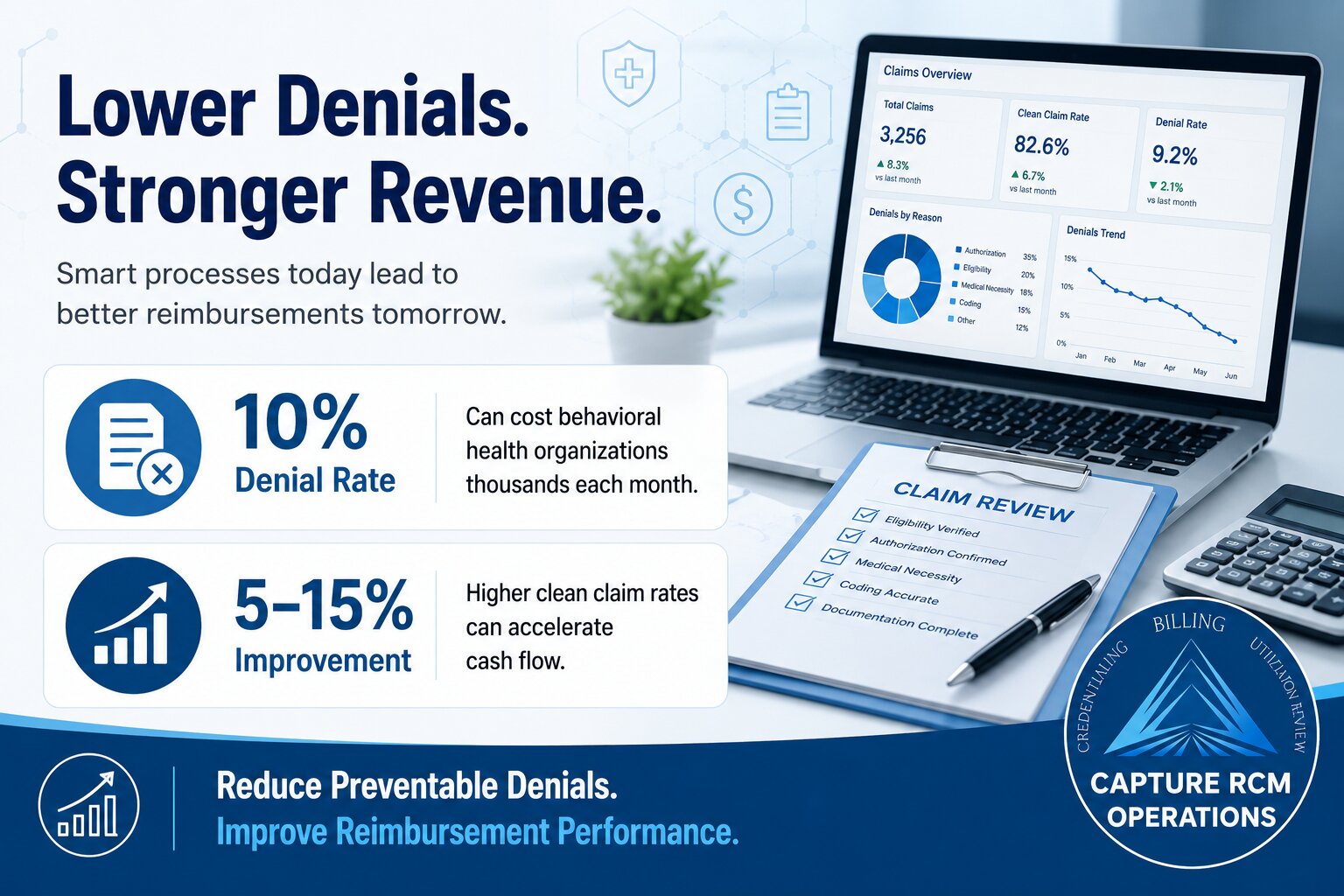
With a 10% denial rate, 300 claims require additional work.
If rework costs average $40 per claim, the organization may spend approximately $12,000 monthly simply correcting denials.
That figure excludes delayed cash flow and potential write-offs.
Reducing denials creates a direct impact on profitability without requiring additional patient volume.
Understanding the Most Common Denial Categories
Before improving performance, organizations must understand why denials occur.
Behavioral health organizations often encounter several recurring denial types.
Authorization Denials
Missing, expired, or incorrect authorizations remain among the most common reimbursement challenges.
Eligibility Denials
Coverage changes, inactive policies, and coordination-of-benefits issues frequently create payment problems.
Medical Necessity Denials
Documentation may not adequately support the services rendered or the level of care provided.
Coding Errors
Incorrect CPT codes, modifiers, diagnosis codes, or billing combinations often result in claim rejection.
Timely Filing Denials
Claims submitted after payer deadlines may be denied regardless of medical necessity.
Documentation Deficiencies
Missing signatures, incomplete notes, or inconsistent treatment records can create reimbursement obstacles.
Most organizations discover that a small number of denial categories account for the majority of their revenue cycle issues.
The objective is not simply working denials faster.
The objective is preventing them from occurring.
Build a Denial Management Framework
Many billing departments spend considerable time resolving denials without analyzing them systematically.
This approach limits improvement.
A denial management framework should categorize claims according to:
- Payer
- Provider
- Service type
- Location
- Denial reason
- Authorization status
- Documentation issue
- Financial value
For example, denial analysis may reveal:
- 35% of denials relate to authorization issues
- 20% stem from eligibility problems
- 15% involve documentation deficiencies
This visibility allows leadership to prioritize the most impactful opportunities.
Organizations that categorize denials consistently often identify root causes much faster.
Strengthen Front-End Revenue Cycle Processes
A significant percentage of denials originate before treatment begins.
Front-end processes represent one of the most effective opportunities for denial reduction.
Eligibility Verification
Insurance coverage should be verified before services are provided.
Many organizations also perform periodic re-verification for ongoing treatment episodes.
Benefits Investigation
Understanding deductibles, co-insurance, limitations, and authorization requirements helps prevent surprises later.
Patient Demographic Validation
Simple errors involving names, dates of birth, or policy numbers frequently trigger rejections.
Authorization Management
Organizations should maintain structured workflows for:
- Initial approvals
- Continued stay requests
- Concurrent reviews
- Authorization renewals
Preventing front-end errors is typically far less expensive than correcting denials after claims are submitted.
Improve Documentation to Reduce Medical Necessity Denials
Behavioral health reimbursement depends heavily on clinical documentation.
Medical necessity denials often occur when records fail to explain why treatment was required.
Strong documentation should answer several questions:
Why Is Treatment Necessary?
Clearly describe symptoms and functional impairment.
Why Is This Level of Care Appropriate?
Support the intensity and frequency of services.
What Interventions Were Provided?
Document therapeutic activities and clinical decision-making.
What Progress Is Being Made?
Demonstrate measurable outcomes and treatment effectiveness.
Why Is Continued Treatment Needed?
Support ongoing medical necessity when applicable.
For example:
“Patient attended therapy session.”
Provides minimal support.
A stronger note might explain symptom severity, interventions used, treatment response, and ongoing clinical needs.
Small documentation improvements often lead to significant reductions in denial volume.
Use Services, Billing, Mental Health Analytics to Identify Opportunities
Data should drive denial reduction initiatives.
Without analytics, organizations often focus on symptoms rather than root causes.
Billing managers should monitor:
Overall Denial Rate
Measures the percentage of denied claims.
Clean Claim Rate
Tracks claims accepted on first submission.
First-Pass Resolution Rate
Measures claims processed successfully without intervention.
Net Collection Rate
Evaluates revenue recovery performance.
Days in Accounts Receivable
Reveals reimbursement efficiency.
Denial Recovery Rate
Measures success in overturning denied claims.
Authorization-Related Denials
Highlights process weaknesses.
Within services, billing, mental health operations, data frequently uncovers opportunities that would otherwise remain hidden.
For example, one payer may account for a disproportionate share of denials due to unique authorization requirements.
Targeted workflow changes can address the issue directly.
Create a Structured Appeals Process
Not every denial should be accepted.
Many denials can be overturned when supported appropriately.
Successful appeals processes include:
Prioritization
Focus first on high-value claims.
Documentation Collection
Gather all supporting records before appeal submission.
Standardized Appeal Templates
Improve consistency and efficiency.
Deadline Tracking
Prevent missed appeal opportunities.
Outcome Analysis
Identify successful appeal patterns and recurring payer concerns.
Organizations often discover that appeal success rates improve significantly when processes become standardized.
Automate High-Risk Revenue Cycle Functions
Manual workflows increase the likelihood of errors.
Automation can reduce denial risk while improving staff efficiency.
Common opportunities include:
Eligibility Verification Automation
Confirm coverage before treatment begins.
Authorization Tracking
Monitor approval dates and expiration timelines.
Claim Scrubbing
Identify coding and billing issues before submission.
Denial Categorization
Improve reporting and trend analysis.
Accounts Receivable Monitoring
Highlight reimbursement delays earlier.
Even modest automation investments can generate substantial operational returns.
Improve Collaboration Between Clinical and Billing Teams
Many denial causes originate at the intersection of clinical and administrative workflows.
When departments operate independently, communication gaps emerge.
High-performing organizations establish:
Monthly Denial Review Meetings
Discuss trends and improvement opportunities.
Shared Documentation Standards
Align clinical records with payer requirements.
Authorization Review Processes
Maintain visibility into approvals and renewals.
Cross-Functional Education
Ensure both teams understand how their work affects reimbursement.
Reducing denials requires organizational alignment rather than isolated billing department efforts.
Establish Continuous Improvement Processes
Denial reduction should not be treated as a one-time project.
Payer requirements continue evolving.
Documentation standards change.
Regulatory expectations shift.
Organizations should establish ongoing review processes including:
- Monthly denial trend analysis
- Quarterly workflow audits
- Staff education initiatives
- Payer policy reviews
- Performance benchmarking
Continuous improvement creates sustainable results.
Organizations that monitor performance consistently often experience lower denial rates and stronger financial outcomes over time.
The ROI of Denial Reduction
Reducing denials produces benefits that extend far beyond reimbursement.
Organizations frequently experience:
- Faster cash flow
- Improved collection rates
- Lower administrative costs
- Reduced staff workload
- Better payer relationships
- Stronger compliance performance
- Improved financial predictability
For billing managers, denial reduction often represents one of the highest-impact opportunities available.
Unlike increasing patient volume, denial reduction improves revenue by maximizing reimbursement from existing services.
In many cases, the fastest path to financial improvement is not additional admissions.
It is collecting more effectively on the services already being provided.
Frequently Asked Questions
What denial rate should behavioral health organizations target?
Many organizations aim for denial rates below 5%, although benchmarks vary by payer mix and service type.
What causes most mental health claim denials?
Authorization issues, eligibility problems, documentation deficiencies, coding errors, and medical necessity concerns are among the most common causes.
How often should denial data be reviewed?
Monthly reviews are recommended, with deeper quarterly analyses to identify long-term trends and improvement opportunities.
What is a clean claim rate?
The clean claim rate measures the percentage of claims accepted on first submission without edits, rejections, or denials.
How can organizations reduce authorization-related denials?
Strong authorization workflows, proactive tracking systems, and timely concurrent reviews significantly reduce authorization-related reimbursement issues.
Should every denied claim be appealed?
Not necessarily. Organizations should prioritize appeals based on claim value, likelihood of success, and operational resources.
How does automation help reduce denials?
Automation improves eligibility verification, authorization tracking, claim scrubbing, reporting, and workflow consistency.
Why is collaboration between clinical and billing teams important?
Many denials involve documentation and medical necessity issues that require coordination between both departments to resolve effectively.
Call (380) 383-6822 or visit our mental health billing services to learn more about our services, billing, mental health services.