
Improving healthcare RCM since 2001 · $2B+ in revenue managed · 99% collection rate · 98% first-pass ratio · 15–20 days DSO
End-to-end provider credentialing and payer enrollment for behavioral health practices nationwide. Getting your clinicians enrolled with payers is the step that decides when you can start billing — and how much revenue slips away before you do. Capture RCM manages the entire credentialing lifecycle for mental health, substance use, ABA, and telehealth providers, so your clinicians can see insured patients and get paid without months of avoidable delay.
Credentialing is the process of verifying a provider’s qualifications: education, training, licensure, board certification, work history, and malpractice coverage, so an insurance payer will recognize them as an in-network provider. In behavioral health, it applies to individual clinicians and to facilities offering detox, residential, PHP, IOP, and outpatient levels of care.
Three terms get used interchangeably, but they describe different steps, and confusing them is where practices lose time:
Our credentialing team handles all three as one continuous workflow, because a gap in any one of them stalls reimbursement.
A clinician who isn’t credentialed with a payer is, for billing purposes, invisible to that payer. Services delivered before enrollment is active are typically not reimbursable, which means a new hire can be seeing patients for weeks while the practice absorbs the cost of care it can’t bill for. Credentialing delays are one of the most common — and most preventable — sources of lost revenue in a behavioral health practice.
Lapsed credentials are just as costly. When a license, CAQH attestation, or DEA registration expires without being renewed on time, claims start denying and the provider effectively falls off the panel until it’s corrected. We treat credentialing not as a one-time onboarding task but as an ongoing revenue-protection function, which is why expirables monitoring is built into how we work.
Credentialing verifies that healthcare providers are appropriately licensed, certified, and have the necessary experience to offer medical services. This process ensures that providers are in compliance with state, federal, and payer-specific regulations. By confirming the credentials of your healthcare providers, you mitigate the risk of working with unqualified professionals, reducing exposure to legal and financial liabilities.
Proper credentialing ensures that healthcare providers are recognized by insurance companies and other payers, which is essential for receiving reimbursement for services rendered. Without proper credentialing, claims may be denied or delayed, resulting in lost revenue. By maintaining up-to-date credentials, healthcare organizations can maximize their reimbursement rates and ensure timely payment.
Credentialing enables healthcare providers to join insurance networks, giving them access to a broader pool of patients covered by various payers. Being part of an insurer’s network increases the likelihood of securing patients and improves the financial stability of the practice. By ensuring that all providers are credentialed with the right payers, you enhance your organization’s access to more insurance contracts and potential patient revenue.
Credentialing serves as a safeguard against fraud and abuse by verifying that healthcare providers are legitimate, licensed, and authorized to perform services. By conducting thorough background checks and verifying credentials, healthcare organizations can avoid working with individuals involved in fraudulent activities, reducing the risk of financial and reputational damage.
By ensuring that healthcare providers are properly credentialed, healthcare organizations help maintain high standards of care. Credentialing verifies that providers have the necessary education, training, and expertise to offer safe and effective services. This directly impacts patient safety and improves the overall quality of care, which is critical for maintaining patient trust and satisfaction.
Credentialing is a foundational aspect of the revenue cycle. Providers who are properly credentialed are more likely to have their claims processed quickly and accurately by payers. A smooth credentialing process reduces the chances of denied claims, underpayments, and delays, which can disrupt cash flow and affect the financial health of an organization. This ensures a seamless revenue cycle and helps organizations stay financially solvent.
Credentialing ensures that healthcare providers meet the requirements set by accreditation bodies, such as The Joint Commission (TJC) or the National Committee for Quality Assurance (NCQA). Being properly credentialed not only satisfies payer requirements but also demonstrates your organization’s commitment to meeting industry standards, improving your reputation, and gaining the trust of both patients and partners.
We manage credentialing across every payer and facility you work with, keeping provider data accurate and applications moving. Our services cover the full lifecycle:
We gather and verify provider documentation, complete payer applications, and manage submissions across commercial and government payers, then follow up proactively until enrollment is active, rather than waiting for the payer to respond.
Payers require re-credentialing on a recurring cycle, and licenses, CAQH profiles, and DEA registrations all expire on their own schedules. We track these dates and manage renewals ahead of deadlines so your providers never drop off a panel because a date slipped through.
Getting on a panel is only half the equation — the contract determines what you’re paid. We support participation agreements and fee schedule review so you understand the terms before you sign, not after the first underpaid claim.
Most commercial payers pull provider data from CAQH, and an incomplete or unattested profile is a frequent cause of stalled applications. We set up, populate, and re-attest CAQH profiles so the data payers rely on is always current.
Government payer enrollment follows its own rules and portals, including PECOS for Medicare. We handle Medicare and state Medicaid enrollment, including the documentation and revalidation requirements that trip up practices doing this in-house.
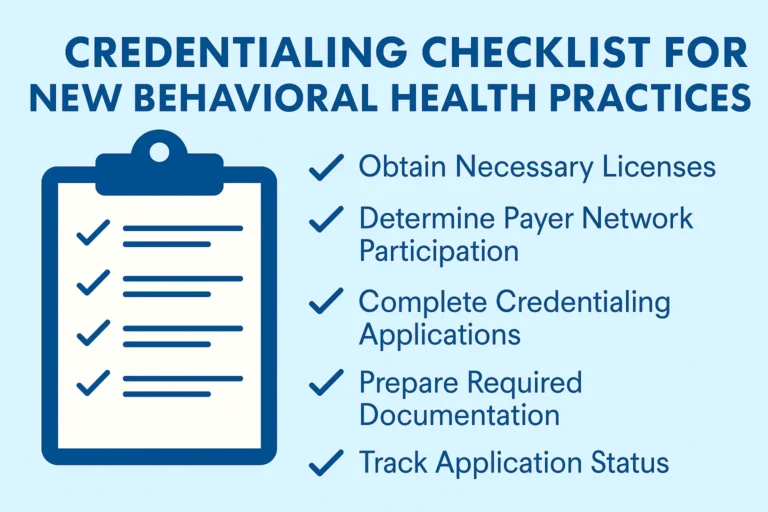
Our process mirrors the disciplined, follow-up-driven approach we use across our billing services. Clean credentialing is what makes clean claims possible.
Most payer credentialing takes 60 to 120 days from a complete application, though the exact timeline depends on the payer, the state, and how quickly documentation and primary source verification come together. Commercial payers often move faster than Medicare and Medicaid, and incomplete CAQH profiles or missing documents are the most common reasons an application drags past the expected window. Because we submit complete applications and follow up proactively, we work to keep your providers at the shorter end of that range and to give you realistic effective dates you can plan hiring and admissions around.
Behavioral health credentialing isn’t one-size-fits-all — a solo therapist and a multi-site residential program face very different payer requirements. We credential providers and facilities across the full continuum of care:
Most practices don’t struggle with credentialing because it’s conceptually hard — they struggle because it’s detail-heavy, deadline-driven, and easy to deprioritize when clinical work takes over. The problems we see most often include payer processing delays that stall new-hire revenue, incomplete or un-attested CAQH profiles, roster errors across multi-provider groups, and multi-state licensure headaches for telehealth-heavy practices. We take ownership of the tracking and follow-up so these issues get caught before they turn into denied claims.
We’ve been improving healthcare revenue cycle management since 2001, and in that time we’ve managed more than $2 billion in revenue for our clients, maintaining a 99% collection rate, a 98% first-pass claim ratio, and days sales outstanding of just 15–20 days. Credentialing done by certified professionals who understand behavioral health payer rules is what makes those numbers possible because reimbursement starts with getting enrolled correctly.
Because we handle credentialing, billing, utilization review, and compliance under one roof, the provider data that drives your claims stays consistent across every part of your revenue cycle. That’s harder to achieve when credentialing sits in a silo, disconnected from the team submitting your claims.
Contact us today at (380)383-6822 to learn how we can partner with your healthcare organization to streamline your operations and maximize your revenue.
Credentialing verifies a provider’s qualifications against a payer’s standards. Payer enrollment is the application that adds the verified provider to a specific insurance panel so claims can be submitted. Credentialing generally has to happen before enrollment can be completed.
Typically 60 to 120 days from a complete application, depending on the payer, the state, and how quickly documentation and primary source verification are completed. Government payers like Medicare and Medicaid often take longer than commercial payers.
In most cases, services delivered before a provider’s enrollment is active with a payer are not reimbursable by that payer. This is why starting credentialing well ahead of a provider’s start date protects your revenue.
CAQH is the database most commercial payers use to access provider credentialing data. An incomplete profile or a missed re-attestation is one of the most common reasons enrollment applications stall, so keeping CAQH current is essential.
Most payers require re-credentialing on a recurring cycle, commonly every two to three years. Separately, licenses, DEA registrations, and CAQH attestations expire on their own schedules and must be renewed to avoid claim denials.
Yes. We manage Medicare enrollment through PECOS and state Medicaid enrollment, including the documentation and revalidation requirements these government payers impose.
Yes. We support multi-state licensure and payer enrollment, which is especially important for telehealth providers and practices operating across state lines.
Credentialing is deadline-driven and easy to deprioritize when clinical demands take over, and small lapses lead to denied claims. Outsourcing to a team that tracks expirables and follows up proactively protects revenue and frees your staff to focus on patient care.