

For small substance use disorder treatment providers, growth often creates an unexpected challenge: billing complexity increases faster than operational capacity.
What starts as a manageable process involving insurance verification, claim submission, and payment posting can quickly become a significant administrative burden. As patient volume grows, so do authorization requirements, payer rules, denial management responsibilities, compliance obligations, and reporting needs.
Many practice owners eventually reach the same crossroads.
Should we continue building our billing operation internally, or should we partner with specialists who focus exclusively on revenue cycle management?
There is no universal answer. However, there is a structured way to evaluate the decision.
Strong substance use disorder billing services can help organizations improve collections, reduce administrative strain, and support sustainable growth. At the same time, some organizations benefit from maintaining internal billing operations.
This guide provides a practical framework for evaluating build-versus-buy decisions while addressing the operational, financial, and compliance concerns that frequently influence small practice owners.
Why Revenue Cycle Complexity Increases Faster Than Patient Volume
Many practice owners assume billing workload grows at roughly the same pace as admissions.
In reality, billing complexity often grows faster than patient volume.
Consider a small practice that expands from 30 active patients to 75.
The increase is not simply additional claims.
The practice may now encounter:
- More insurance carriers
- Additional authorization requirements
- More payer-specific documentation standards
- Increased denial volume
- Greater reporting requirements
- Higher compliance expectations
- More accounts receivable follow-up
A practice that once worked with three insurance plans may now be managing ten or more.
Each payer has unique requirements, timelines, and reimbursement policies.
The result is an operational challenge that many small organizations underestimate.
Growth becomes harder to manage because administrative infrastructure is struggling to keep pace.
Understanding the Full Cost of Internal Billing
One of the most common mistakes small practice owners make is comparing outsourced billing costs only against employee salaries.
This creates an incomplete picture.
Internal billing costs often include much more than payroll.
Staffing Expenses
Billing specialists require salaries, benefits, payroll taxes, paid time off, and ongoing support.
Even a single experienced revenue cycle employee represents a significant investment.
Recruiting and Turnover Costs
Behavioral health organizations continue to face staffing challenges.
Replacing experienced billing personnel often requires recruiting expenses, onboarding time, and productivity loss.
Training and Education
Payer requirements change constantly.
Coding updates, authorization rules, and compliance expectations require continuous education.
Technology Investments
Most organizations need:
- Practice management software
- Clearinghouse access
- Revenue cycle reporting tools
- Eligibility verification systems
- Authorization tracking platforms
Technology costs continue regardless of patient volume.
Leadership Oversight
Someone must monitor billing performance, manage staff, address denials, review reports, and resolve operational issues.
Many owners fail to account for the value of their own time.
When these costs are combined, internal billing may be significantly more expensive than initially assumed.
When Maintaining Internal Billing Makes Strategic Sense
Outsourcing is not automatically the right answer.
Some organizations perform exceptionally well with internal teams.
Internal billing may be the better option when:
You Have Experienced Revenue Cycle Leadership
Organizations with knowledgeable billing managers often maintain strong performance internally.
Staff Turnover Is Low
Consistency creates operational stability.
Denial Rates Are Already Well Controlled
If denial rates remain low and collections are strong, major changes may not be necessary.
Growth Is Relatively Predictable
Stable organizations often find internal operations easier to manage.
Direct Oversight Is a Priority
Some practice owners prefer complete operational control.
In these situations, continuing to build internal capabilities may support long-term goals.
The key is making that decision intentionally rather than by default.
Warning Signs That Internal Billing Is Reaching Its Limits
Most practices do not experience a sudden billing crisis.
Instead, warning signs appear gradually.
Accounts Receivable Continues Growing
Longer reimbursement timelines often indicate workflow inefficiencies.
Denials Are Increasing
Growing denial rates frequently signal documentation, authorization, or payer requirement issues.
Billing Staff Seem Overwhelmed
When teams spend most of their time reacting to problems, performance often declines.
Authorizations Are Delayed
Missed or delayed authorizations can affect both reimbursement and patient access.
Reporting Is Inconsistent
Limited visibility makes it difficult to identify operational risks.
Owners Spend Excessive Time Managing Billing
Many practice owners discover they are spending hours each week addressing revenue cycle concerns rather than focusing on growth.
These warning signs often indicate that current systems are approaching capacity.
Evaluating the Business Case for Outsourcing
The strongest outsourcing decisions are driven by business outcomes rather than convenience.
Practice owners should evaluate how outsourcing may affect:
Collections
Specialized billing organizations often improve reimbursement performance through stronger claim management.
Cash Flow
Faster collections can improve financial predictability.
Administrative Efficiency
Internal teams spend less time managing claims and follow-up activities.
Scalability
Growth becomes easier when additional billing infrastructure is not required.
Compliance
Specialized teams typically monitor payer requirements and industry changes closely.
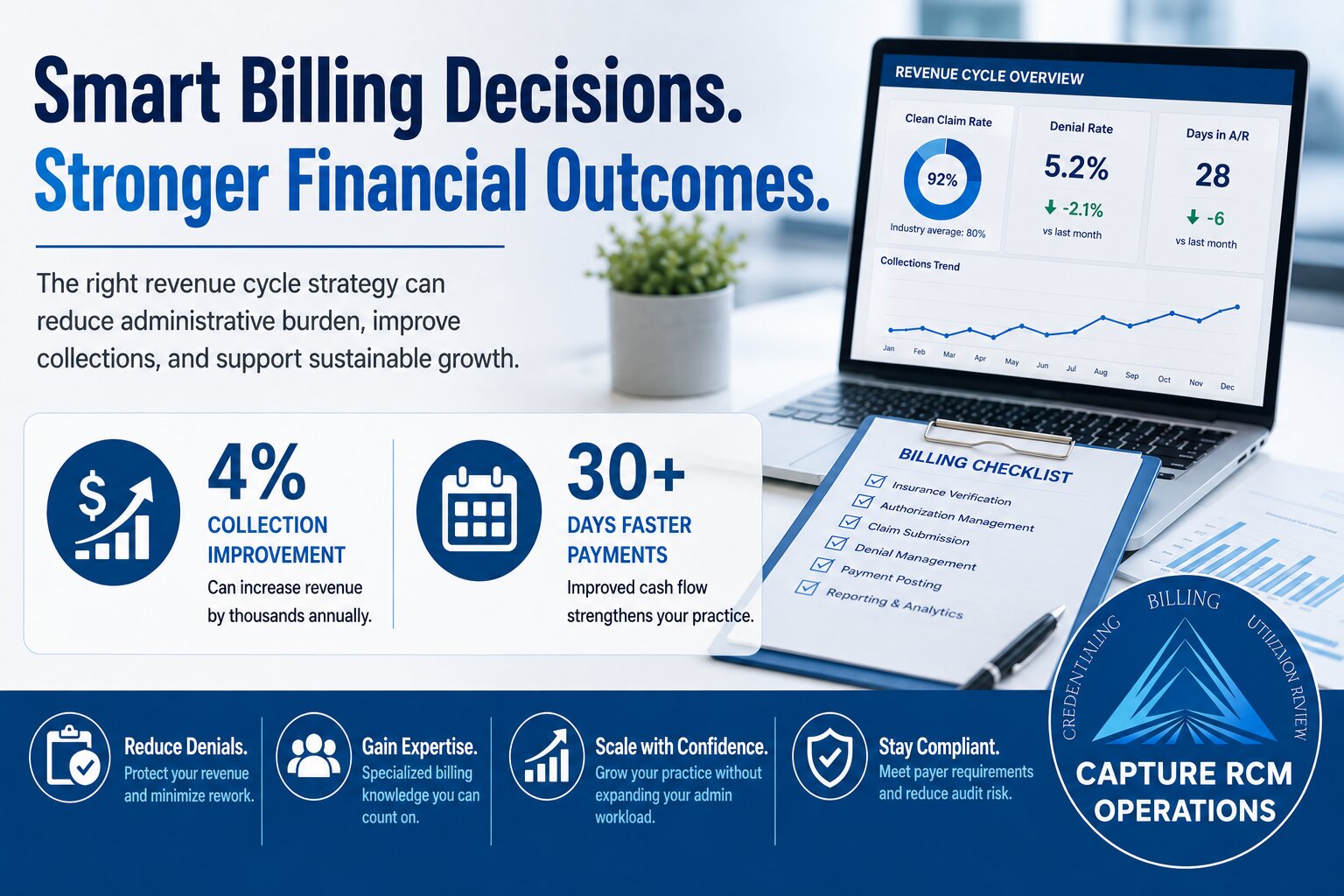
For example, improving collections by just 4% on $1.5 million in annual revenue would generate an additional $60,000.
Small improvements can create meaningful financial impact.
How Services, Billing, Substance Use Disorder Partners Support Growth
As payer requirements become more complex, many organizations seek specialized services, billing, substance use disorder support to strengthen financial performance.
These partnerships typically extend beyond basic claim submission.
Support often includes:
Insurance Verification
Confirming eligibility and benefits before treatment begins.
Authorization Management
Tracking approvals, concurrent reviews, and renewals.
Claims Processing
Submitting clean claims and monitoring claim status.
Denial Management
Investigating, correcting, and appealing denied claims.
Accounts Receivable Follow-Up
Reducing aging balances and improving collections.
Revenue Cycle Reporting
Providing operational visibility and financial insights.
Compliance Monitoring
Supporting documentation standards and payer requirements.
For growing organizations, these services can create a stronger operational foundation without requiring significant internal expansion.
Addressing Common Concerns About Outsourcing
Small practice owners often hesitate because of legitimate concerns.
“We’ll Lose Control”
A quality billing partner should increase visibility through reporting and communication.
You should have more insight into performance, not less.
“We’re Too Small”
Smaller practices often benefit significantly because they lack the economies of scale available to larger organizations.
“It’s Too Expensive”
The comparison should be against total internal costs, not just payroll.
Many hidden expenses are overlooked during initial evaluations.
“We Already Have Someone Handling Billing”
The relevant question is not whether billing is being handled.
The question is whether it is being handled efficiently, accurately, and at a scale that supports future growth.
These concerns deserve careful evaluation but should not prevent objective analysis.
Creating a Build-vs-Buy Decision Framework
A structured framework can simplify the evaluation process.
Consider scoring each option across five categories:
Cost
What is the total expense over the next 12 months?
Expertise
Does the team possess specialized substance use disorder reimbursement knowledge?
Scalability
Can the current model support projected growth?
Risk
What operational or compliance risks exist?
Performance
How effectively is the current system performing?
Many practice owners discover that the best decision becomes clearer when viewed through measurable business criteria rather than assumptions.
Metrics Every Practice Owner Should Monitor
Regardless of whether billing remains internal or becomes outsourced, performance measurement is critical.
Important metrics include:
- Clean claim rate
- Net collection percentage
- Denial rate
- Days in accounts receivable
- Authorization approval rate
- Revenue per patient
- Cost to collect
- First-pass claim acceptance rate
Organizations that consistently monitor these metrics make stronger operational decisions and identify issues earlier.
The Long-Term Growth Perspective
Many practice owners initially view billing as an administrative necessity.
The most successful organizations eventually recognize it as a growth strategy.
Efficient revenue cycle management creates:
- Stronger cash flow
- Better forecasting
- Greater operational stability
- Improved patient access
- Enhanced scalability
- Reduced administrative burden
Whether you choose to build internally or partner with specialists, the goal remains the same:
Create a revenue cycle infrastructure capable of supporting long-term growth.
The organizations that scale successfully are rarely those working the hardest.
They are the ones building systems that allow growth to happen without sacrificing efficiency, compliance, or financial performance.
Frequently Asked Questions
What is the biggest benefit of outsourcing substance use disorder billing?
Many organizations gain access to specialized expertise, stronger denial management, improved collections, and greater operational scalability.
How can I determine if outsourcing makes financial sense?
Compare total internal expenses—including salaries, software, benefits, turnover, training, and management time—against outsourcing costs and expected performance improvements.
Is outsourcing only beneficial for larger organizations?
No. Small practices often benefit significantly because they may not have access to dedicated revenue cycle expertise internally.
Will outsourcing improve cash flow?
Many organizations experience faster reimbursement and lower accounts receivable balances through stronger claim management and follow-up processes.
Can outsourced teams manage authorizations and denials?
Yes. Many specialized revenue cycle organizations provide comprehensive support including authorization management, denial prevention, appeals, and reporting.
What should I look for in a billing partner?
Evaluate industry expertise, reporting capabilities, communication processes, compliance support, performance metrics, and experience within substance use disorder treatment.
How long does implementation usually take?
Most transitions occur within several weeks, although timelines vary based on system complexity and organizational requirements.
What metrics indicate billing performance problems?
High denial rates, increasing accounts receivable balances, low collection percentages, authorization delays, and limited reporting visibility are common warning signs.
Call (380) 383-6822 or visit our substance use disorder billing services to learn more about our services, billing, substance use disorder services.