

For operations managers in behavioral health organizations, prior authorization delays are rarely just an administrative inconvenience. They impact admissions, disrupt patient care, delay reimbursement, increase denial rates, and create compliance risks that can affect the entire organization.
Whether you manage outpatient programs, residential treatment, detox services, or multiple levels of care, authorization efficiency directly affects revenue cycle performance. Organizations that streamline authorization management often see improvements in cash flow, staff productivity, denial reduction, and payer relationships.
Strong substance use disorder billing services help organizations build predictable workflows that support both operational efficiency and financial performance. This guide outlines practical strategies operations managers can use to reduce authorization bottlenecks and improve reimbursement outcomes.
Why Prior Authorization Delays Have a Bigger Impact Than Most Organizations Realize
Many organizations treat authorizations as a utilization review responsibility.
High-performing organizations view them as a revenue cycle function.
The difference matters.
Every delayed authorization can create a chain reaction:
- Admissions wait longer for approval
- Clinical teams spend more time gathering documentation
- Billing teams face delayed claim submissions
- Accounts receivable balances increase
- Cash flow becomes less predictable
- Patients experience treatment interruptions
Consider a facility with 150 admissions per month and an average reimbursement value of $4,000 per admission.
If only 10 admissions are delayed because of authorization issues, the organization may be waiting on $40,000 or more in expected revenue.
Multiply that across multiple programs and multiple payers, and the financial impact becomes substantial.
For operations managers, authorization workflows should be treated as a strategic business process rather than a routine administrative task.
Mapping the Entire Authorization Lifecycle
One of the most common causes of authorization delays is fragmented ownership.
In many organizations, admissions, clinical teams, utilization review specialists, and billing departments all touch the authorization process.
Unfortunately, responsibility often becomes unclear.
A typical authorization lifecycle includes:
- Insurance verification
- Benefits investigation
- Clinical assessment
- Initial authorization request
- Payer review
- Approval or request for additional information
- Concurrent review management
- Continued stay requests
- Claims submission
- Payment reconciliation
Without clear accountability, requests can stall at any stage.
Successful organizations assign ownership to every step.
For example:
| Workflow Stage | Primary Owner |
|---|---|
| Eligibility Verification | Admissions Team |
| Clinical Documentation | Clinical Staff |
| Initial Authorization | Utilization Review |
| Follow-Up Tracking | Authorization Specialist |
| Concurrent Reviews | Utilization Review |
| Claims Submission | Billing Department |
| Reimbursement Tracking | Revenue Cycle Team |
This structure improves visibility and eliminates uncertainty regarding who is responsible for moving requests forward.
Creating a Standardized Authorization Checklist
Many authorization-related denials occur because information is missing before the request reaches the payer.
A standardized checklist can significantly reduce preventable delays.
Eligibility Verification
Before services begin, verify:
- Active coverage dates
- Plan type
- Deductibles
- Co-insurance requirements
- Out-of-network limitations
- Authorization requirements
Medical Necessity Documentation
Ensure documentation clearly supports:
- Diagnosis
- Level of care
- Clinical severity
- Functional impairment
- Treatment goals
Required Supporting Records
Include:
- Initial assessments
- Treatment plans
- Physician documentation
- Utilization review notes
- Progress reports
Submission Documentation
Always maintain:
- Submission confirmation numbers
- Contact names
- Dates submitted
- Reference IDs
- Follow-up schedules
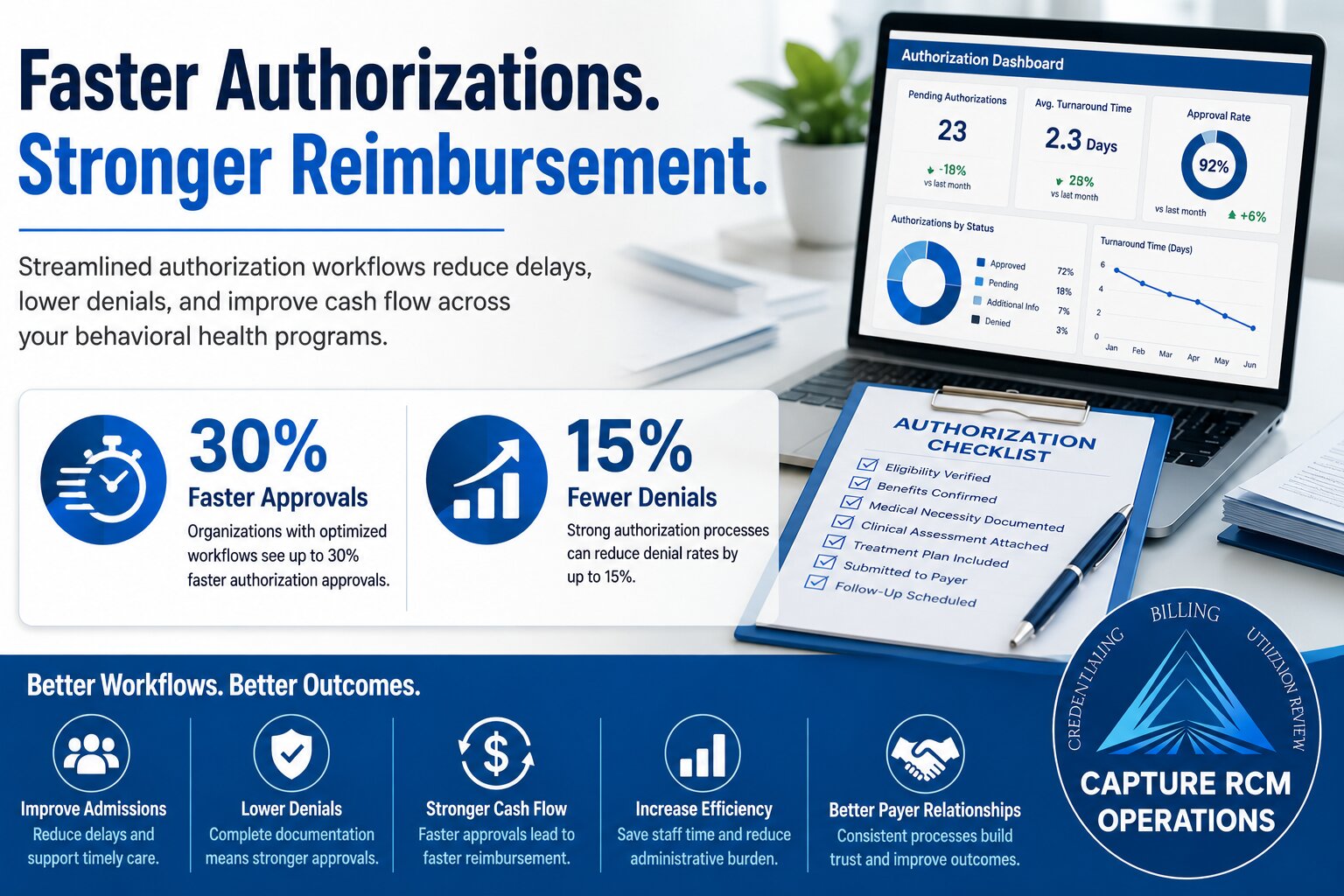
Organizations using standardized authorization checklists often experience fewer payer requests for additional information and faster approval times.
Identifying the Most Common Causes of Authorization Delays
Operations managers frequently focus on denied claims while overlooking delayed authorizations.
In reality, many reimbursement issues begin much earlier.
Common authorization bottlenecks include:
Incomplete Clinical Documentation
Missing information forces payers to request additional records.
Delayed Concurrent Reviews
Failure to submit continued stay requests before expiration dates often creates reimbursement risk.
Manual Tracking Systems
Spreadsheets can become difficult to manage as patient volume grows.
Payer-Specific Requirements
Different payers often maintain unique documentation standards.
Staff Turnover
Knowledge gaps frequently appear when experienced utilization review staff leave.
Communication Breakdowns
Clinical teams and billing departments sometimes operate independently, creating workflow gaps.
Understanding these failure points allows organizations to build targeted process improvements.
Using Data to Improve Authorization Performance
Organizations cannot improve what they do not measure.
Operations managers should establish key performance indicators specifically related to authorization management.
Important metrics include:
Average Authorization Turnaround Time
Measures the time between submission and approval.
Initial Approval Rate
Tracks how often requests are approved without additional documentation.
Concurrent Review Success Rate
Measures approval performance for continued treatment.
Authorization-Related Denials
Identifies claims impacted by authorization issues.
Days in Accounts Receivable
Reveals downstream financial effects.
Payer-Specific Approval Rates
Highlights opportunities for workflow optimization.
For example, if one commercial payer consistently generates longer approval times than others, specialized workflows can be created to address those requirements.
Data-driven decision making helps organizations move from reactive management to proactive optimization.
Strengthening Collaboration Between Clinical and Revenue Cycle Teams
Authorization workflows often fail because departments operate in silos.
Clinical teams focus on patient outcomes.
Revenue cycle teams focus on reimbursement.
Operations managers must bridge that gap.
Practical strategies include:
Weekly Authorization Meetings
Review pending requests and high-priority cases.
Shared Documentation Standards
Ensure clinical records support payer requirements.
Escalation Protocols
Define procedures for urgent approvals and payer delays.
Concurrent Review Calendars
Prevent authorization expirations through proactive monitoring.
Cross-Department Reporting
Create visibility across all teams involved in the process.
Organizations that improve communication frequently reduce both authorization delays and denial rates.
Leveraging Technology to Reduce Administrative Burden
Manual authorization management creates significant risk.
As patient volume increases, spreadsheets and email chains become increasingly difficult to maintain.
Modern authorization management systems can help organizations:
- Monitor authorization status in real time
- Track expiration dates
- Generate renewal reminders
- Centralize documentation
- Improve payer communication tracking
- Create operational reporting dashboards
Consider a multi-location substance use disorder organization managing hundreds of active authorizations.
Without automated tracking, missing even a small percentage of expiration dates can create substantial reimbursement challenges.
Technology helps reduce these risks while improving staff efficiency.
How Specialized Services, Billing, Substance Use Disorder Teams Support Operations
Behavioral health reimbursement requirements continue to become more complex.
Many operations managers find internal teams stretched thin by:
- Growing patient volumes
- Increasing payer requirements
- Staffing shortages
- Documentation expectations
- Regulatory compliance demands
Dedicated services, billing, substance use disorder specialists help address these challenges through focused expertise.
Common support areas include:
Authorization Management
Managing submissions, follow-ups, approvals, and renewals.
Denial Prevention
Identifying issues before claims are submitted.
Utilization Review Support
Aligning documentation with payer expectations.
Revenue Cycle Analytics
Providing visibility into performance metrics.
Compliance Monitoring
Supporting adherence to payer and regulatory requirements.
Workflow Optimization
Improving efficiency across the authorization lifecycle.
For operations managers, this often translates into stronger reimbursement performance and reduced administrative burden.
Compliance Risks Associated With Authorization Failures
Authorization delays create financial challenges.
Authorization compliance failures create financial and regulatory exposure.
Common risk areas include:
- Missing authorizations
- Untimely submissions
- Incorrect level-of-care requests
- Insufficient medical necessity documentation
- Missing concurrent reviews
- Poor payer communication records
Audits frequently examine whether organizations maintained proper documentation supporting reimbursement.
Strong authorization workflows help protect revenue while reducing compliance risk.
Organizations that treat compliance as part of operational excellence typically perform better financially as well.
Building a Sustainable Authorization Strategy
Many organizations focus on fixing problems after denials occur.
Leading organizations focus on prevention.
A sustainable authorization strategy should include:
Documented Standard Operating Procedures
Every step should have a defined process.
Authorization Dashboards
Real-time visibility improves accountability.
Performance Benchmarks
Measure turnaround times and approval rates.
Ongoing Staff Training
Payer requirements continue to evolve.
Workflow Audits
Regular reviews identify inefficiencies before they become costly.
Escalation Frameworks
Urgent cases require clear decision-making pathways.
When these elements work together, authorization management becomes a competitive advantage rather than a constant operational challenge.
The Business Impact of Strong Authorization Management
Efficient authorization management affects far more than reimbursement.
Organizations often experience:
- Faster admissions
- Lower denial rates
- Improved patient retention
- Reduced staff burnout
- Better payer relationships
- Stronger compliance outcomes
- More predictable cash flow
The organizations that consistently outperform competitors are rarely working harder.
They are operating with stronger processes, clearer accountability, better data visibility, and more efficient revenue cycle infrastructure.
For operations managers, authorization management is no longer just a utilization review function.
It is a critical component of organizational growth and financial stability.
Frequently Asked Questions
Why are prior authorizations so important in substance use disorder treatment?
Many payers require authorization before approving reimbursement for treatment services. Missing or delayed approvals can result in denied claims and delayed payments.
What is the biggest cause of authorization-related denials?
Incomplete documentation and missed authorization requirements are among the most common causes of denial.
How can operations managers reduce authorization turnaround times?
Implementing standardized workflows, using tracking technology, improving documentation quality, and monitoring performance metrics can significantly reduce delays.
What metrics should organizations monitor?
Key metrics include authorization approval rates, turnaround times, authorization-related denials, days in accounts receivable, and concurrent review success rates.
Can technology help improve authorization management?
Yes. Automated tracking systems reduce manual workload, improve visibility, and help prevent missed deadlines and expired authorizations.
How do specialized billing teams support authorization workflows?
Specialized teams often manage authorization requests, follow-ups, denial prevention, utilization review coordination, reporting, and compliance monitoring.
What happens if a concurrent review is missed?
Missing a concurrent review can create authorization gaps that may result in denied reimbursement for continued treatment services.
How often should authorization workflows be reviewed?
Most organizations benefit from quarterly workflow audits and monthly performance reviews to identify opportunities for improvement.
Call (380) 383-6822 or visit our substance use disorder billing services to learn more about our services, billing, substance use disorder services.