

For behavioral health and substance use disorder (SUD) treatment centers, financial performance depends on much more than submitting insurance claims. Every patient interaction—from the first phone call through final payment—affects reimbursement, cash flow, and operational stability. A missed authorization, incomplete verification of benefits (VOB), or documentation gap can delay payments or result in avoidable denials, even when high-quality care has been delivered.
This is why revenue cycle management is a strategic function rather than simply an administrative process. When managed effectively, it aligns clinical operations, payer requirements, coding accuracy, and billing workflows to maximize reimbursement while reducing financial risk.
Many organizations partner with professional revenue cycle management services to streamline these processes, improve collections, and allow leadership teams to focus on patient care and organizational growth instead of resolving billing issues.
Unlike many healthcare specialties, behavioral health reimbursement involves multiple levels of care, evolving medical necessity requirements, frequent authorization updates, and payer-specific documentation standards. Understanding the full revenue cycle helps treatment center operators, finance leaders, and administrators identify where revenue is protected—and where it is often lost.
What Revenue Cycle Management Is
Revenue cycle management (RCM) is the end-to-end financial process that tracks a patient encounter from initial contact through final reimbursement.
Rather than focusing only on claims submission, it encompasses every administrative and financial activity required to convert patient services into collected revenue.
For behavioral health organizations, the cycle typically includes:
- Patient scheduling
- Insurance verification
- Verification of benefits (VOB)
- Prior authorization
- Clinical documentation
- Medical necessity review
- Coding
- Claim submission
- Payment posting
- Denial management
- Appeals
- Patient billing
- Collections and reporting
Every stage influences the next. A problem early in the process—such as inaccurate eligibility verification or incomplete authorization—can create downstream delays that affect reimbursement weeks or even months later.
Viewed strategically, RCM is not simply a billing function. It is an operational framework that supports predictable cash flow, compliance, and financial sustainability.
The Steps of the Revenue Cycle
Although workflows vary among organizations, high-performing behavioral health providers generally follow a structured process from patient intake through payment.
Patient Registration and Scheduling
The revenue cycle begins before treatment starts.
During registration, staff collect:
- Patient demographics
- Insurance information
- Referral details
- Contact information
- Initial clinical information
Accurate registration helps prevent claim rejections caused by demographic or policy errors.
Insurance Eligibility and Verification of Benefits
Eligibility verification confirms that insurance coverage is active.
Verification of benefits (VOB) goes further by identifying:
- Covered services
- Deductibles
- Copayments
- Coinsurance
- Out-of-pocket responsibilities
- Authorization requirements
- Network status
- Benefit limitations
Behavioral health providers rely on VOB to determine financial expectations before admission.
Prior Authorization
Many behavioral health services require insurance approval before treatment begins.
Common services requiring authorization include:
- Medical detoxification
- Residential treatment
- Partial hospitalization (PHP)
- Intensive outpatient (IOP)
- Medication-assisted treatment (MAT)
- Extended therapy services
Submitting complete clinical documentation early helps reduce authorization delays and supports timely admissions.
Clinical Documentation and Medical Necessity
As treatment progresses, providers document:
- Assessments
- Diagnoses
- Treatment plans
- Progress notes
- Session details
- Functional improvement
- Continued need for care
Medical necessity documentation supports both ongoing authorizations and future reimbursement.
Without strong documentation, even clinically appropriate services may be denied.
Medical Coding
After services are documented, coding specialists assign standardized codes that communicate what care was provided.
Behavioral health billing commonly involves:
- ICD-10-CM diagnosis codes
- CPT® procedure codes
- HCPCS codes when applicable
- Modifiers
- Place-of-service codes
Coding accuracy directly influences claim acceptance and payment.
Claim Preparation and Submission
Billing teams convert coded encounters into electronic insurance claims.
Before submission, they typically review:
- Patient information
- Provider credentials
- Authorization status
- Coding accuracy
- Documentation completeness
- Payer-specific requirements
Submitting clean claims improves first-pass acceptance rates.
Payment Posting
Once insurers process claims, payments are posted to patient accounts.
Payment posting includes:
- Insurance reimbursement
- Patient responsibility
- Contract adjustments
- Coordination of benefits
- Secondary insurance processing
Accurate posting provides visibility into financial performance.
Denial Management and Appeals
Not every claim is paid on the first submission.
High-performing RCM teams investigate denials by identifying root causes such as:
- Missing authorizations
- Documentation deficiencies
- Coding errors
- Eligibility issues
- Filing deadline problems
Appeals supported by complete documentation often recover revenue that would otherwise be lost.
Patient Billing and Collections
After insurance processing, remaining patient balances are billed according to payer contracts and practice policies.
Transparent billing processes improve collection rates while supporting positive patient experiences.
Why Behavioral Health RCM Is Uniquely Complex
Although every medical specialty manages insurance reimbursement, behavioral health introduces challenges that are less common in many other areas of healthcare.
Multiple Levels of Care
Patients frequently transition between different treatment settings, including:
- Detoxification
- Residential treatment
- Partial hospitalization (PHP)
- Intensive outpatient (IOP)
- Outpatient therapy
- Medication management
Each transition may require updated authorizations, documentation, and payer approval.
Poor coordination during these transitions often leads to reimbursement delays.
Ongoing Medical Necessity Requirements
Behavioral health reimbursement is heavily dependent on demonstrating continued medical necessity.
Insurers commonly request:
- Progress updates
- Continued stay reviews
- Functional assessments
- Treatment response documentation
Maintaining consistent clinical documentation throughout treatment helps support ongoing coverage.
Payer-Specific Authorization Rules
Commercial insurers, Medicaid managed care organizations, Medicare Advantage plans, and employer-sponsored health plans frequently maintain different authorization requirements.
Treatment centers must navigate:
- Different review schedules
- Varying documentation standards
- Multiple submission portals
- Distinct medical necessity criteria
This administrative complexity increases operational workload.
Specialized Coding Requirements
Behavioral health coding extends beyond assigning diagnosis codes.
Billing teams often manage:
- Time-based psychotherapy codes
- Group therapy billing
- Medication management services
- Telehealth modifiers
- Substance use disorder diagnoses
- Crisis intervention coding
Small coding errors can significantly affect reimbursement.
Frequent Regulatory Changes
Behavioral health reimbursement continues to evolve as payers update telehealth policies, coding guidance, documentation expectations, and reimbursement rules.
Successful organizations continually monitor these changes to maintain compliance.
In-House vs. Outsourced RCM
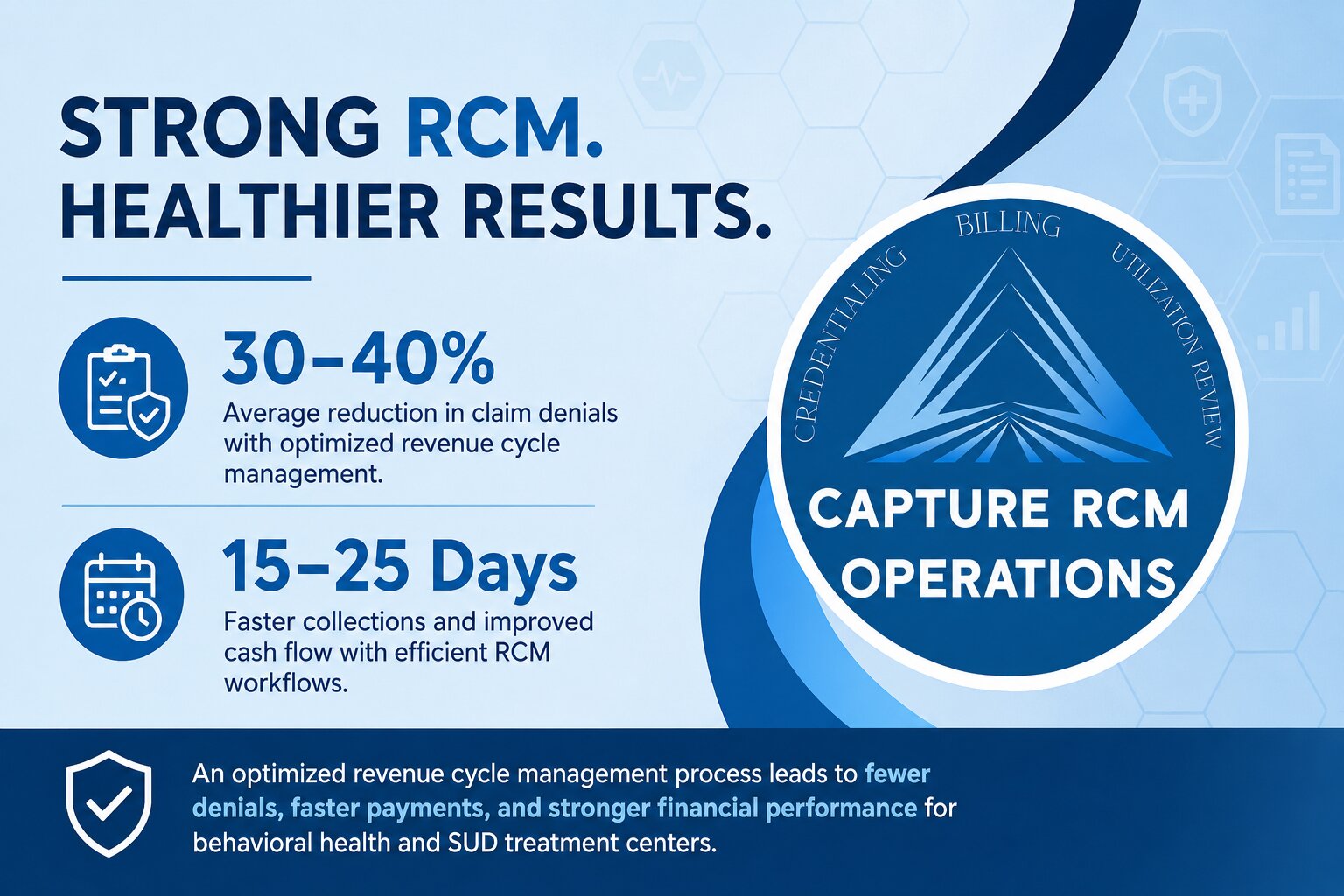
As treatment centers grow, leadership often evaluates whether to manage revenue cycle functions internally or partner with an external RCM provider.
The right approach depends on organizational size, staffing, growth goals, and operational complexity.
Managing RCM In-House
Internal teams typically provide:
- Greater direct oversight
- Immediate collaboration with clinicians
- Internal workflow customization
- Direct control over daily operations
However, maintaining in-house expertise often requires significant investment in staffing, training, technology, compliance monitoring, and payer knowledge.
Organizations may also face challenges related to employee turnover and keeping pace with changing payer requirements.
Outsourcing RCM
Specialized behavioral health RCM partners provide dedicated expertise across the entire reimbursement process.
Services often include:
- Insurance verification
- Verification of benefits (VOB)
- Prior authorization support
- Medical coding
- Claims management
- Payment posting
- Denial management
- Appeals
- Revenue reporting
- Compliance monitoring
Because outsourced teams focus exclusively on reimbursement operations, they often identify process improvements that reduce denials and accelerate cash flow.
For many treatment centers, outsourcing also allows clinical leadership and administrative staff to focus more fully on patient care, strategic growth, and operational management.
KPIs That Define a High-Performing RCM Operation
Strong revenue cycle performance should be measured using objective financial and operational metrics.
Key performance indicators commonly include:
Clean Claim Rate
Measures the percentage of claims accepted on first submission without correction.
Higher clean claim rates typically indicate strong front-end processes and accurate coding.
Days in Accounts Receivable (A/R)
Tracks how quickly claims convert into collected revenue.
Lower A/R generally reflects healthier cash flow.
Denial Rate
Measures the percentage of claims denied by insurers.
Monitoring denial trends helps identify recurring operational issues.
Net Collection Rate
Evaluates how much collectible revenue the organization successfully receives.
High-performing organizations consistently monitor this metric to assess overall reimbursement effectiveness.
Authorization Success Rate
Behavioral health providers benefit from tracking the percentage of services successfully authorized before treatment.
Strong authorization performance reduces downstream billing problems.
Appeal Recovery Rate
Measures the percentage of denied claims successfully overturned through appeals.
This metric reflects both documentation quality and denial management effectiveness.
Conclusion
For behavioral health and substance use disorder treatment centers, revenue cycle management extends far beyond billing. It is the operational framework that connects patient intake, insurance verification, authorization management, clinical documentation, coding, claims processing, and collections into a single financial strategy.
Because behavioral health reimbursement involves multiple levels of care, complex authorization requirements, evolving payer rules, and intensive medical necessity documentation, even small process failures can have significant financial consequences.
Organizations that invest in a well-managed revenue cycle—whether through experienced internal teams or specialized partners—are better positioned to reduce denials, improve cash flow, strengthen compliance, and support sustainable growth. For treatment center operators and financial leaders, an effective RCM strategy is not simply about getting claims paid; it is about protecting revenue while enabling clinicians to remain focused on delivering high-quality care. Call us today at (380) 383-6822 to learn how our specialized revenue cycle management solutions support behavioral health and SUD providers with accurate billing, stronger reimbursement, and a healthier financial future.
Frequently Asked Questions
What is revenue cycle management?
Revenue cycle management is the end-to-end process of managing the financial aspects of patient care, from scheduling and insurance verification through claim submission, payment collection, denial management, and final reimbursement.
Why is behavioral health revenue cycle management more complex?
Behavioral health organizations often manage multiple levels of care, frequent authorization requirements, ongoing medical necessity reviews, specialized coding, and payer-specific documentation standards. These factors create additional administrative complexity compared with many other healthcare specialties.
Should treatment centers outsource revenue cycle management?
The decision depends on an organization’s resources and operational needs. While some centers maintain effective in-house teams, others outsource to specialized RCM providers to gain expertise, reduce denials, improve reimbursement timelines, and allow staff to focus more on patient care and organizational growth.