

For behavioral health and substance use disorder (SUD) practices, accurate documentation is the foundation of successful reimbursement. Whether your organization provides outpatient therapy, intensive outpatient programs (IOP), medication-assisted treatment (MAT), or psychiatric services, every encounter begins with proper clinical documentation—and every successful insurance payment depends on accurate billing.
Many providers entering private practice or taking on administrative responsibilities eventually ask, what is a superbill, and why does it matter?
A superbill is much more than a receipt. It serves as the bridge between clinical care and the insurance billing process by capturing the coding and provider information required to generate a clean insurance claim.
Practices that partner with professional medical billing services often rely on billing specialists to review superbills for completeness, verify coding accuracy, and convert them into compliant insurance claims before submission. This process helps reduce denials while improving reimbursement accuracy.
Understanding how superbills work—and how they fit into the larger revenue cycle—can help behavioral health organizations improve cash flow, reduce claim errors, and streamline billing operations.
What Is a Superbill?
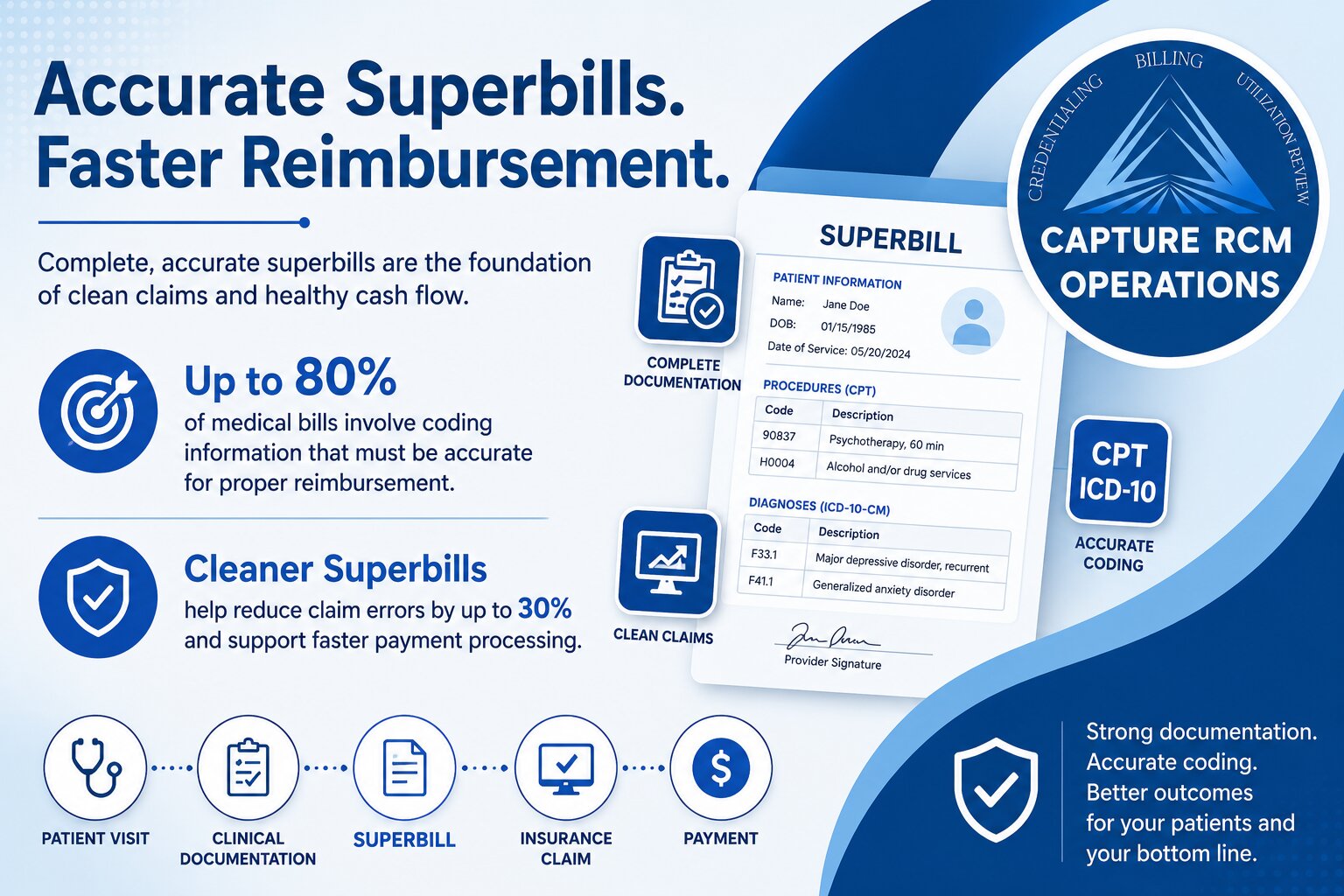
A superbill is a detailed document created after a patient visit that summarizes the healthcare services provided. It contains the information needed to create an insurance claim, including diagnosis codes, procedure codes, provider credentials, and patient details.
Unlike a standard receipt, a superbill includes standardized medical coding that insurance companies use to determine reimbursement.
Think of the process this way:
Patient Visit → Clinical Documentation → Superbill → Insurance Claim → Payment
The superbill itself is not submitted directly to every insurance payer. Instead, it serves as the source document from which billing software or medical billing specialists prepare an electronic insurance claim.
In behavioral health practices, a superbill typically reflects services such as:
- Individual psychotherapy
- Family therapy
- Group counseling
- Psychiatric evaluations
- Medication management
- Substance use disorder treatment
- Telehealth behavioral health visits
- Psychological testing
Because reimbursement depends heavily on matching diagnoses with documented services, accuracy at the superbill stage is especially important.
What a Superbill Must Include
Although formats vary between electronic health record (EHR) systems, every compliant superbill contains essential information needed for insurance billing.
Patient Information
The document should identify the patient receiving services, including:
- Full name
- Date of birth
- Insurance information (when applicable)
- Patient identification number
This ensures claims are matched to the correct beneficiary.
Provider Information
Insurance companies must know exactly who rendered the service.
Provider details generally include:
- Provider name
- Practice name
- Practice address
- National Provider Identifier (NPI)
- Tax Identification Number (TIN), when required
- Contact information
For group practices, the rendering provider and billing provider may differ, making accurate identification critical.
Date of Service
Every superbill includes the date the patient received treatment.
Behavioral health practices with recurring weekly therapy sessions should ensure each visit is documented separately with its corresponding date of service.
Procedure Codes (CPT Codes)
Current Procedural Terminology (CPT®) codes identify the services performed.
Examples commonly used in behavioral health include:
- Diagnostic evaluations
- Individual psychotherapy
- Family therapy
- Group therapy
- Medication management
- Crisis intervention
Selecting the appropriate CPT code directly affects reimbursement.
Diagnosis Codes (ICD-10-CM)
Every billed service must be medically supported by an appropriate diagnosis code.
Examples may include diagnoses related to:
- Major depressive disorder
- Generalized anxiety disorder
- PTSD
- Bipolar disorder
- Opioid use disorder
- Alcohol use disorder
Accurate diagnosis coding helps establish medical necessity.
Place of Service (POS)
Behavioral health services may occur in several settings, including:
- Office
- Outpatient clinic
- Telehealth
- Community-based settings
Correct place-of-service coding affects payer processing.
Charges
The superbill includes the fee associated with each service provided.
Although reimbursement depends on contracted payer rates, charge information remains an important component of claim generation.
Provider Signature or Authentication
Many EHR systems electronically authenticate the documentation.
Proper authentication demonstrates that services were personally rendered and documented by the treating provider.
Superbill vs. a Claim
One of the biggest misconceptions is that a superbill and an insurance claim are the same document.
They serve different purposes.
Superbill |
Insurance Claim |
|---|---|
| Internal clinical billing document | Standardized document submitted to insurance |
| Created after patient visit | Created using information from the superbill |
| Includes provider documentation and coding | Formatted for payer processing |
| Used by billing staff | Sent electronically to insurance companies |
| Supports accurate claim creation | Requests reimbursement |
A simple way to think about it is:
The superbill provides the information.
The claim requests payment.
Without an accurate superbill, creating a clean insurance claim becomes significantly more difficult.
How Accurate Coding on the Superbill Affects Reimbursement
For behavioral health organizations, coding accuracy isn’t simply an administrative task—it directly influences revenue.
Even small documentation mistakes can result in:
- Claim denials
- Payment delays
- Additional documentation requests
- Underpayments
- Compliance concerns
- Increased administrative workload
CPT and Diagnosis Matching
Insurance companies review whether the documented diagnosis supports the billed procedure.
For example:
- A psychotherapy code should align with documented behavioral health treatment.
- Medication management should reflect appropriate psychiatric services.
- Diagnostic evaluations should support the assessment performed.
When CPT and ICD-10 codes don’t logically align, claims are more likely to be rejected.
Provider Credential Accuracy
Behavioral health practices often include multiple provider types, including:
- Psychiatrists
- Psychologists
- Licensed clinical social workers (LCSWs)
- Licensed professional counselors (LPCs)
- Nurse practitioners
- Addiction counselors
Each payer may have different reimbursement rules depending on provider credentials.
Incorrect provider information or NPI selection can delay payment.
Documentation Consistency
The superbill should accurately reflect what appears in the clinical record.
Auditors may compare:
- Session length
- Diagnosis
- Treatment provided
- Medical necessity
- Progress notes
- Procedure codes
Consistent documentation reduces compliance risk.
How Billing Services Use the Superbill
Once providers complete documentation, the billing workflow begins.
Professional billing teams typically follow several important steps.
Review for Completeness
Billing specialists first verify that required information is present, including:
- Patient demographics
- Provider information
- Date of service
- CPT codes
- ICD-10 diagnosis codes
- NPI numbers
- Charges
Missing information can prevent successful claim submission.
Verify Coding Accuracy
Experienced billing professionals review coding to identify potential issues before claims are submitted.
This may include checking:
- Appropriate CPT selection
- Diagnosis linkage
- Modifier usage
- Medical necessity
- Payer-specific billing rules
Identifying errors early helps reduce denials.
Create the Insurance Claim
After review, information from the superbill is entered into claim management software or generated directly from the EHR.
The billing team prepares the standardized electronic claim required by the insurance payer.
Submit Claims
Claims are transmitted electronically through clearinghouses to commercial insurers, Medicaid, Medicare, or other payers.
Clean claims generally process more quickly than claims requiring corrections.
Monitor Claim Status
Billing services continue tracking the claim after submission.
Responsibilities often include:
- Claim status monitoring
- Denial management
- Appeals
- Payment posting
- Patient balance processing
- Reporting reimbursement trends
This ongoing oversight supports healthier revenue cycle performance.
Why Behavioral Health Practices Need Accurate Superbills
Behavioral health billing often involves unique reimbursement requirements compared to other medical specialties.
Practices frequently manage:
- Time-based psychotherapy codes
- Telehealth billing
- Medication-assisted treatment services
- Intensive outpatient programs (IOP)
- Partial hospitalization programs (PHP)
- Multiple payer policies
- Frequent authorization requirements
Because of these complexities, accurate superbills become especially valuable.
A well-prepared superbill helps ensure:
- Cleaner claims
- Faster reimbursement
- Fewer denials
- Better compliance
- Reduced administrative burden
- More predictable cash flow
Rather than spending time correcting preventable billing errors, providers can focus on delivering patient care while experienced billing professionals manage claim preparation and follow-up.
Conclusion
Understanding what a superbill is is an important first step in learning the healthcare billing process. Although patients rarely see them, superbills play a central role in transforming clinical documentation into reimbursable insurance claims.
For behavioral health and SUD practices, every diagnosis code, CPT code, provider identifier, and service detail on the superbill contributes to claim accuracy. Small documentation errors can lead to denied claims, delayed payments, and increased administrative work.
By maintaining accurate superbills and following consistent coding practices—or partnering with experienced billing professionals—practices can improve reimbursement, strengthen compliance, and create a more efficient revenue cycle. Call us today at (380) 383-6822 to learn how our specialized solutions support behavioral health and SUD providers with accurate billing, stronger reimbursement, and a healthier financial future.
Frequently Asked Questions
What is a superbill?
A superbill is a detailed document created after a patient visit that includes diagnoses, procedure codes, provider information, and other billing details. It serves as the source document used to prepare an insurance claim.
How is a superbill different from a claim?
A superbill is an internal billing document that captures the details of a patient encounter. An insurance claim is the standardized electronic submission created from that information and sent to a payer to request reimbursement.
Who needs a superbill?
Healthcare providers who bill insurance—including behavioral health, psychiatry, psychology, counseling, and substance use disorder treatment practices—commonly use superbills. They are especially important for practices that submit insurance claims or provide patients with documentation for reimbursement.