

For clinical directors, compliance has become one of the most important responsibilities within a behavioral health organization. While clinical outcomes remain the primary focus, regulatory expectations, payer requirements, and reimbursement rules continue to grow more complex each year.
A single documentation gap can trigger a denied claim. Multiple gaps can lead to repayment requests, payer audits, or operational disruption. As organizations expand services, add providers, and work with more insurance plans, maintaining compliance becomes increasingly challenging.
The good news is that compliance does not have to be reactive.
Organizations that establish structured workflows, documentation standards, and monitoring systems often experience stronger reimbursement performance, fewer denials, improved audit outcomes, and greater operational efficiency.
Strong mental health billing services can support these efforts by helping organizations align clinical documentation, authorization processes, and revenue cycle management with payer expectations.
This guide provides a practical framework for clinical directors seeking to strengthen compliance programs while supporting organizational growth.
Why Compliance Is No Longer Just a Regulatory Concern
Many clinical directors still view compliance primarily through a regulatory lens.
While regulatory adherence remains important, compliance now directly influences financial performance.
Every service billed must be supported by:
- Clinical documentation
- Medical necessity
- Appropriate coding
- Authorization requirements
- Treatment planning records
- Progress documentation
When any of these elements are missing, reimbursement may be delayed or denied.
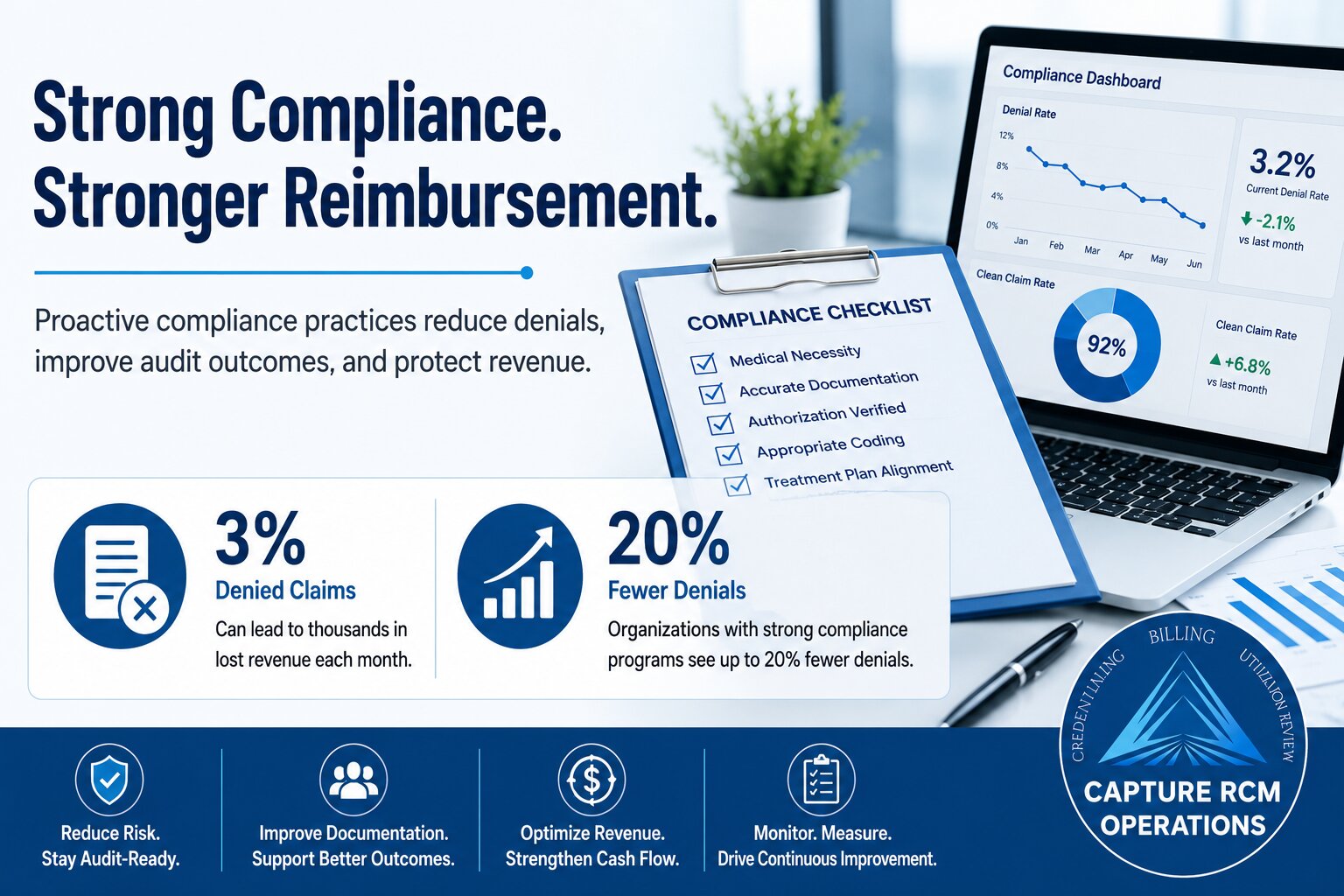
Consider a behavioral health organization processing 1,000 claims per month.
If only 3% of claims are denied due to documentation deficiencies, that represents 30 claims requiring additional work, delayed reimbursement, or possible write-offs.
The administrative burden grows quickly.
Organizations that invest in compliance infrastructure often experience:
- Lower denial rates
- Improved clean claim percentages
- Faster reimbursement
- Better audit outcomes
- Stronger payer relationships
Compliance excellence is increasingly becoming a revenue protection strategy.
Understanding Compliance Risks Within Services, Billing, Mental Health Operations
Behavioral health organizations face unique reimbursement challenges.
Unlike many healthcare specialties, mental health treatment often relies heavily on narrative clinical documentation to demonstrate medical necessity.
Several areas consistently create compliance risk.
Medical Necessity Documentation
Payers expect clear evidence that treatment is clinically appropriate.
Documentation should explain:
- Why treatment is needed
- Why the selected level of care is appropriate
- What symptoms support ongoing treatment
- What risks exist without intervention
Authorization Management
Missing authorizations remain one of the most preventable reimbursement problems.
Organizations frequently encounter issues involving:
- Expired authorizations
- Missed concurrent reviews
- Insufficient supporting documentation
- Delayed authorization requests
Coding Accuracy
Billing codes must accurately reflect documented services.
Discrepancies between documentation and billing often attract payer scrutiny.
Treatment Plan Alignment
Clinical records should demonstrate consistency between:
- Diagnosis
- Treatment goals
- Interventions
- Progress notes
- Discharge planning
When these components fail to align, compliance concerns increase.
Step 1: Build Documentation Standards That Support Reimbursement
Strong documentation standards are the foundation of compliance.
Without consistency, organizations become vulnerable to denials and audits.
Clinical directors should establish documented expectations for every stage of treatment.
Initial Assessments
Assessments should clearly establish:
- Presenting concerns
- Diagnostic rationale
- Functional impairment
- Risk factors
- Treatment recommendations
Treatment Plans
Treatment plans should contain:
- Measurable goals
- Target symptoms
- Clinical interventions
- Timeframes for review
Progress Notes
Notes should document:
- Services provided
- Patient response
- Progress toward goals
- Ongoing medical necessity
Discharge Documentation
Discharge summaries should clearly explain:
- Treatment outcomes
- Remaining needs
- Continuing care recommendations
Organizations with standardized documentation frameworks often experience fewer reimbursement issues and stronger audit performance.
Step 2: Align Clinical Documentation With Medical Necessity Requirements
One of the most common reasons for behavioral health denials is insufficient medical necessity support.
A note may accurately describe a therapy session while still failing to justify reimbursement.
Clinical directors should encourage staff to answer key questions within documentation:
Why Is Treatment Necessary?
Describe symptoms and functional limitations.
Why Is This Level of Care Appropriate?
Support the intensity and frequency of treatment.
What Risks Exist Without Treatment?
Document potential consequences of untreated symptoms.
What Progress Is Being Made?
Demonstrate ongoing clinical benefit.
For example:
“Patient attended session and discussed stress.”
Provides limited support.
In contrast:
“Patient reported severe anxiety affecting employment performance. CBT interventions focused on symptom management and reduction of avoidance behaviors. Continued treatment remains medically necessary due to persistent functional impairment.”
Provides stronger reimbursement support.
Small improvements in documentation quality can significantly reduce denial risk.
Step 3: Develop an Internal Audit Program
Many organizations wait for payer audits to identify compliance concerns.
This approach creates unnecessary risk.
Internal audits allow organizations to identify issues before external reviewers do.
A practical audit process should include:
Monthly Documentation Reviews
Evaluate compliance with organizational standards.
Random Chart Sampling
Review records across clinicians and service lines.
Authorization Validation
Confirm services were supported by required approvals.
Coding Reviews
Verify documentation supports billed services.
Corrective Action Tracking
Monitor recurring deficiencies and improvement efforts.
Organizations conducting routine audits often discover patterns that would otherwise remain hidden.
For example, a chart review may reveal that multiple clinicians are consistently omitting progress updates tied to treatment goals.
Addressing the issue proactively can prevent future denials.
Step 4: Create Collaboration Between Clinical and Billing Teams
One of the most overlooked compliance strategies is improving communication between departments.
Clinical teams focus on treatment.
Billing teams focus on reimbursement.
Compliance requires both groups to work together.
Practical collaboration strategies include:
Monthly Denial Review Meetings
Analyze trends and identify root causes.
Shared Documentation Standards
Ensure billing and clinical teams understand payer expectations.
Authorization Tracking Processes
Maintain visibility into upcoming reviews and renewals.
Joint Education Programs
Train staff on documentation and reimbursement requirements.
Organizations that strengthen communication often reduce denial rates while improving workflow efficiency.
Step 5: Monitor Regulatory and Payer Changes
Behavioral health reimbursement requirements are constantly evolving.
Payers regularly modify:
- Documentation standards
- Authorization rules
- Medical necessity criteria
- Coding requirements
- Utilization review expectations
Organizations relying on outdated workflows frequently experience increasing denial rates.
Clinical directors should establish structured processes for:
- Monitoring payer updates
- Reviewing regulatory changes
- Updating internal policies
- Training staff
Quarterly compliance reviews help ensure organizational practices remain aligned with current requirements.
Step 6: Use Compliance Metrics to Drive Improvement
Compliance management should be data driven.
Organizations should monitor key performance indicators that reveal emerging risks.
Important metrics include:
Denial Rate
Measures claims denied due to documentation or compliance concerns.
Documentation Completion Rate
Tracks timely completion of clinical records.
Authorization Compliance Rate
Measures adherence to authorization requirements.
Clean Claim Rate
Indicates claim accuracy.
Audit Findings
Highlights recurring deficiencies.
Days in Accounts Receivable
Reveals financial impact of compliance issues.
For example, a rising denial rate may indicate a documentation problem long before a formal audit occurs.
Data provides an early warning system.
Step 7: Prepare for Audits Before They Happen
Audit readiness should be viewed as an ongoing process rather than a one-time project.
Organizations that prepare continuously experience significantly less disruption when audits occur.
A practical audit readiness strategy includes:
Centralized Documentation Storage
Ensure records are accessible and organized.
Consistent Record Retention Policies
Maintain documentation according to applicable requirements.
Staff Training Programs
Provide regular compliance education.
Mock Audits
Simulate payer reviews to identify weaknesses.
Documentation Checklists
Improve consistency across providers.
The goal is not simply surviving an audit.
The goal is creating systems that make audits routine rather than disruptive.
How Services, Billing, Mental Health Specialists Support Compliance
As organizations grow, compliance management becomes increasingly difficult.
Specialized services, billing, mental health teams often provide support in areas including:
Documentation Review
Identifying potential reimbursement concerns.
Authorization Oversight
Monitoring approvals and concurrent reviews.
Revenue Cycle Analytics
Tracking compliance-related trends.
Denial Management
Resolving reimbursement issues efficiently.
Reporting and Monitoring
Providing operational visibility.
Regulatory Preparedness
Supporting audit readiness efforts.
For clinical directors, these resources help strengthen organizational infrastructure while reducing administrative burden.
The Business Value of Compliance Excellence
Compliance is frequently viewed as a cost center.
In reality, strong compliance programs often produce measurable financial returns.
Organizations with mature compliance systems commonly experience:
- Reduced denial rates
- Faster payment cycles
- Lower audit risk
- Fewer repayment demands
- Improved staff efficiency
- Better payer relationships
- Stronger revenue performance
The organizations that consistently outperform competitors are often the ones with the strongest operational discipline behind the scenes.
Compliance is no longer simply about avoiding penalties.
It is about protecting revenue, supporting growth, and maintaining operational stability.
Frequently Asked Questions
Why is compliance so important in mental health billing?
Compliance ensures that documentation, coding, and reimbursement activities align with payer and regulatory requirements, reducing denial and audit risk.
What is the most common compliance issue in behavioral health?
Insufficient medical necessity documentation remains one of the most frequent causes of denials and audit findings.
How often should internal audits be performed?
Most organizations benefit from monthly chart reviews and quarterly compliance assessments.
What documentation elements are commonly missing?
Organizations often identify issues involving treatment plan updates, progress toward goals, authorization records, and medical necessity support.
How do authorization issues affect compliance?
Missing authorizations or concurrent reviews can result in denied claims and increased audit exposure.
What metrics should clinical directors monitor?
Denial rates, clean claim rates, authorization compliance, documentation completion, audit findings, and days in accounts receivable are all valuable indicators.
How can organizations improve audit readiness?
Routine internal audits, staff training, documentation standardization, and proactive monitoring significantly improve preparedness.
Why consider specialized billing support?
Specialized teams can provide expertise in compliance monitoring, authorization management, denial prevention, reporting, and revenue cycle optimization.
Call (380) 383-6822 or visit our mental health billing services to learn more about our services, billing, mental health services.