
For most behavioral health organizations, outsourced revenue cycle management costs about 4% to 10% of collections, with many behavioral health billing arrangements falling closer to 5% to 8%. Other vendors may charge a flat monthly rate or a fixed fee per claim.
That gives you a useful starting point, but the percentage alone doesn’t tell you whether an RCM service is expensive or cost-effective. The services included, your payer mix, claim volume, levels of care, denial burden, and the amount of work your internal staff still has to perform all affect the true cost.
For behavioral health organizations, this distinction is especially important. Mental health, substance use disorder, and ABA providers can face complex authorization requirements, payer rules, documentation standards, and denial management needs.
Capture RCM provides behavioral health billing and revenue cycle management built around these reimbursement challenges.
Understanding the breakdown of behavioral health RCM outsourcing costs, the most common pricing models, and how to compare outsourced services with the cost of maintaining billing operations in-house can help you make the decision that best fits your organization.
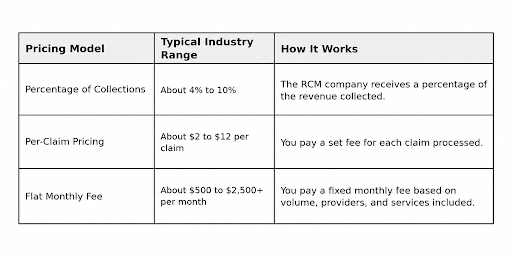
RCM companies generally use one of three pricing structures: a percentage of collections, a per-claim fee, or a flat monthly fee.
Behavioral health pricing examples tend to cluster more tightly around 5% to 8% of collections, although more complex or lower-volume arrangements may be priced higher. General medical billing sources can see per-claim fees ranging from approximately $3 to $12 and monthly fees beginning around $500 and exceeding $2,500 depending on the services provided.
These figures are market benchmarks; actual outsourced billing pricing should be based on the organization, services, claim volume, and work involved.
Practice or Organization Size
A small outpatient mental health practice usually has a different revenue cycle than a multi-location organization with dozens of clinicians.
Larger organizations may submit more claims, but volume can sometimes make billing work more efficient on a per-claim basis. Smaller practices may pay a higher percentage because the vendor still must maintain staffing, technology, reporting, and account management for a lower volume of revenue.
Claim Volume
Claim volume affects the amount of processing and follow-up required.
High-volume organizations may have thousands of transactions to manage each month. However, claim count isn’t the only measure of complexity. A smaller number of difficult claims may require more work than a large number of straightforward outpatient claims.
Payer Mix
Commercial insurance, Medicare, Medicaid, and other payers can have different billing rules and reimbursement processes.
A complicated payer mix may require more eligibility verification, payer-specific follow-up, claim correction, and denial management.
Behavioral Health Service Line
Behavioral health isn’t a single billing environment.
An outpatient psychotherapy practice may have relatively predictable recurring claims. A substance use disorder provider offering detoxification, residential treatment, PHP, IOP, and outpatient services may have much more complicated authorization and reimbursement workflows.
Capture RCM supports behavioral health billing across multiple treatment settings, including mental health billing services, SUD billing services, and ABA billing services.
ABA organizations can also face their own challenges involving authorization units, session documentation, provider credentials, and payer-specific requirements.
Denial and Accounts Receivable Backlogs
An organization with a healthy revenue cycle may primarily need ongoing billing management.
Another organization may arrive with months of unresolved denials, aging accounts receivable, missed follow-up, or inconsistent billing processes.
Cleaning up an existing backlog requires additional labor. When comparing proposals, ask whether old AR and denial recovery are included in the ongoing fee or priced as a separate project.
The in-house vs. outsourced billing cost comparison should include more than salary.
The U.S. Bureau of Labor Statistics reported a median annual wage of $50,250 for medical records specialists in May 2024. That figure represents wages alone. It doesn’t include employer payroll costs, benefits, recruiting, paid leave, training, workspace, computers, billing technology, clearinghouse fees, or management time.
Maintaining an internal revenue cycle can also require more than one person. Someone may need to manage:
A behavioral health organization may divide those duties among several employees or rely heavily on one experienced biller.
That creates another cost that doesn’t always appear on a spreadsheet: staffing risk. If a key billing employee takes leave or resigns, claims don’t stop arriving. An organization may need to recruit and train a replacement while simultaneously preventing an AR backlog.
With outsourcing, staffing capacity becomes the vendor’s responsibility rather than the provider’s.
Consider a behavioral health organization collecting $150,000 per month.
At a hypothetical 6% outsourcing rate:
$150,000 x 6% = $9,000 per month
Annual outsourced cost = $108,000
That number may initially seem high. But it shouldn’t be compared only with one employee’s salary.
The in-house calculation may also include:
Billing salaries + payroll costs + benefits + software + clearinghouse costs + equipment + recruiting + training + management + coverage during absences
The correct comparison is not vendor percentage versus biller salary, but rather, total revenue cycle cost versus total outsourced RCM cost.
The phrase “RCM services” doesn’t necessarily mean the same thing from one company to another.
A basic medical billing package may primarily cover claim submission and payment posting. A broader revenue cycle arrangement may include work before and after the claim is filed.
Depending on the vendor and contract, services may include:
Capture RCM’s service structure extends across billing, credentialing, utilization review, compliance, denial management, reporting, and revenue cycle analysis.
That makes scope one of the most important questions to ask when comparing quotes.
A 4% billing service and a 7% full-service RCM agreement aren’t necessarily competing products. The higher-priced agreement may be taking responsibility for substantially more of the revenue cycle.
For services outside the core billing workflow, organizations can also explore Capture RCM’s credentialing services.
The mental health RCM outsourcing cost for a traditional outpatient practice may differ from the cost for an organization operating several behavioral health programs.
One reason is that reimbursement doesn’t begin when the claim is submitted.
Behavioral health revenue cycles may involve eligibility verification, authorizations, documentation requirements, coding, payer follow-up, denial management, payment posting, and reporting. Capture RCM’s current RCM process reflects this broader workflow rather than treating billing as an isolated administrative task.
Consider a provider offering several substance use disorder levels of care. Billing processes may need to account for detoxification, residential treatment, PHP, IOP, and outpatient services. Each program can involve different authorization periods, payer requirements, reimbursement structures, and documentation workflows.
The amount of revenue cycle work matters just as much as the amount of revenue being collected.
Outsourcing is financially worthwhile when the value created or the internal costs avoided exceed what you’re paying the vendor.
That value isn’t limited to reducing payroll.
Consider what happens when a claim isn’t paid because of a missed filing deadline, an authorization problem, incomplete information, or a denial that wasn’t followed up promptly. The cost isn’t just administrative time. It can become lost revenue.
This is why denial management should be part of the outsourcing conversation.
Capture RCM emphasizes proactive payer follow-up and individualized denial management rather than automatically rebilling the same claim. The company also uses reporting to identify denial trends, payer behavior, documentation issues, and potential revenue leakage.
When evaluating whether outsourcing is worth it, ask:
Those questions help turn an outsourcing quote into a meaningful financial comparison.
Cost isn’t the only reason organizations move away from an in-house billing model.
Outsourcing may deserve a closer look if:
The question isn’t simply whether an outside company can perform billing for less money.
The better question is whether your current revenue cycle is reliably converting the care your organization provides into the reimbursement it has earned.
Two proposals can look similar while covering completely different services.
Before choosing a vendor, ask for clear answers about:
Find out whether the fee covers only billing or broader RCM functions.
Ask specifically about credentialing, authorizations, patient collections, denial appeals, and legacy AR.
Understand exactly how the vendor defines collections.
This can significantly affect smaller practices.
Backlog recovery may use a different pricing structure.
You should be able to evaluate denials, AR, collections, and payer performance.
Behavioral health billing can involve reimbursement requirements that differ from general medical billing.
There is no single price that applies to every behavioral health revenue cycle. But organizations don’t have to begin the process without useful benchmarks.
Most outsourced billing arrangements can be evaluated using three basic structures: a percentage of collections, a per-claim fee, or a fixed monthly price. From there, practice size, payer mix, service lines, claim volume, denial burden, and scope of work determine what the arrangement is actually worth.
A strong cost comparison also looks beyond the vendor invoice. It considers what your organization currently spends on staffing, technology, management, training, and unresolved revenue cycle problems.
If you’re evaluating outsourcing, reviewing your current revenue cycle first can give you a more accurate baseline for comparison. Capture RCM works with behavioral health organizations nationwide to assess billing workflows, denials, payer behavior, and revenue cycle performance.
Learn more about Capture RCM’s mental health billing services, SUD billing services, ABA billing services, or broader behavioral health services.
Outsourced mental health billing commonly uses a percentage-of-collections model. Current industry sources generally place mental health billing around 5% to 10% of collections, with many practices falling near the 6% to 8% range. The exact rate depends on claim volume, payer mix, complexity, and the services included.
A reasonable starting benchmark is approximately 4% to 10% of collections, with behavioral health frequently falling around 5% to 8%. More extensive RCM services can cost more than basic claim submission because they may include denial management, AR follow-up, authorization support, reporting, and other functions.
Current published medical billing benchmarks often range from approximately $3 to $12 per claim. Behavioral health sources report ranges beginning around $2 per claim for some arrangements. Claim complexity, volume, payer mix, and the amount of follow-up included can affect pricing.
It can be, but salary alone isn’t enough to determine that. An in-house revenue cycle includes wages as well as benefits, payroll costs, technology, training, recruiting, supervision, and coverage when employees leave or take time off. Compare the full internal cost with the complete outsourcing proposal.
Percentage-based pricing links the vendor’s compensation to revenue actually collected. As collections increase or decrease, the billing fee changes with them. Practices should still verify exactly which collections are included in the calculation and which RCM services are covered by the percentage.
Not necessarily. A lower fee can become expensive if important services aren’t included or if weak follow-up contributes to delayed or uncollected revenue. Compare scope, reporting, denial management, behavioral health expertise, and performance along with price.