
You launched your program to serve people—not fight with insurance portals. But here you are, facing denial after denial with no clear reason and no time to chase down answers.
If behavioral health billing feels like a black hole of wasted time and vanishing revenue, you’re not imagining it. Capture RCM helps programs untangle billing chaos every day—and it starts with a consultation that shows exactly where the bleed is happening.
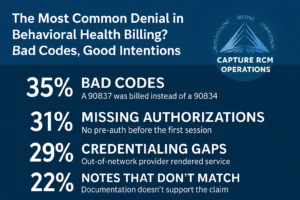
The Most Common Denial in Behavioral Health Billing? Bad Codes, Good Intentions
It’s easy to miss a code modifier or misclassify a service—especially when you’re juggling intake, documentation, and scheduling on top of clinical care. The result? Payers bounce the claim, delay your payment, and tie up your admin team for weeks.
Real Example:
A 90837 (60-minute therapy) was billed for a session that lasted only 38 minutes. It should have been a 90834. The payer noticed. Now the entire claim is in limbo.
Prevention Tip:
Use a behavioral health billing partner who specializes in your level of care (IOP, PHP, ABA). And if your team’s still trying to do this in-house with Google searches and guesswork, it’s time for backup.
Missing Authorizations = Instant Denial
For most behavioral health services, prior authorization isn’t optional—it’s essential. If you don’t have the right approvals logged before the first session, that revenue’s already in jeopardy.
Real Example:
Your front desk booked a client for an IOP intake on Tuesday, but the pre-auth didn’t come through until Thursday. Even if your notes were spotless, that claim is toast.
Prevention Tip:
Systematize your intake process. Capture RCM helps teams build pre-auth workflows that flag payer requirements before the first appointment is booked.
Credentialing Gaps Will Sabotage You
Launching a new program often means adding new providers—and nothing tanks a claim faster than an out-of-network rendering provider. Even if the service was perfect, the claim won’t go through until credentialing is clean.
Prevention Tip:
Map out credentialing timelines and track them aggressively. We help providers in North Carolina and Ohio stay ahead of credentialing delays so billing doesn’t suffer when census starts to grow.
Notes That Don’t Match the Claim = Denied
If the note doesn’t justify the billed service, insurance companies will deny it—fast. For new programs, this often happens when clinicians don’t fully understand how their documentation impacts billing.
Prevention Tip:
Train your clinical team in billing-aligned documentation. Or better yet, work with a partner who can flag note mismatches before claims go out.
Timely Filing Deadlines Will Burn You
Some payers have 90-day windows. Miss that? Kiss the claim goodbye. If your billing process involves “catching up on claims” at the end of each month, you’re already losing money.
Prevention Tip:
File fast. With Capture RCM, claims are submitted within 48 hours—so deadlines don’t sneak past you while you’re putting out fires.
What Happens in a Billing Assessment?
Most RCM “reviews” are glorified sales calls. This one’s not. Capture RCM offers a real diagnostic so you can see what’s working, what’s not, and what’s bleeding money.
Here’s what you’ll walk away with:
- A denial analysis based on your last 30–90 days of claims
- A credentialing snapshot across all rendering providers
- A report showing underutilized codes or session gaps
- A risk flag for compliance or documentation issues
There’s no pressure, no lock-in, no catch. Just clarity. And right now, that’s worth a lot.
Take the First Step Toward Clean Claims
Your team is stretched. Your program is new. And your billing should not be this stressful.
📞 Call (380) 383-6822 or visit Capture RCM Operations to learn more about our behavioral health billing services in United States.