
You finally said yes to help.
Maybe you sat in a quiet office and heard a diagnosis out loud for the first time. Maybe you picked up a prescription and held it in your hand longer than you expected. Maybe you nodded while your provider explained next steps — but your mind was racing.
And then, almost as an afterthought, someone mentioned insurance. Coverage. Out-of-pocket costs.
It’s a small moment that can feel enormous.
At Capture RCM Operations, we believe financial clarity is part of ethical care. That’s why our mental health billing services are designed to protect both providers and the people sitting in their offices — people like you, who are already carrying enough.
Because when you’re newly diagnosed and unsure about medication, you don’t need mystery layered on top of vulnerability.
The Fear Isn’t Just About Medication
If you’re scared to take medication, it usually isn’t about the pill itself.
It’s about identity.
What if this changes me?
What if I feel numb?
What if I lose the sharp parts of myself?
What if I depend on this forever?
Those fears deserve space. They deserve thoughtful conversations, not pressure.
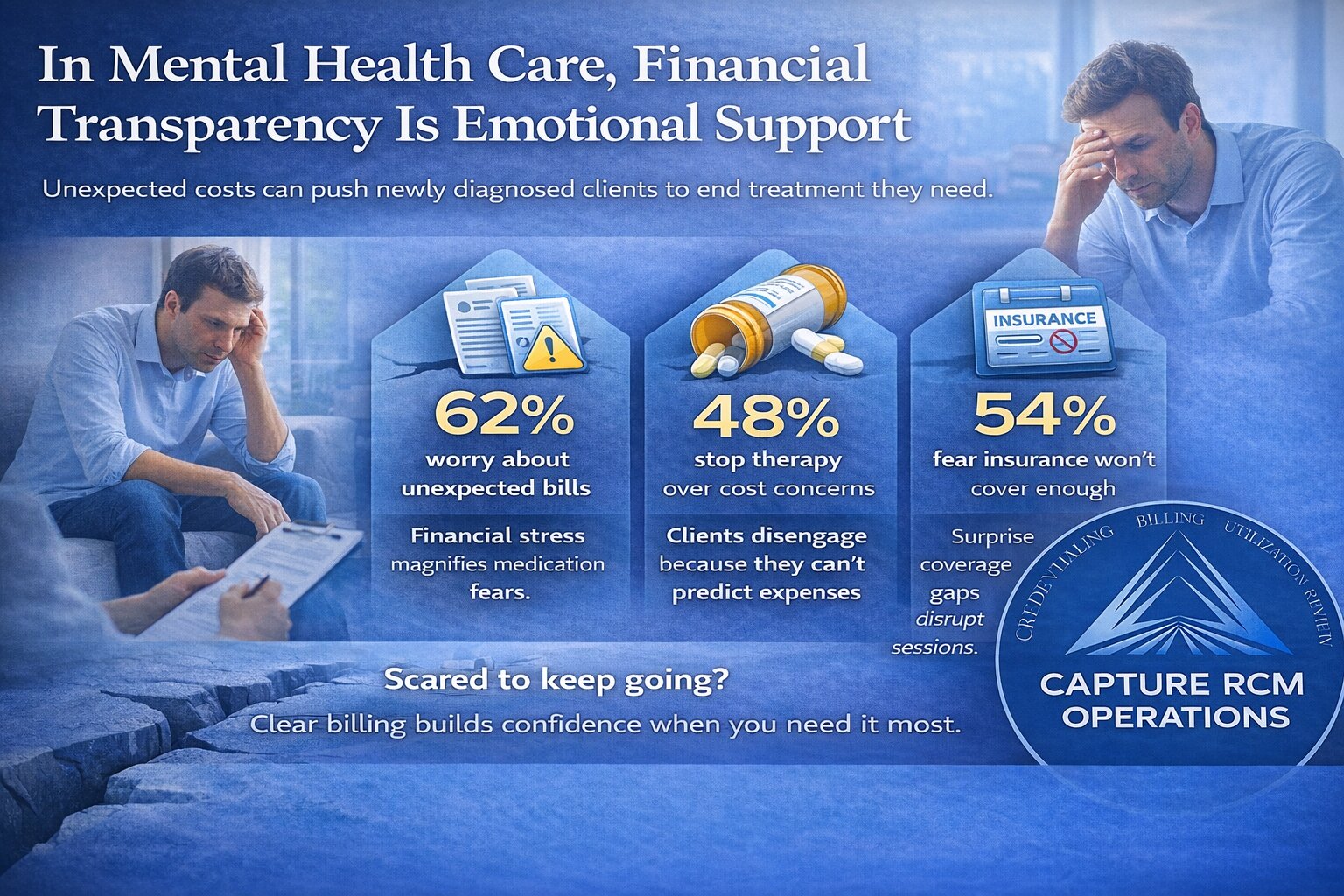
But here’s what often goes unspoken: financial stress magnifies every one of those fears.
When you don’t know what treatment will cost, the question quietly shifts from Is this right for me? to Can I even afford to try?
That’s not a small difference. It changes how safe you feel.
Why Financial Transparency Is Emotional Care
Mental health treatment is built on trust.
You’re sharing private thoughts. You’re revealing patterns you may have hidden for years. You’re considering changes that feel risky.
If the financial side feels unclear, that trust erodes.
Transparency in billing communicates something powerful:
- We’re not hiding anything.
- We respect your right to understand your investment.
- You won’t be blindsided.
When costs are explained clearly — what insurance covers, what it doesn’t, what your responsibility will be — your nervous system can settle.
And when your nervous system settles, you can actually focus on healing.
Financial transparency isn’t administrative. It’s relational.
The Silent Drop-Off No One Talks About
Here’s something many people don’t realize:
Clients often stop attending therapy not because it isn’t helping — but because they’re afraid of the bill.
We’ve seen it from the operational side.
A provider builds strong rapport. Progress is happening. Medication adjustments are thoughtful and slow. The client is cautiously hopeful.
Then an unexpected statement arrives.
Even if the amount is manageable, the surprise itself creates doubt. Doubt turns into avoidance. Avoidance turns into silence.
Appointments get canceled.
Not because the care wasn’t working — but because the financial process felt unpredictable.
That’s preventable.
What Good Billing Support Looks Like Behind the Scenes
When billing systems are handled correctly, most clients never have to think about them.
That’s the goal.
Strong backend support includes:
- Verifying insurance before services begin
- Clearly communicating expected out-of-pocket costs
- Submitting claims accurately and promptly
- Following up with insurers when delays happen
- Explaining statements in plain language
When these systems run smoothly, you’re not left wondering if a large charge is coming weeks later.
You’re free to focus on therapy sessions. Medication conversations. Sleep. Stability.
The logistics fade into the background — where they belong.
Medication Decisions Are Hard Enough
Let’s talk about the medication fear again.
Starting psychiatric medication often feels like stepping into the unknown. You may worry about side effects. About feeling flat. About losing creativity or emotional range.
Those conversations require calm, collaborative space.
But if you’re also calculating costs in your head — What if this takes months? What if follow-ups aren’t covered? What if dosage changes increase my bills? — you’re no longer fully present.
Financial anxiety crowds out clinical clarity.
Transparent billing systems reduce that noise. They give you solid ground while you evaluate treatment options.
You deserve to make medical decisions based on health — not hidden financial pressure.
The Ripple Effect on Providers
As a facility voice, we see another side of this too.
Providers want to focus on care. They want to answer your questions about side effects, therapy goals, coping tools.
They don’t want to become debt collectors.
When billing is disorganized or unclear, providers are pulled into uncomfortable conversations that strain relationships.
When financial systems are transparent and well-managed, clinicians stay clinicians.
That protects the therapeutic relationship — and your experience inside it.
A Practice Owner’s Realization
One behavioral health practice we supported shared something that stuck with us.
They said, “My clients are already questioning whether they’re ‘too much.’ I don’t want them questioning whether they’re a financial burden too.”
That insight changed how they approached their operations.
Once billing became proactive and transparent, their dropout rate decreased. Conversations about money became straightforward instead of tense. Clients expressed relief knowing what to expect.
It wasn’t flashy. It wasn’t marketing-driven.
It was quiet stability.
And stability matters in mental health care.
Financial Clarity Reduces Shame
Newly diagnosed clients often carry invisible shame.
They may feel behind in life. Fragile. Different.
Unexpected financial stress can reinforce that shame:
“I should have known.”
“I shouldn’t have started.”
“I can’t even handle this.”
Transparent processes interrupt that narrative.
Clear communication says:
You are not irresponsible.
You are not naïve.
You are making informed decisions.
That shift protects dignity.
Ethical Care Includes the Back End
There’s a myth that good mental health care is purely clinical — that compassion only lives in the therapy room.
But ethical care extends into every system surrounding treatment.
It includes:
- Honest cost discussions
- Clear policies
- Timely communication
- Respectful explanations
Operational integrity reinforces clinical integrity.
At Capture RCM Operations, we specialize in supporting practices with mental health billing services that prioritize clarity, compliance, and consistency — not confusion.
Because we know what’s at stake.
You Deserve Steady Ground
If you’re newly diagnosed, scared about medication, unsure about next steps — pause for a moment.
You are allowed to move slowly.
You are allowed to ask questions.
And you are allowed to expect financial transparency as part of your care.
Treatment should not feel like stepping into a fog — clinically or financially.
It should feel like being guided with the lights on.
Frequently Asked Questions
Why does financial transparency matter so much in mental health care?
Mental health treatment requires vulnerability. If financial expectations are unclear, it adds stress and uncertainty that can undermine progress. Clear billing builds trust and allows clients to focus on healing instead of worrying about surprise costs.
Can billing confusion really cause people to stop treatment?
Yes. Many clients discontinue therapy because of unexpected costs or unclear insurance coverage — even if treatment is helping. Predictable billing reduces that risk and supports continuity of care.
How should costs be explained before treatment starts?
Ideally, insurance is verified in advance, expected out-of-pocket expenses are discussed clearly, and policies around cancellations or additional services are explained in plain language. Clients should never feel rushed or pressured into financial decisions.
What if I’m afraid I can’t afford ongoing treatment?
That fear is common — and valid. A transparent billing process allows you to understand your options upfront. When you know the real numbers, you can make informed decisions instead of reacting to surprises.
How do mental health billing services support providers?
Professional billing support ensures claims are submitted correctly, payments are tracked, compliance standards are followed, and communication with insurers is consistent. This reduces administrative strain and protects both providers and clients.
Is it okay to ask my provider detailed questions about cost?
Absolutely. Ethical providers expect and welcome those questions. Financial clarity is part of responsible care, not an inconvenience.
If you’re a provider who wants your clients to feel safe from their first session to their final invoice, operational strength matters.
Call 380-383-6822 or visit our mental health billing services to learn how we support behavioral health practices with clarity, compliance, and compassion.