
You built your program to change lives.
But somewhere between admissions, staffing, and payroll, a quiet question starts showing up:
Are we protected?
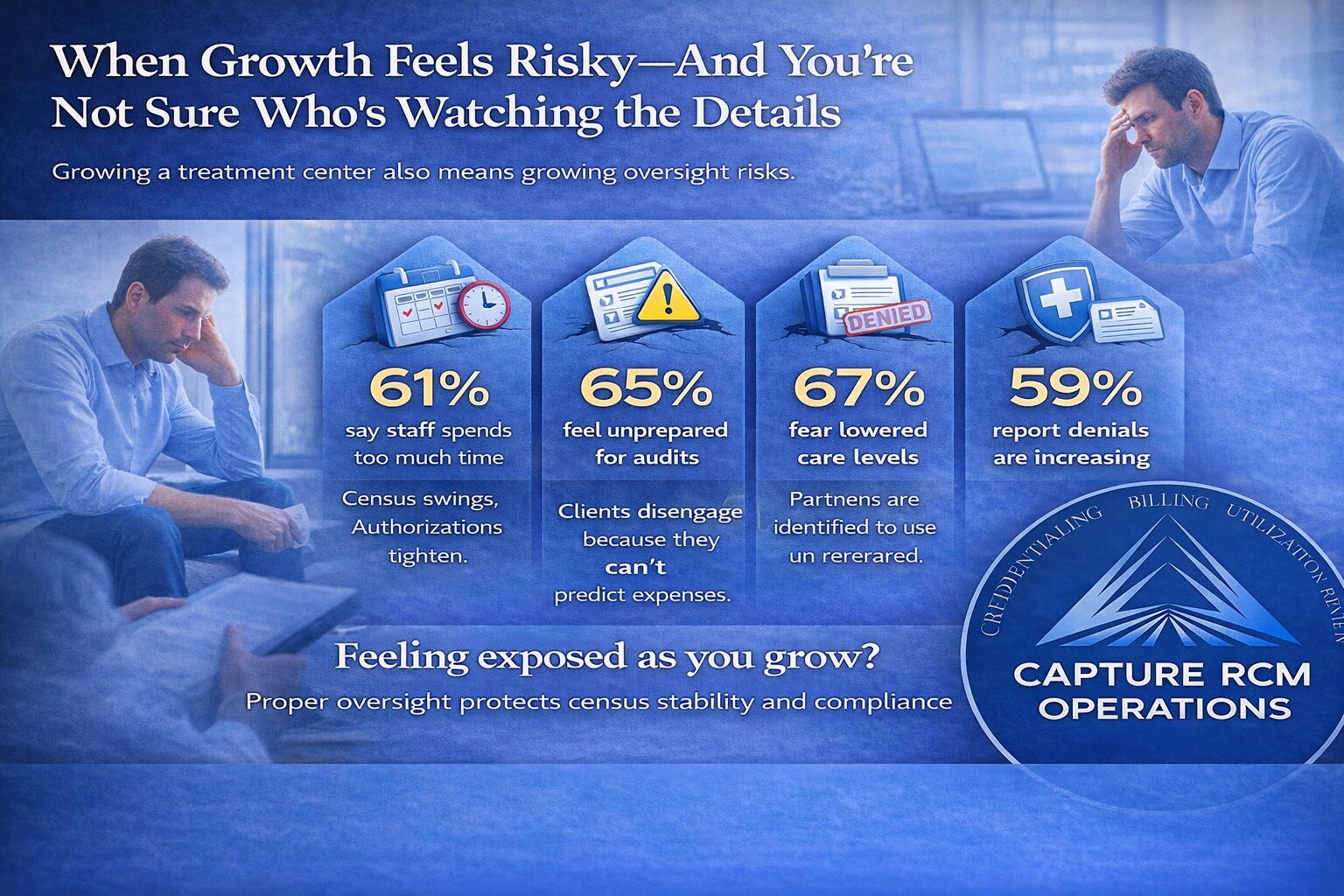
If you’re expanding—or trying to—growth can feel fragile. Census swings. Authorizations tighten. Payers push back harder. And compliance expectations never seem to slow down.
We see this every day. That’s why our utilization review support team works behind the scenes to stabilize both census and compliance at the same time.
Because growth without operational clarity doesn’t feel exciting.
It feels exposed.
1. Protect the Clinical Narrative Before a Denial Does
Every admission begins with a story.
A client struggling. A family looking for help. A clinical team assessing need. But when that story reaches a payer, it has to translate into criteria, severity, and medical necessity.
If that bridge is weak, census suffers.
Strong utilization review services ensure that the clinical reality of your program is clearly documented and defensible. Notes align with criteria. Treatment plans reflect measurable progress. Continued stays are justified before payers question them.
This isn’t about over-documenting.
It’s about protecting the truth of the care you’re already providing.
When the narrative is clear, approvals become steadier. And steady approvals protect census.
2. Reduce Length-of-Stay Volatility That Quietly Impacts Revenue
Unpredictable authorizations are one of the fastest ways to destabilize a growing center.
A few shortened stays can ripple through scheduling, staffing, and revenue forecasting. Multiply that over months—and leadership feels the pressure.
Structured oversight reduces those surprises.
When reviews are proactive, not reactive:
- Continued stay requests are submitted early
- Criteria are addressed directly
- Clinical teams receive documentation coaching
- Payer patterns are tracked
Over time, this consistency protects average length of stay.
And average length of stay protects census stability.
Not through manipulation. Through alignment.
3. Strengthen Compliance Before an Audit Forces It
Compliance anxiety rarely announces itself loudly.
It shows up as:
- “Are we charting enough?”
- “Would this hold up in an audit?”
- “Why are our denials increasing?”
When compliance is unclear, leadership tension rises. Staff morale dips. Documentation becomes inconsistent.
Dedicated review processes bring structure.
Gaps are identified early. Risk areas are corrected before they become systemic. Trends are analyzed instead of ignored.
This isn’t about fear-based oversight.
It’s about building operational confidence.
When your documentation aligns with payer expectations and regulatory standards, you don’t brace for audits.
You prepare for growth.
4. Support Clinicians So They Can Focus on Treatment
Burnout doesn’t always start with client care.
It often starts with insurance.
When clinicians are pulled into repeated peer reviews, rushed documentation edits, and denial appeals, emotional fatigue builds. Over time, turnover increases. Recruitment costs rise. Continuity of care suffers.
Strategic oversight absorbs that pressure.
Instead of reacting to payer requests at the last minute, structured processes anticipate them. Clinicians receive clarity about what matters most in documentation. Leadership gains visibility into trends before they escalate.
The result?
Your clinical team gets to do what they were trained to do: treat.
And that stability keeps census from quietly declining due to staffing strain.
5. Convert Admissions Into Retained Census
Getting referrals isn’t the hard part for most growing centers.
Keeping clients authorized long enough to complete meaningful treatment is.
There’s a difference between admissions growth and census growth.
Without strong internal oversight, new admissions can feel like short-term spikes rather than sustainable census expansion.
When utilization oversight is integrated:
- Initial authorizations are aligned with likely treatment trajectories
- Step-down planning is coordinated
- Documentation evolves with clinical progress
- Extension requests are supported with clear justification
This creates continuity.
And continuity protects census integrity.
6. Shift From Reactive Appeals to Strategic Prevention
Appeals are expensive—financially and emotionally.
If your team is constantly fighting denials after the fact, that’s not just a documentation issue. It’s a systems issue.
Strong review processes reduce denial volume at the source.
Patterns are identified:
- Specific payers tightening criteria
- Certain levels of care triggering more scrutiny
- Documentation gaps across particular clinicians
When these patterns are addressed proactively, denial rates decrease.
And leadership stops living in reaction mode.
You move from firefighting to forecasting.
That shift alone changes how growth feels.
7. Align Operations With Long-Term Expansion Goals
Adding capacity, opening new tracks, or expanding services introduces new payer relationships and increased scrutiny.
Without operational alignment, growth can unintentionally amplify compliance risk.
Integrated oversight scales with you.
New programs are built with documentation expectations already embedded. Payer criteria are mapped before admissions begin. Internal audits support expansion rather than threaten it.
Growth becomes calculated—not risky.
You stop asking, “Can we handle this?”
And start asking, “How far can we go?”
The Deeper Truth: Census and Compliance Are Not Opposites
Many treatment centers operate under a quiet tension:
“If we push too hard for growth, compliance will suffer.”
Or:
“If we tighten compliance, census will shrink.”
But these aren’t competing forces.
They reinforce each other.
When documentation reflects medical necessity clearly, payers authorize care more consistently. When authorizations are predictable, census stabilizes. When census stabilizes, staffing stabilizes. When staffing stabilizes, documentation improves.
It’s a system.
And when the system is aligned, growth doesn’t feel fragile.
It feels earned.
Frequently Asked Questions
How does stronger oversight directly impact census numbers?
Consistent authorizations protect average length of stay. When fewer clients are discharged early due to denials or shortened approvals, census stabilizes. Stability compounds over time, leading to measurable growth.
Will this increase workload for our clinicians?
Done correctly, no. The goal is to streamline documentation—not expand it. By clarifying expectations and addressing payer criteria strategically, clinicians spend less time revising notes and more time providing care.
What if our denial rate is already low?
Low denials don’t always mean optimized systems.
We often see centers with “acceptable” denial rates still experiencing shortened stays, inconsistent authorizations, or compliance vulnerabilities that haven’t surfaced yet.
Proactive review strengthens long-term stability—not just crisis prevention.
Can better review processes really reduce audit risk?
Yes. Structured oversight identifies documentation gaps before audits do. Internal alignment with payer expectations reduces exposure and increases defensibility.
It’s about preparation, not fear.
Is this only helpful for large treatment centers?
No. Smaller and mid-sized programs often feel the impact of census fluctuations more acutely. Stabilizing authorizations can have an even greater proportional effect on growth.
How quickly can centers see impact?
While every program is different, improvements in authorization consistency and denial reduction are often visible within the first few review cycles.
Operational confidence builds as patterns become clearer and processes stabilize.
If You’re Building Something That Matters, Protect It
You didn’t start your program to fight insurance companies.
You started it because treatment works.
If you’re feeling that quiet operational tension—the sense that growth could be stronger, steadier, safer—you’re not imagining it.
The right oversight doesn’t slow expansion.
It supports it.
Call (380) 383-6822 or visit our Utilization review services services to learn more about our behavioral health billing services.