
For many small behavioral health practices, billing starts as a manageable internal task. A front desk staff member handles claims, a clinician finishes notes at the end of the day, and revenue comes in—at least initially.
Over time, though, inefficiencies begin to surface. Payments slow down, denials increase, and administrative workload starts pulling focus away from patient care. At that point, many practice owners begin evaluating their current mental health billing services approach to understand whether internal management is still sustainable—or if outsourcing is the more strategic choice.
Why Small Practices Struggle With Mental Health Billing Services
Mental health billing is uniquely complex compared to other specialties. It involves ongoing authorizations, strict documentation requirements, and payer-specific rules that change frequently.
Small practices often face constraints such as:
- Limited administrative staff
- Lack of specialized billing expertise
- Manual processes that don’t scale
Operational Reality: What works for a small caseload often breaks down as patient volume grows.
Data Insight: Practices with underdeveloped billing systems can experience denial rates exceeding 15–20%, compared to optimized systems operating below 8%.
Understanding this complexity is the first step in making an informed build vs. buy decision.
Mistake #1: Treating Billing as a Secondary Function
Billing is often viewed as a back-office task rather than a core business function. This leads to underinvestment in systems, training, and oversight.
Common signs:
- Billing handled part-time by administrative staff
- No formal processes or documented workflows
- Limited accountability for revenue outcomes
Impact: Errors accumulate over time, creating delays and revenue leakage that are difficult to trace.
Best Practice:
Treat billing as a revenue-generating function. Assign clear ownership, define processes, and track performance metrics regularly.
Mistake #2: Allowing Documentation Delays to Disrupt Revenue
In behavioral health, billing cannot occur without complete and compliant documentation. When clinicians delay note completion, billing slows down.
Typical issues:
- Notes completed several days after sessions
- Missing or incomplete treatment documentation
- Inconsistent clinical language affecting medical necessity
Example: A practice delaying documentation by just 3–5 days can extend reimbursement timelines by 2–3 weeks.
Best Practice:
- Require documentation within 24 hours of service
- Standardize templates aligned with payer expectations
- Monitor documentation completion rates
Aligning clinical workflows with billing timelines is essential for consistent cash flow.
Mistake #3: Weak Eligibility and Authorization Processes
Eligibility and authorization errors are among the most expensive mistakes small practices make.
Common breakdowns:
- Eligibility verified only at intake, not ongoing
- Authorization units not tracked accurately
- Services delivered outside approved parameters
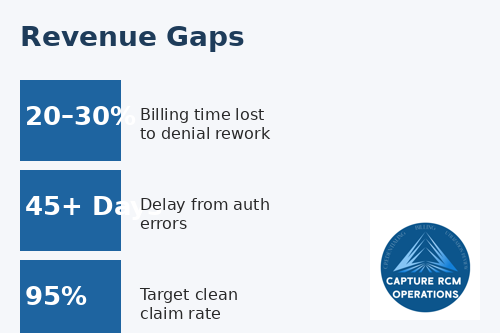
Data Point: Authorization-related issues can delay payments by 30–90 days or result in full claim denials.
Best Practice:
- Verify eligibility at every visit
- Track authorization usage in real time
- Assign responsibility for authorization management
Strong front-end controls prevent costly downstream issues.
Mistake #4: Accepting Denials as “Normal”
Many small practices normalize denials instead of addressing their root causes.
This creates a cycle:
- Claims are denied
- Staff rework and resubmit
- Revenue is delayed
- The same issues repeat
Operational Impact: Denial rework can consume up to 25–30% of billing resources.
Best Practice:
- Categorize denials by type and payer
- Identify recurring issues
- Implement process changes to prevent future denials
Reducing denials improves both efficiency and revenue consistency.
Mistake #5: Inconsistent Claims Submission Practices
Delayed or inconsistent claims submission is a major contributor to revenue gaps.
Common inefficiencies:
- Batch billing once or twice per week
- Manual charge entry delays
- Lack of claim validation before submission
Benchmark: High-performing practices submit claims within 24–48 hours and maintain clean claim rates above 95%.
Best Practice:
- Move to daily claim submission workflows
- Use claim scrubbing tools
- Automate charge capture where possible
Faster submission leads to faster reimbursement.
Mistake #6: Lack of Structured Follow-Up on Outstanding Claims
Even clean claims require consistent follow-up to ensure payment.
Small practices often:
- Delay follow-ups beyond 30 days
- Lack prioritization of high-value claims
- Have no standardized follow-up schedule
Impact: Revenue sits in A/R longer than necessary, increasing financial uncertainty.
Best Practice:
- Initiate follow-up within 7–10 days
- Maintain weekly follow-up cycles
- Track outcomes and payer responses
Structured follow-up accelerates collections and improves cash flow predictability.
Mistake #7: Limited Visibility Into Revenue Cycle Performance
Without clear reporting, practice owners are operating without insight into their financial performance.
Common gaps:
- No real-time A/R tracking
- Limited understanding of denial trends
- Delayed or incomplete financial reports
Best Practice:
Track key performance indicators:
- Days in A/R
- Clean Claim Rate
- Denial Rate
- Net Collection Rate
Key Insight: You cannot improve what you cannot measure.
Build vs. Buy: Evaluating the Right Approach
The decision to manage billing internally or outsource depends on your practice’s capacity, expertise, and growth goals.
When Internal Billing May Work
- Low patient volume
- Simple payer mix
- Strong internal billing expertise
When Outsourcing Becomes Strategic
- A/R exceeds 45–60 days
- Denial rates are consistently high
- Staff is overwhelmed or inconsistent
- Cash flow is unpredictable
Cost Consideration:
While outsourcing involves a service fee, many practices recover more revenue than they spend due to improved efficiency.
What Small Practices Should Expect From Mental Health Billing Services
A high-quality billing partner provides more than basic claim submission.
Key capabilities include:
- Behavioral health specialization
- End-to-end revenue cycle management
- Proactive denial prevention
- Transparent reporting and analytics
The goal is not just to process claims—but to improve overall financial performance.
The Long-Term ROI of Fixing Billing Operations
Optimizing billing—whether internally or through outsourcing—has a direct impact on business stability and growth.
Benefits include:
- Predictable cash flow
- Reduced administrative burden
- Improved compliance and audit readiness
- More time to focus on patient care
Bottom Line: Efficient billing is a competitive advantage, not just an operational necessity.
FAQs: Mental Health Billing Services for Small Practices
When should a small practice consider outsourcing billing?
When internal processes lead to high A/R, frequent denials, or inconsistent cash flow, outsourcing becomes a strategic option.
Is outsourcing billing more expensive than managing it internally?
Not necessarily. Many practices recover more revenue and reduce inefficiencies, offsetting outsourcing costs.
What is a healthy denial rate for mental health billing?
A well-optimized billing system should maintain denial rates below 5–8%.
How quickly should claims be submitted?
Claims should ideally be submitted within 24–48 hours of service to minimize delays.
What role does documentation play in billing success?
Documentation directly impacts reimbursement. Incomplete or inconsistent notes can lead to denials or delays.
How can small practices improve cash flow without outsourcing?
Focus on:
- Faster claim submission
- Better authorization tracking
- Reduced denial rates
- Structured follow-up processes
What should I look for in a billing partner?
Look for specialization in behavioral health, transparent reporting, and proactive revenue cycle management—not just claim processing.
Make a Smarter Billing Decision for Your Practice
If your current billing process is creating delays, increasing workload, or limiting growth, it’s time to reassess your approach. Understanding these common mistakes allows you to make a more informed decision about whether to optimize internally or partner with experts.
Call 380-383-6822 or explore our mental health billing services to improve collections, reduce administrative burden, and build a more efficient, scalable revenue cycle.