

For small mental health practices, billing isn’t just a back-office function—it’s a growth-limiting factor when done inefficiently. If you’re exploring mental health billing services as a path to reclaim time, reduce denials, or improve compliance, understanding what these services include—and what they don’t—is key to making a smart decision.
At Capture RCM Operations, we support behavioral health providers across the country who are weighing whether to keep billing in-house or bring in expert help. Here’s a detailed look at what to expect.
What Mental Health Billing Services Actually Cover
At a baseline, professional billing services for mental health providers are designed to manage the entire revenue cycle—starting before the first session and ending with clean reconciliation.
Here’s what a full-service billing partner should typically provide:
- Insurance eligibility and verification before the client’s first session
- Claim creation and submission using correct CPT and HCPCS codes
- Modifier and payer rules management to reduce rejection risk
- Claim status monitoring to catch issues early
- Denial management and appeals
- Payment posting and reconciliation
- Accounts receivable (AR) follow-up
- Monthly reporting and performance reviews
For practices dealing with complex payer mixes, Medicaid plans, or high-volume outpatient services like IOP or ABA, outsourcing this work can unlock serious time and revenue gains.
What Billing Partners Don’t Do (And Why That Matters)
A billing company can optimize your financial operations—but they can’t (and shouldn’t) replace key practice responsibilities. Here’s what typically stays on your plate:
1. Clinical Documentation and Timeliness
Your therapists must still complete accurate, timely progress notes. Late or incomplete documentation is a top reason for delayed or denied claims—and billing partners can only work with what’s provided.
2. Intake Data Accuracy
If your front desk enters the wrong DOB or policy ID, even the best billing company will struggle. Clean intake workflows are critical for a clean claim.
3. Prior Authorization (in some models)
Some billing partners include prior auth support; others leave it to the practice. Clarify this upfront—especially if you rely on high-authorized services like TMS or ABA.
4. Client Balances and Collections
Most billing services stop at insurance billing. Client-facing balance collection (copays, deductibles, no-shows) often remains your team’s job unless specifically arranged.
5. Credentialing and Contracting
Credentialing is a separate process. If you need help with payer enrollment, confirm that your billing partner offers this service—or refer to a separate credentialing specialist.
Real ROI: The Business Case for Outsourcing
Many small practice owners hesitate to outsource billing because it feels like giving up control—or adding cost. But when you compare total time, revenue leakage, and compliance risk, outsourcing often delivers stronger ROI.
Let’s break it down:
| Cost Factor | In-House | Outsourced |
|---|---|---|
| Staff salary + benefits | $50–$80k/year | N/A |
| Claim rejections due to error | 10–25% | Often <5% |
| Denial appeals workload | Internal burden | Handled by partner |
| Days in AR (avg) | 45–60+ | Often <30 |
| Revenue leakage | High (due to unworked claims) | Low |
| Compliance support | Minimal | Proactive feedback loop |
Even for a 3–5 clinician practice, the difference can total $40,000–$60,000/year in reclaimed revenue and reduced administrative strain.
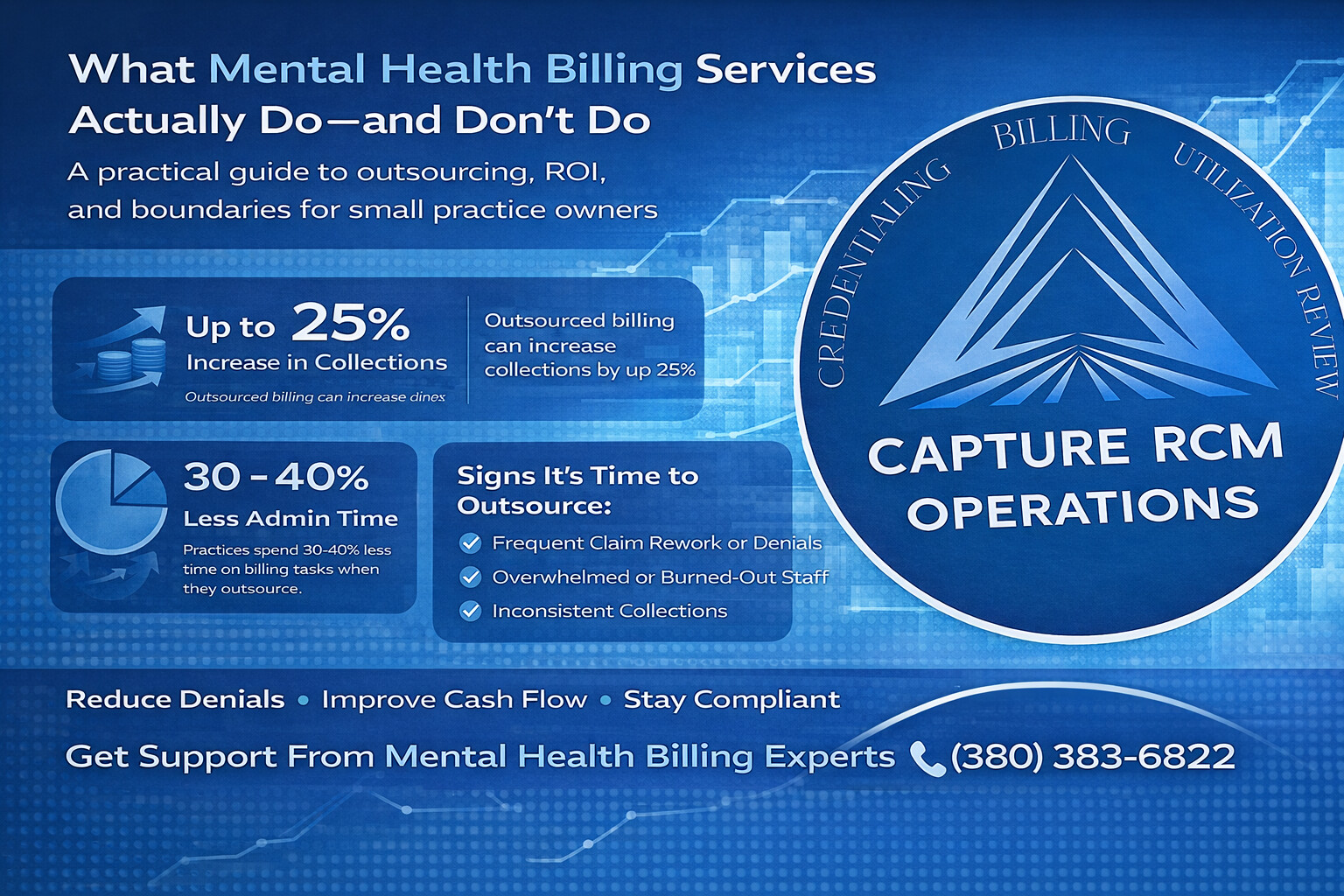
Signs It’s Time to Outsource Your Billing
Still on the fence? Here are signs your practice may benefit from professional billing services:
- You’re spending 10+ hours/week on billing or follow-up.
- Your collections are inconsistent—or unpredictable.
- Your practice has grown beyond 3–4 clinicians and AR is slipping.
- You’re expanding into new services (e.g., IOP, group therapy, or TMS).
- You’re facing increased audit anxiety or payer scrutiny.
- You’ve experienced recent staff turnover in billing roles.
When billing stress starts cutting into client care—or clinician morale—it’s time to consider bringing in support.
Compliance Isn’t Just a Bonus—It’s the Backbone
Mental health billing isn’t just about money. It’s about protecting your license and clinical credibility. The right billing partner should:
- Alert you to documentation risks (e.g., missing signatures, incomplete service notes)
- Keep up with payer-specific rules for services like group therapy, telehealth, or supervision
- Help your team reduce risky habits (like same-day late entries or billing before documentation is complete)
This isn’t scare tactics—it’s business risk management. Billing partners don’t replace your legal responsibilities, but they can help you avoid preventable errors that trigger audits or clawbacks.
Choosing the Right Mental Health Billing Service
Not all billing partners are created equal. Here’s what to ask before signing a contract:
- Do you specialize in mental health billing?
A generic billing firm may not understand behavioral CPT codes or documentation norms. - What payer types do you work with?
Ask about Medicaid plans, EAPs, and managed care orgs. - How do you handle denials?
Denial resolution should be proactive—not reactive. - Can we talk to current clients?
References speak volumes. - What’s your reporting cadence?
You should receive monthly reports with clear AR breakdowns and trends.
FAQ: Mental Health Billing Services
How much do mental health billing services typically cost?
Billing companies charge a percentage of collections (usually 5–10%) or a flat monthly rate. For small practices, this is often less than hiring a full-time biller.
Is outsourcing still worth it if I only have 2–3 clinicians?
Yes—especially if you’re spending hours each week on denials, follow-ups, or manual entry. Many small practices report faster collections and less stress with outsourcing.
Will I lose control of my financial data?
No. A quality billing partner will provide transparent reporting and secure system access. You stay in control of your revenue—it just moves faster.
Can billing services help with credentialing?
Some do, but not all. Ask early if credentialing support is included, or if they offer it as a separate service.
What systems do they use—will it work with mine?
Most billing services integrate with common EHRs and clearinghouses. Capture RCM, for example, works with TherapyNotes, SimplePractice, AdvancedMD, and more.
Get More Time for Clients—Not Claims
Mental health billing doesn’t have to be a constant headache—or a source of lost revenue. At Capture RCM Operations, we partner with practices like yours to bring clarity, consistency, and compliance back into your revenue cycle.
📞 Call (380) 383-6822 or visit our mental health billing services page to learn more about how we support practices like yours.
Let us handle the billing—so you can get back to healing.