

A/R aging doesn’t spike without warning—it builds quietly across your revenue cycle until it becomes visible in your reports. By the time most Billing Directors react, the issue has already spread across intake, authorizations, documentation, and collections.
Behavioral Health Revenue Cycle Management is not just about billing efficiency—it’s about creating a system that prevents revenue delays before they happen. Many organizations start by evaluating their current behavioral health revenue cycle services to uncover hidden breakdowns and restore financial control.
A/R Spikes Reflect Process Gaps—Not Team Performance
When A/R aging increases, the immediate response is often operational pressure: more calls, more follow-ups, more urgency. But this approach treats the symptom—not the cause.
In most cases:
- Billing teams are already operating at capacity
- Increased workload leads to more manual errors
- Staff focus shifts from prevention to rework
Operational Reality: If your team is spending more time fixing claims than submitting clean ones, your system is creating inefficiency.
High-performing organizations shift focus from effort to structure. Instead of asking “How do we collect faster?” they ask, “Why are we not getting paid the first time?”
The Reporting Gap: Why A/R Data Isn’t Telling You Enough
Traditional A/R reports are designed for visibility—not decision-making. They show balances and aging buckets but fail to explain why claims are delayed.
Critical insights often missing:
- Denial trends by payer and category
- Percentage of A/R tied to authorization issues
- Volume of claims pending documentation corrections
Example: A 90-day aging bucket may appear stable, but without segmentation, you may not realize that a single payer accounts for 60% of that delay.
Strategic Upgrade:
Transform your reporting into a diagnostic tool:
- Break down A/R by payer performance
- Track denial categories monthly
- Identify trends by service line
This shift allows Billing Directors to address root causes instead of reacting to outcomes.
Front-End Accuracy: The Most Overlooked Revenue Driver
The intake process is one of the most critical—and most neglected—components of Behavioral Health Revenue Cycle Management.
Small errors at intake create large delays downstream.
Common front-end failures:
- Eligibility verified once but not updated
- Missing or incorrect insurance details
- Lack of financial responsibility verification
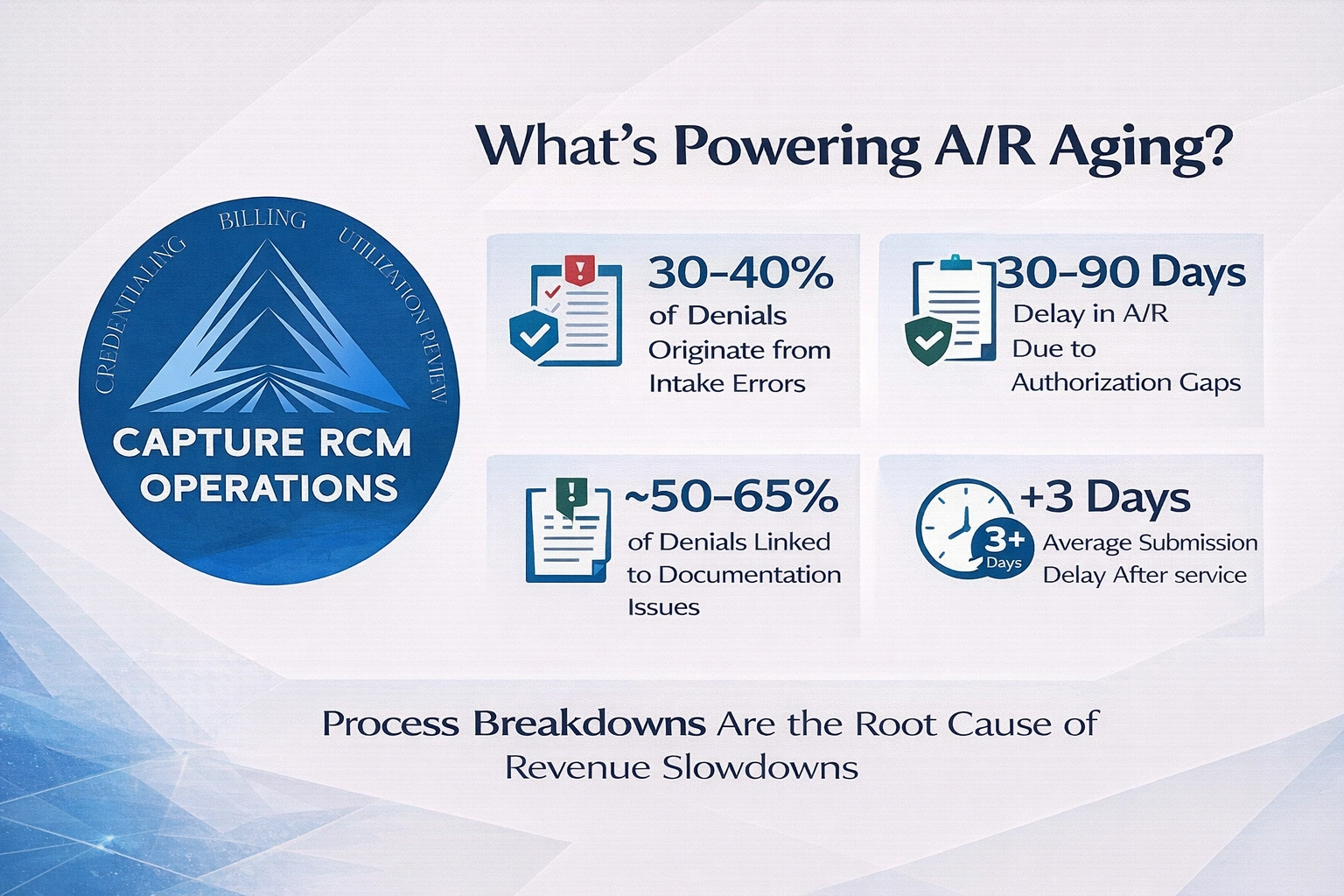
Data Insight: Up to 30–40% of denials originate from front-end inaccuracies.
Operational Fix:
- Implement standardized intake workflows across all locations
- Require eligibility verification at every visit—not just admission
- Introduce front-end quality checks for high-value services
Organizations that strengthen front-end processes reduce rework, accelerate claims, and improve overall cash flow predictability.
Authorization Breakdowns That Quietly Stall Revenue
Authorization management is one of the most complex—and most critical—areas in behavioral health billing.
Unlike other specialties, behavioral health services often require ongoing authorization updates throughout treatment.
Common breakdowns include:
- Authorization units not aligned with treatment frequency
- Delayed concurrent reviews
- Expired authorizations mid-episode
Impact: Authorization-related delays can extend A/R cycles by 30 to 90 days, depending on payer response times.
System-Level Solution:
- Centralize authorization tracking across all patients
- Assign dedicated ownership for authorization management
- Implement automated alerts for expiring approvals
Organizations that prioritize authorization accuracy often see immediate improvements in both denial rates and A/R performance.
Documentation and Coding Misalignment: A Silent Revenue Leak
In Behavioral Health Revenue Cycle Management, documentation is not just clinical—it is financial.
Payers evaluate claims based on:
- Medical necessity
- Session duration
- Level of care justification
When documentation does not align with billing, claims are delayed or denied.
Frequent issues:
- CPT codes not matching documented session time
- Incomplete or missing progress notes
- Lack of clear clinical justification
Stat Insight: Documentation-related issues account for 50–65% of denials in behavioral health.
Action Plan:
- Standardize documentation templates for each level of care
- Train clinicians on payer expectations
- Conduct regular internal audits
Aligning clinical and billing teams ensures that documentation supports reimbursement—not delays it.
Claims Submission Delays That Extend A/R Cycles
Even accurate claims lose value when they are not submitted quickly.
Common inefficiencies:
- Delayed charge entry (3–5 days after service)
- Batch processing instead of daily submissions
- Lack of claim scrubbing tools
Best Practice Benchmark:
- Claims submitted within 24–48 hours
- Clean claim rate above 95%
Process Improvements:
- Automate charge capture where possible
- Implement pre-submission claim validation
- Transition to daily submission workflows
Speed and accuracy at submission significantly reduce A/R aging.
Follow-Up Inefficiencies That Slow Collections
Submitting claims is only the first step. Without structured follow-up, even clean claims can age unnecessarily.
Common gaps:
- Follow-ups initiated too late (30+ days)
- No prioritization of high-value claims
- Inconsistent payer communication
High-Performance Standard:
- First follow-up within 7–10 days
- Weekly follow-ups until resolution
- Defined escalation pathways for each payer
Result: Organizations with structured follow-up processes improve collection timelines by 15–25%.
Denial Management Without Prevention Strategy
Many billing teams focus on correcting denials rather than preventing them. This creates a cycle that keeps A/R high.
Top denial drivers:
- Authorization errors
- Eligibility issues
- Documentation gaps
Critical Shift: Move from reactive denial management to proactive prevention.
Execution Framework:
- Categorize denials by type and payer
- Identify recurring patterns
- Implement process changes at the source
Reducing denial volume—even slightly—has a compounding effect on A/R performance.
Behavioral Health Revenue Cycle Management as a Strategic Fix
A/R improvement requires a coordinated system—not isolated fixes.
A high-performing Behavioral Health Revenue Cycle Management strategy includes:
- Accurate front-end processes
- Real-time authorization tracking
- Documentation aligned with payer standards
- Rapid claims submission
- Consistent follow-up workflows
- Data-driven performance monitoring
Organizations that implement these systems often reduce A/R days by 15–30% within 90 days, while also improving team efficiency.
Turning A/R Data Into Operational Action
Data is only valuable if it drives change.
To operationalize your A/R strategy:
- Conduct weekly revenue cycle performance reviews
- Assign ownership for each KPI
- Align billing metrics with operational decisions
Key Metrics to Track:
- Days in A/R
- Clean Claim Rate
- Denial Rate
- Net Collection Rate
When these metrics are monitored consistently, A/R becomes predictable and manageable.
FAQs: Behavioral Health Revenue Cycle Management and A/R Aging
What is the primary cause of A/R spikes in behavioral health?
A/R spikes are usually caused by a combination of front-end errors, authorization gaps, and documentation misalignment—not a single issue.
How quickly should claims be submitted after services?
Best practice is within 24–48 hours. Delays beyond this window can significantly increase A/R days.
What is a healthy denial rate for behavioral health billing?
A strong operation maintains a denial rate below 5–8%. Higher rates indicate systemic issues that need correction.
How can Billing Directors reduce A/R quickly?
Focus on:
- Fixing front-end processes
- Improving authorization tracking
- Implementing structured follow-up
- Reducing denial volume
These actions deliver faster results than increasing billing activity alone.
Why is authorization management so critical in behavioral health?
Because most services require payer approval, any gap or delay in authorization directly impacts reimbursement timelines.
How often should A/R performance be reviewed?
Weekly reviews are recommended to catch and resolve issues early before they escalate into larger delays.
Does improving A/R impact patient care?
Yes. Strong revenue cycle performance ensures stable cash flow, which supports staffing, program expansion, and consistent patient care delivery.
Improve A/R Performance With a System That Works
If your A/R is increasing despite consistent effort, the issue isn’t your team—it’s your system. Addressing the root causes across intake, authorizations, documentation, and follow-up can significantly improve financial performance.
Call 380-383-6822 or explore our Behavioral Health Revenue Cycle Management services to reduce A/R days, improve collections, and build a more efficient, scalable revenue cycle.