

I used to think the stress was temporary.
That if I just pushed a little harder, caught up on claims over the weekend, or hired one more admin person, things would finally stabilize. I kept telling myself the pressure was part of owning a counseling practice. Something you survive quietly until you “figure it out.”
But eventually the stress stopped feeling temporary and started feeling structural.
I’d finish a full day of sessions emotionally drained, then spend hours dealing with insurance portals, denied claims, unpaid balances, and authorization issues. Somewhere along the way, my evenings stopped belonging to me. My weekends did too.
That was around the time I started looking into mental health billing services.
Not because I was ready.
Because I was exhausted.
The Practice Was Growing — But So Was the Weight
From the outside, things looked successful.
More referrals. A fuller schedule. New clinicians joining the practice. Revenue technically increasing.
But growth can hide dysfunction for a while.
The bigger we got, the more fragile the operational side became. One billing issue could throw off cash flow for weeks. One employee taking vacation suddenly created a backlog nobody could catch up on.
And the strangest part? I kept normalizing it.
I convinced myself this was just what scaling a counseling practice felt like.
But there’s a difference between hard work and constant strain.
One builds something.
The other slowly empties you out.
I Started Carrying Billing Stress Into Therapy Sessions
This part still makes me uncomfortable to admit.
I wasn’t just stressed after work anymore. I was distracted during sessions. Not because I cared less about clients, but because my nervous system was overloaded.
I’d hear part of a session while another part of my brain silently calculated:
Did that insurance payment finally clear?
Did we submit that authorization correctly?
How many denied claims are still sitting unresolved?
That’s the thing nobody warns you about when you’re running both the clinical and operational side of a practice.
Administrative stress doesn’t stay in the office.
It follows you into conversations. Into sleep. Into relationships. Into your body.
Like background static you can’t fully turn off.
I Thought Outsourcing Meant Losing Control
Honestly, that fear kept me stuck longer than the actual workload did.
I worried that outsourcing billing would somehow disconnect me from the financial side of my own business. I imagined becoming dependent on a system I couldn’t oversee myself.
So I kept trying to hold everything internally.
Even when it clearly wasn’t working anymore.
Even when staff turnover kept interrupting workflows.
Even when denied claims were piling up faster than we could resolve them.
Even when I started dreading checking our accounts receivable reports.
I told myself keeping billing in-house was financially smarter.
But eventually I had to ask a harder question:
Smarter for who?
Because it definitely wasn’t smarter for my mental health.
The Real Cost Was Hiding in Places I Wasn’t Measuring
At first, I only compared direct expenses.
Internal staff payroll versus outsourced therapy billing costs.
Software fees.
Clearinghouse expenses.
Training time.
But eventually I realized I was leaving out the biggest costs entirely.
The unpaid hours.
The emotional fatigue.
The constant interruptions.
The delayed reimbursements.
The burnout creeping into every part of my day.
I started realizing that “saving money” internally only looked true if I ignored what the system was actually costing me personally.
And honestly?
I think a lot of practice owners quietly do that math in their heads without saying it out loud.
The Breaking Point Was Surprisingly Small
People imagine burnout arrives dramatically.
Mine didn’t.
It happened during an ordinary Tuesday night while reworking rejected claims after dinner. I remember staring at my laptop and realizing I physically could not tolerate one more administrative problem that day.
Not emotionally.
Not mentally.
Not even cognitively.
It felt like my brain had hit capacity.
And for the first time, instead of thinking:
“I need to work harder,”
I thought:
“This system is hurting me.”
That sentence changed something.
Letting Go of Survival Mode Felt Unnatural at First
Transitioning billing didn’t immediately feel freeing.
At first, it felt uncomfortable.
There were onboarding conversations, workflow questions, clarifications, and moments where I wondered if I’d made a mistake. Handing over processes I’d personally controlled for years felt strangely emotional.
I think because I had tied my identity to handling everything myself.
Like being overwhelmed somehow proved I cared enough.
But slowly, things shifted.
Claims were getting followed up on consistently.
Reports became clearer.
Problems stopped sitting unresolved for weeks.
I stopped waking up already behind.
The relief wasn’t dramatic.
It was quieter than that.
More like finally setting down a heavy bag you forgot you were carrying.
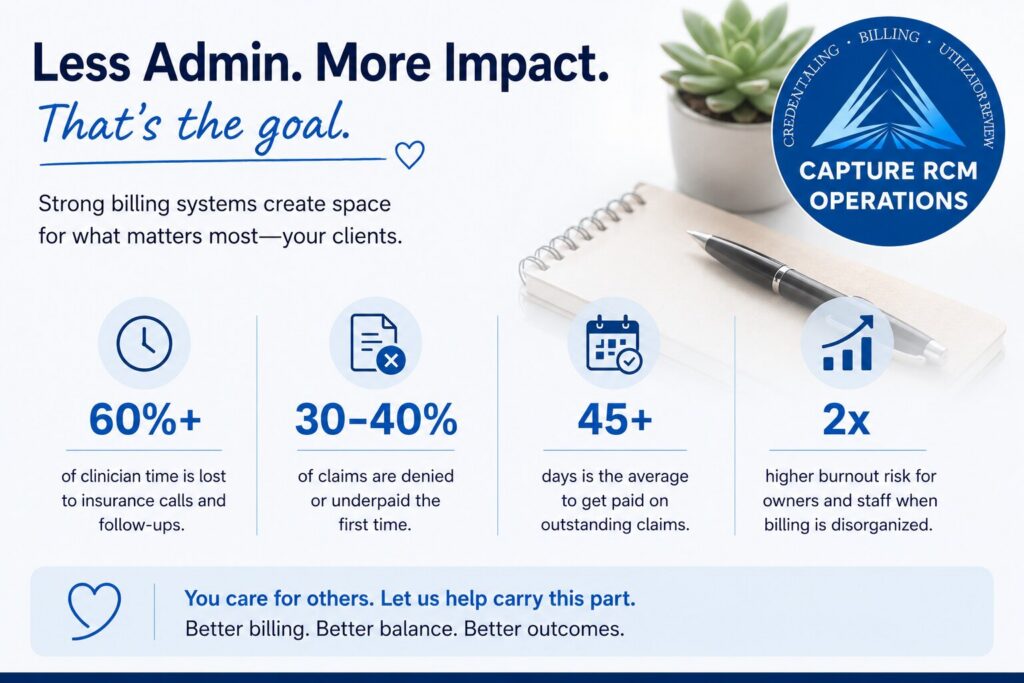
I Didn’t Realize How Burned Out I Was Until Things Stabilized
This part surprised me most.
Once the operational chaos settled down a little, I started noticing how dysregulated I’d become without realizing it.
I had normalized:
- Constant urgency
- Late-night administrative work
- Financial anxiety
- Checking emails compulsively
- Feeling guilty anytime I rested
When those things eased, even slightly, I realized how long my nervous system had been functioning in survival mode.
And the truth is, survival mode can become addictive in its own way.
You start mistaking constant stress for responsibility.
Constant urgency for commitment.
But eventually your body keeps score whether you acknowledge it or not.
The Financial Side Improved — But That Wasn’t the Biggest Win
Yes, operationally things got better.
Denied claims were addressed faster.
Reimbursements became more predictable.
Reporting improved.
Administrative bottlenecks eased.
But honestly, the biggest difference wasn’t financial.
It was emotional bandwidth.
I could actually think strategically again instead of reactively.
I could focus on clinicians, clients, and long-term growth instead of constantly putting out fires.
I stopped feeling resentful every time another insurance issue appeared.
And maybe most importantly:
I started liking my practice again.
That felt bigger than revenue.
There’s a Particular Loneliness in Running a Counseling Practice
Especially when you’re the one carrying both emotional labor and operational responsibility.
You spend all day helping other people regulate while privately feeling overwhelmed yourself.
And because the practice may still appear “successful” externally, it becomes harder to admit how much pressure you’re under internally.
That isolation can distort your thinking.
You start believing:
Everyone else handles this better.
Maybe I’m just not organized enough.
Maybe I should be able to manage all this alone.
But most people running growing practices are struggling more quietly than they admit.
Especially with billing.
Looking Back, I Waited Too Long
Not because outsourcing is perfect.
No operational system is.
But because I confused endurance with sustainability.
There’s a difference.
Being able to survive a broken workflow doesn’t mean it’s healthy to keep operating inside it indefinitely.
And the longer I delayed support, the more normalized the exhaustion became.
That’s what worries me now when I talk to other practice owners.
Not the financial side.
Not the operational side.
The way burnout slowly starts convincing you that this level of stress is just your personality now.
What I Wish Someone Had Told Me Earlier
Nobody hands you a medal for carrying everything alone.
Seriously.
There is no hidden reward for being the most exhausted person in your practice.
And asking for operational support doesn’t mean you failed at building your business correctly. Sometimes it means your practice has grown beyond systems that were only designed for survival mode.
That’s not failure.
That’s growth happening faster than infrastructure.
FAQ: Outsourcing Billing for a Counseling Practice
Is outsourcing billing worth it for a small counseling practice?
For many practices, yes. Especially once claim volume, administrative workload, or denial rates begin affecting daily operations and cash flow consistency.
How do outsourced therapy billing costs compare to in-house billing?
The answer depends on staffing, software expenses, denied claims, unpaid administrative hours, and turnover risk. Many owners initially underestimate the hidden operational costs of in-house billing.
Will outsourcing billing reduce control over my practice?
Not necessarily. Many practice owners actually gain more visibility through structured reporting, KPI tracking, and consistent reimbursement workflows.
Can outsourced billing improve cash flow?
Yes. Faster claim submission, stronger denial management, and better payer follow-up often improve reimbursement consistency over time.
What are signs my billing system is no longer sustainable?
Common warning signs include:
- Constant claims backlog
- Staff burnout
- Delayed reimbursements
- High denial rates
- Frequent billing errors
- Administrative overwhelm
- Difficulty scaling operations
Does outsourcing billing help with therapist burnout?
Indirectly, yes. Reducing operational pressure often creates more emotional bandwidth for clinicians and practice owners.
How long does onboarding usually take?
Most billing transitions take several weeks depending on payer setup, credentialing status, workflow complexity, and EHR integrations.
Is outsourced billing only for large practices?
No. Many smaller counseling practices outsource billing specifically because they lack the internal infrastructure larger organizations have.
If You’re Quietly Falling Apart Behind the Scenes
I know how easy it is to minimize your own exhaustion.
Especially when clients still need you.
Staff still rely on you.
The practice still technically functions.
But there comes a point where constantly surviving operational stress starts costing too much emotionally.
And if you’re sitting there wondering whether you’re reaching that point now…
You probably already know the answer.
You don’t have to overhaul everything overnight.
You don’t have to pretend the decision feels easy either.
But you may deserve systems that support your practice instead of quietly draining the life out of it.
Call (380) 383-6822 or visit our mental health billing services to learn more about our mental health billing services in your area.