

You’ve built your operations from the ground up. For years, your internal team handled revenue cycle management (RCM) and compliance with diligence. But now… the cracks are showing. The pressure, the complexity, the constant rule changes—it’s starting to feel less like strategy and more like survival. If this sounds familiar, you’re not alone. Outsourcing compliance and RCM isn’t about letting go of control—it’s about protecting what you’ve built.
1. Compliance Is Eating Your Bandwidth
When payer audits, documentation updates, and CMS changes take up more of your team’s day than actual clinical support, something’s off. Compliance isn’t optional—but doing it in-house shouldn’t mean losing focus on care delivery.
2. UR Reviews Are Always One Step Behind
Utilization Review delays can cause a ripple effect—missed reimbursements, frustrated clinicians, and longer authorization cycles. If your UR reviews feel reactive instead of proactive, it’s time to re-evaluate your workflow.
3. Staff Turnover Is Hurting Consistency
A single billing coordinator leaving can set your whole system back. And retraining? It’s never just a two-week ramp-up. Outsourcing creates stability—and removes the constant worry of losing institutional knowledge to LinkedIn job alerts.
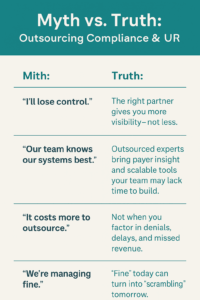
Myth vs. Truth: Outsourcing Compliance and UR in Behavioral Health
Myth:
“If I outsource, I’ll lose control over my revenue cycle.”
Truth:
Outsourcing doesn’t mean hands-off—it means having a specialized team that keeps you informed, compliant, and efficient. You gain more visibility, not less, with the right partner.
Myth:
“Our internal team knows our systems better than anyone.”
Truth:
They probably do—but external partners bring deep cross-payer insight, auditing expertise, and scalable processes that in-house teams simply don’t have time to build.
Myth:
“It’ll be more expensive to outsource.”
Truth:
Most CEOs only calculate cost in salaries—not in missed reimbursements, preventable denials, or time lost chasing documentation. Done right, outsourcing pays for itself in stability and accuracy.
Myth:
“We’re managing fine. No need to change what’s working.”
Truth:
“Fine” today might be “at risk” tomorrow. Staying compliant means staying ahead—especially as payer demands and documentation rules evolve.
4. Payer Requirements Are Outpacing Your Policies
It’s not just about catching up anymore. Payers change their expectations fast—and keeping your documentation, billing, and authorization processes aligned is a full-time job. Outsourced partners stay current by design.
5. Your Clinicians Are Doing Too Much Admin
When your best therapists are spending half their time on treatment plans that meet UR requirements instead of client needs, that’s a compliance tax your team can’t afford. Clinical excellence requires operational backup.
6. You’re Always in “Fix It” Mode
If your billing team is constantly troubleshooting denials, reworking authorizations, or double-checking modifier codes, the system’s not working—it’s coping. Outsourcing shifts you from crisis mode to performance mode.
7. You’re Asking, “Is This Sustainable?”
That question is your cue. CEOs don’t reconsider their RCM systems because everything’s running smoothly—they do it because they know something has to change. Recognizing that doesn’t make you reactive. It makes you strategic.
📞 Ready to Reclaim Your Focus?
Capture RCM Operations is built for behavioral health providers who are ready to grow without losing sleep over billing and compliance. Learn more about our compliance services or call (380) 383-6822 to talk with someone who gets it. Let’s make your operations as strong as your clinical care.