

There’s a kind of exhaustion that settles into treatment centers slowly.
Not dramatic enough to stop operations.
Not obvious enough for outsiders to notice.
But the people inside the building feel it.
The admissions coordinator answering payer calls while trying to process intakes. The clinical director checking authorization statuses between group sessions. The owner reviewing denied claims late at night after everyone else has gone home.
At first, everyone tells themselves it’s temporary.
Just a busy month.
Just a staffing issue.
Just growth pains.
But eventually something changes. The stress stops feeling temporary and starts feeling built into the structure itself.
That’s usually around the time people quietly begin searching for substance use disorder billing services. Not because they suddenly care more about revenue than patients. Because they’re realizing the current system is slowly draining the people trying hardest to hold the program together.
Most Small Programs Learn to Survive Before They Learn to Scale
A lot of smaller addiction treatment programs are built by people who care deeply about the work.
They know recovery personally.
They know what burnout feels like.
They know what happens when people fall through cracks.
So when operational problems appear, they compensate.
Everyone compensates.
Staff work longer hours.
Leadership absorbs more pressure.
Clinical teams stretch beyond their roles.
People skip breaks, postpone vacations, answer emails at midnight.
The organization survives because the people inside it keep overextending themselves emotionally.
For a while, that can almost feel admirable.
Until you realize survival mode quietly became the operating system.
Nobody Talks About the Emotional Weight of Insurance Problems
Operational strain doesn’t stay operational for long.
It becomes emotional.
You can see it in the tension before staff meetings. In the exhausted tone of payer conversations. In the way people brace themselves every time another authorization issue appears.
There’s a specific kind of helplessness that develops when your team is working hard clinically but constantly blocked administratively.
Patients need care.
Families need answers.
Staff are trying to stay emotionally present.
Meanwhile insurance issues keep creating friction underneath everything.
One denied authorization can ripple across an entire day inside a small program.
Not just financially.
Emotionally.
The Clinical Team Usually Feels It First
This is important.
Burnout inside treatment programs rarely starts because clinicians stop caring.
If anything, it’s usually the opposite.
People care so much they keep carrying operational strain longer than they should.
Therapists start helping with insurance follow-up.
Case managers track paperwork outside their role.
Clinical supervisors get pulled into utilization review chaos.
Everyone starts absorbing pieces of the pressure manually because nobody wants patient care disrupted.
But over time, something subtle changes.
Staff stop feeling connected to the work the same way.
Not because they lost compassion.
Because constant operational stress slowly dulls emotional capacity.
Like static noise playing in the background all day long.
We Kept Telling Ourselves We Could Handle It Internally
I’ve seen this pattern repeatedly with growing treatment centers.
Leadership hesitates bringing in outside support because internally managing everything feels more responsible somehow.
More controlled.
More cost-conscious.
More independent.
But eventually the cracks become harder to ignore.
Claims start aging.
Authorizations become inconsistent.
Staff turnover creates workflow gaps.
Payer communication falls behind.
Leadership spends entire days reacting instead of planning.
At that point, keeping everything internal stops feeling strategic and starts feeling survival-based.
That’s usually when organizations begin seriously evaluating whether an addiction treatment RCM company could actually stabilize things instead of simply adding another vendor relationship.
Not Every Billing Partner Understands Addiction Treatment
This matters more than people realize.
A general healthcare billing company may understand claims processing technically. But addiction treatment environments operate differently than many other healthcare models.
Structured daytime care and multi-day weekly treatment programs involve constant movement.
Admissions fluctuate.
Lengths of stay change quickly.
Concurrent reviews require urgency.
Documentation timelines matter heavily.
Insurance communication can shift hour to hour.
If a billing partner doesn’t understand those realities operationally, the treatment center ends up doing endless translation work.
Explaining workflows.
Explaining urgency.
Explaining clinical reasoning.
Explaining why delays affect patient care downstream.
Eventually the partnership creates more stress instead of less.
Good Operational Support Feels Steady
The strongest billing partnerships I’ve seen all shared something surprisingly simple:
They reduced emotional volatility inside the organization.
That’s harder to measure than reimbursement metrics, but honestly, it matters just as much.
Things become calmer.
Claims are followed up on consistently.
Authorization tracking improves.
Communication becomes clearer.
Problems get addressed before turning into emergencies.
The building itself starts feeling different.
Less frantic.
Less reactive.
Less emotionally stretched thin.
Like finally removing background pressure everyone had adapted to without realizing it.
There’s a Difference Between Stress and Chronic Strain
Treatment centers are always going to experience pressure.
That part is unavoidable.
Patients relapse.
Families struggle.
Staffing fluctuates.
Insurance companies create complications.
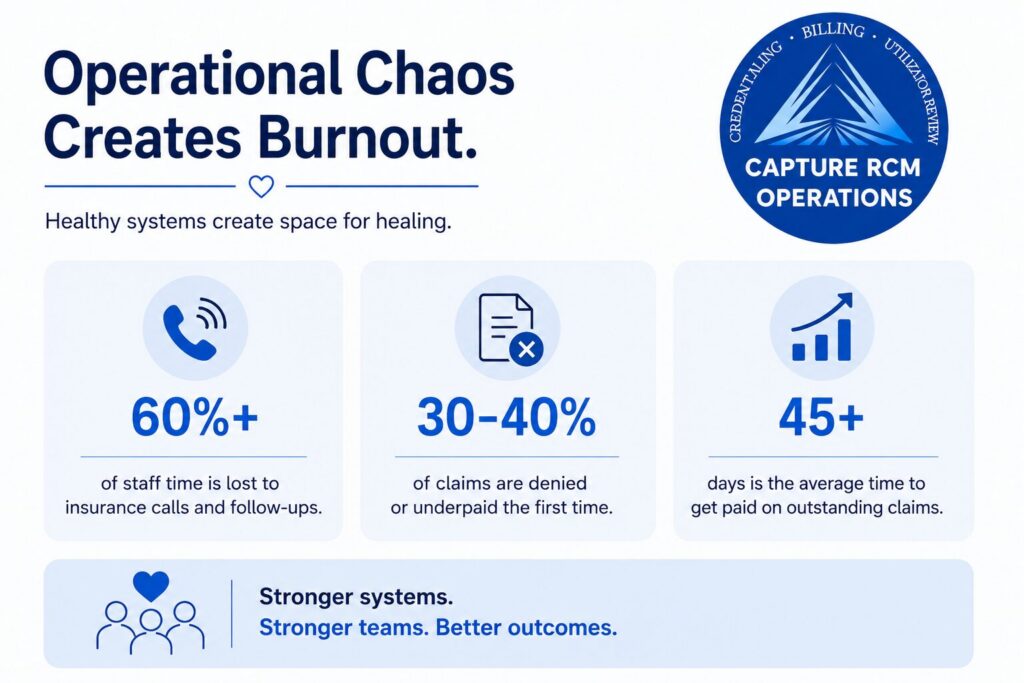
But there’s a major difference between manageable stress and chronic operational instability becoming part of the culture.
One creates difficult moments.
The other slowly drains entire teams.
And the dangerous thing about chronic strain is how normal it starts feeling after enough time passes.
People stop recognizing exhaustion as a warning sign because exhaustion becomes routine.
Leadership Often Carries the Heaviest Silence
Owners and directors usually absorb more than anyone realizes.
Not just financially.
Emotionally.
They’re trying to protect staff morale while privately worrying about reimbursements, payroll, census consistency, denials, staffing gaps, and operational sustainability all at once.
Most don’t talk about that pressure openly.
They just keep carrying it.
Until eventually leadership itself starts feeling emotionally disconnected from the mission that originally built the program.
That’s often the hidden cost of unstable operational systems.
Not collapse.
Numbness.
Programs Don’t Usually Need Perfection — They Need Support
This is something smaller treatment centers sometimes forget.
The goal isn’t building flawless operations.
The goal is building systems strong enough that exhausted staff stop compensating for preventable problems manually every day.
That distinction matters.
Because no treatment center eliminates stress entirely. But strong operational infrastructure changes how much emotional pressure individuals are forced to carry personally.
That’s where reliable billing support actually changes organizations.
Not just financially.
Culturally.
The Best Partnerships Feel Human
This probably sounds strange for a conversation about billing, but it’s true.
The strongest operational partners don’t feel transactional.
They feel grounding.
Communication becomes more collaborative.
Leadership feels less isolated.
Staff stop constantly firefighting.
Problems become manageable instead of emotionally consuming.
A good addiction treatment RCM company understands that behind every claim, authorization, and payer issue is an actual treatment team trying to stay emotionally available for vulnerable people.
That perspective changes everything.
Reliable Systems Protect Clinical Presence
This is the part many organizations underestimate most.
When operational chaos decreases, clinicians regain emotional bandwidth.
That affects:
- Group quality
- Patient engagement
- Documentation consistency
- Team morale
- Staff retention
- Leadership clarity
You can feel the difference inside programs where staff are no longer operating entirely from depletion.
People become more patient again.
More collaborative.
More connected to the mission itself.
Operational stability creates emotional space.
And in addiction treatment, emotional space matters enormously.
Sometimes the Strongest Teams Wait Too Long to Ask for Help
High-functioning organizations often normalize overload because everyone inside them is capable and deeply committed.
People keep adapting.
Keep compensating.
Keep surviving.
Until eventually exhaustion becomes invisible because it’s everywhere.
That’s why many treatment centers don’t seriously evaluate operational support until the strain has already spread through the organization emotionally.
But support doesn’t mean failure.
It usually means the organization grew beyond systems originally built for survival mode.
That’s not weakness.
That’s growth exposing infrastructure limits.
FAQ: Finding Reliable Billing Support for Rehab Programs
Why do addiction treatment programs struggle with claims and authorizations?
Behavioral health reimbursement involves frequent authorization reviews, complex documentation requirements, payer communication, and changing clinical timelines that create heavy operational demands.
When should a treatment center consider outside billing support?
Common signs include:
- Staff burnout
- Delayed reimbursements
- Authorization issues
- Growing accounts receivable
- Leadership constantly handling insurance problems
- Clinical teams absorbing operational work
Can a general healthcare billing company handle addiction treatment billing?
Some can process claims technically, but many lack understanding of behavioral health workflows, utilization review urgency, and treatment program operations.
What should treatment centers look for in a billing partner?
Look for:
- Behavioral health specialization
- Utilization review experience
- Strong communication
- Consistent follow-through
- Authorization management support
- Understanding of treatment operations
How does operational instability affect clinical teams?
Constant administrative pressure reduces emotional bandwidth, increases burnout risk, and can affect staff morale, documentation consistency, and patient engagement.
Will outsourcing billing immediately solve operational problems?
No system fixes everything overnight, but strong operational support often reduces chaos, improves workflow consistency, and creates more stability over time.
Why do smaller treatment programs delay asking for support?
Many leadership teams normalize exhaustion, worry about costs, or feel responsible for keeping everything internal even after operational strain becomes unsustainable.
Can stronger billing systems improve staff retention?
Indirectly, yes. Reducing administrative overload and operational chaos often improves workplace stability and decreases emotional exhaustion.
If Your Team Feels Tired in a Way Rest Isn’t Fixing
Pay attention to that.
Not just the financial pressure.
Not just the operational inefficiencies.
The emotional atmosphere inside the organization.
If people feel constantly stretched…
If leadership never feels caught up…
If administrative problems keep bleeding into clinical care…
The system may be asking too much from exhausted people.
And sometimes the healthiest thing a program can do is stop expecting staff to carry operational instability manually forever.
Call (380) 383-6822 or visit our substance use disorder billing services to learn more about our services, billing, substance use disorder services in your area.