

Managing billing in a behavioral health organization is rarely as simple as submitting claims. Between authorizations, documentation requirements, and evolving payer rules, the revenue cycle management process quickly becomes one of the most complex parts of operations.
At some point, most organizations face a critical question: Should billing stay in-house, or is it time to outsource?
The answer depends on more than cost—it impacts cash flow, team bandwidth, and long-term scalability. Below, we break down both models in a way that reflects how they actually perform in behavioral health settings.
Understanding the Two Models
In-house billing means your internal team is responsible for the full revenue cycle, from insurance verification through collections. This approach offers proximity and control, but it also requires consistent staffing, training, and oversight to remain effective.
Outsourced billing shifts those responsibilities to a third-party partner. In behavioral health, this typically includes everything from authorizations and coding to denial management and reporting. The value here lies in specialization but it depends heavily on the quality of the partner.
Where In-House Billing Works and Where It Struggles
In-house billing can be effective when a team is experienced, stable, and well-integrated with clinical staff. Organizations with lower claim volume or simpler payer mixes may find this model manageable and even efficient.
However, challenges tend to emerge over time. Staffing becomes a recurring pressure point, especially when turnover disrupts workflows and delays claims. Training also becomes ongoing, particularly as payer requirements evolve. What starts as a controlled system can gradually become reactive, with teams spending more time fixing issues than preventing them.
In behavioral health specifically, the complexity of authorizations and medical necessity reviews adds another layer. Without deep specialization, even strong internal teams can struggle to keep pace.
Why More Organizations Are Moving Toward Outsourcing
Outsourced billing tends to gain traction when internal systems begin to strain under growth or complexity. Rather than building out a larger internal department, organizations look for a partner that already has the infrastructure in place.
The advantage isn’t just cost—it’s consistency. Specialized RCM teams are built around processes that reduce variability, from cleaner claim submission to more structured denial follow-up. Over time, this often translates into more predictable cash flow.
That said, outsourcing is not a hands-off solution. Success depends on communication, transparency, and alignment between teams. Without that, organizations can feel disconnected from their own revenue cycle.
The Differences That Actually Impact Revenue
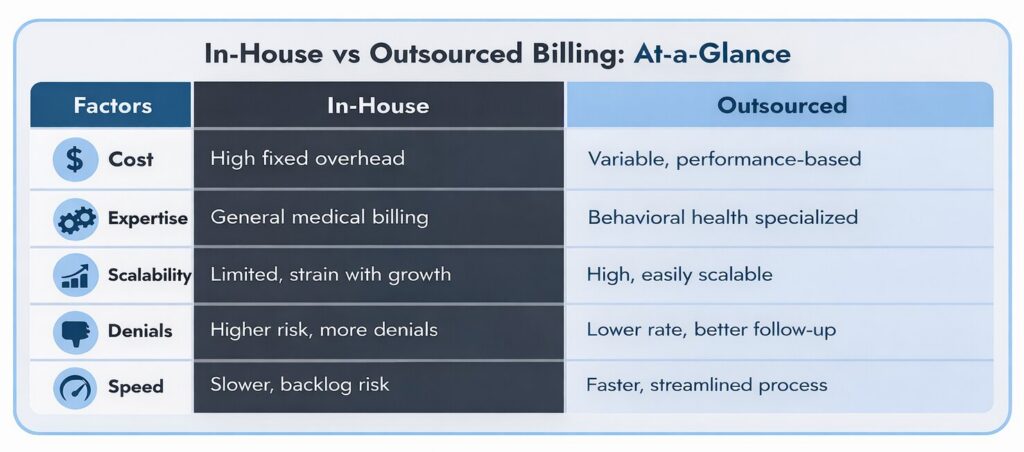
When comparing these two models, the biggest differences show up in performance—not theory.
Denial rates, for example, often reflect the level of specialization behind the process. Teams that regularly handle behavioral health claims are typically better equipped to prevent errors before submission.
Speed is another key factor. Delays in claim submission or follow-up can quietly impact revenue over time. More structured systems tend to move faster and with fewer interruptions.
Cost is often misunderstood. While in-house billing may appear less expensive on the surface, it carries fixed overhead and hidden inefficiencies. Outsourcing shifts that model, often tying cost more directly to performance.
Finally, scalability becomes a defining factor as organizations grow. What works at one stage doesn’t always hold up under increased volume.
When Keeping Billing In-House Still Makes Sense
There are situations where maintaining an internal billing team is the right decision. Organizations with experienced staff, strong systems, and manageable volume can operate effectively without external support.
In these cases, the key is consistency. When workflows are stable and performance is predictable, the benefits of control and proximity can outweigh the challenges.
When Outsourcing Becomes the Better Strategic Move
For many organizations, the shift toward outsourcing happens gradually—often in response to recurring issues rather than a single decision point. As complexity increases, organizations often look toward outsourced revenue cycle management solutions to stabilize operations and improve performance.
It may start with rising denial rates or inconsistent cash flow. Over time, leadership may notice that internal resources are being pulled away from growth and patient care to manage billing challenges. As complexity increases, so does the need for a more structured solution.
At that point, outsourcing becomes less about convenience and more about sustainability.
The Costs That Don’t Show Up on Paper
One of the most overlooked aspects of this decision is the cost of inefficiency.
In-house billing doesn’t just involve salaries; it includes the time spent training staff, resolving errors, and managing workflows. Delayed payments and missed follow-ups also carry a financial impact that isn’t always immediately visible.
Over time, these factors can quietly erode revenue, even when operations appear stable on the surface.
Choosing the Right Path Forward
There isn’t a one-size-fits-all answer to this decision. The right approach depends on your organization’s size, growth stage, and internal capabilities.
What matters most is alignment. Your billing model should support, not limit, your ability to grow, maintain compliance, and deliver consistent care.
Final Thoughts
Billing in behavioral health is more than an administrative function; it’s a critical part of operational stability.
Whether managed internally or through a partner, the goal remains the same: to create a system that is accurate, efficient, and built to scale.
If your organization is evaluating whether to maintain an in-house team or transition to a more scalable approach, understanding the full picture is key.
Explore how Capture RCM Operations supports behavioral health organizations across the entire revenue cycle.