
It’s an exciting moment. The phones are ringing, referrals are flowing, and your new program is gaining traction. But behind the scenes, there’s a quiet panic: How do we keep up with all of it? Scaling means more moving parts—more clients, more paperwork, more risk. Utilization review is one way to stay ahead before things fall through the cracks.
Scaling Adds Complexity—Fast
A growing caseload means more documentation, more insurance requirements, and more room for small errors to turn into big setbacks. It’s not about doing more—it’s about doing it right, consistently.
Why Utilization Review Is Your First Line of Defense
Utilization review ensures your clinical documentation matches medical necessity criteria and payer expectations. When your notes don’t align, you risk denials, delays, and audits. A strong UR process protects both reimbursement and reputation.
Billing Looks Different for Every Service You Offer
Each level of care and service type brings its own billing nuances. What’s required for one program might look completely different for another. And if you’re expanding into new clinical areas, those distinctions matter more than ever.
Here’s what that can look like:
Substance Use Disorder (SUD)
- Preauthorization requirements are strict.
- Documentation must reflect both ASAM criteria and time-based progress.
- Missing one key term in your notes can mean no reimbursement.
Mental Health
- Often includes blended modalities: group, individual, family therapy.
- Payers expect clinical justification for every service billed—even when frequency seems standard.
- Outcomes need to be clearly tied to goals on the treatment plan.
Applied Behavioral Analysis (ABA)
- Highly structured service plans with regular recertification.
- Payers scrutinize measurable data; subjective language alone won’t suffice.
- UR must show functional improvement, not just attendance.
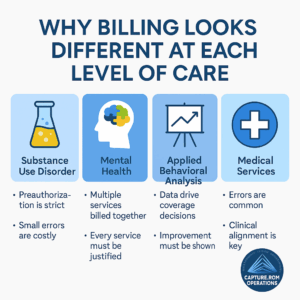
Medical Services
- Billing often spans multiple CPT codes per visit.
- Errors in coding or documentation timing are common and costly.
- Utilization review ensures alignment with both clinical notes and regulatory requirements.
Each of these areas has different documentation rules, billing codes, and utilization benchmarks. That’s where having a specialized RCM partner becomes essential—not optional.
Compliance and Credentialing: The Infrastructure Beneath Growth
Here’s the part no one tells you when launching a new program: you don’t just need great care. You need proof that your staff are credentialed, that your operations meet payer compliance standards, and that your documentation can stand up to scrutiny.
A solid utilization review process supports this from day one—but it’s credentialing and compliance systems that keep the whole thing from falling apart. From verifying provider licenses to ensuring billing procedures match payer policies, these are the invisible rails that keep you moving forward.
You Can’t Afford to Wing It Anymore
In the early days, it’s common to “just get it done.” But as your program expands, that approach starts to crack. Having a professional utilization review process in place keeps you compliant, credible, and funded.
Good UR Isn’t Just Checking Boxes—It’s Telling the Right Story
Insurance doesn’t pay for transformation; they pay for services that meet clinical criteria. Your UR partner helps translate real client progress into the kind of language and structure that payers recognize and approve.
Outsourcing Doesn’t Mean Losing Control
Working with a team like Capture RCM Operations doesn’t replace your clinicians—it supports them. We collaborate with your staff to strengthen documentation, reduce denials, and keep care on track. You still set the tone; we help you hold the line.
Build With Confidence, Not Caution
You didn’t launch a program just to get buried in paperwork or stalled by billing delays. Utilization review is what lets you move forward with clarity, not fear. It’s the system under the surface that keeps your growth sustainable.
📞 Feeling the strain of scaling? We can help.
Call (380) 383-6822 or visit to learn more about our utilization review services in United States.