


Small practice owners often start with the assumption that billing can be handled internally with minimal friction. On paper, it seems efficient—keep costs low, manage everything in-house, and maintain control.
But over time, cracks begin to show. Payments slow down, denials increase, and administrative staff become overwhelmed. What initially feels like a cost-saving strategy often turns into a revenue bottleneck.
Understanding where mental health billing services break down—and how to fix those gaps—can help small practices move from reactive billing to a more stable, scalable financial model. Many practices reach this point after evaluating structured mental health billing services support to correct inefficiencies and regain control over cash flow.
Misjudging the Complexity of Mental Health Billing Services
Mental health billing is fundamentally different from other healthcare specialties. It is not just about submitting claims—it requires precision across documentation, coding, and payer compliance.
Small practices often underestimate:
- The importance of time-based CPT coding accuracy
- The role of detailed session documentation
- Variability in payer rules for behavioral health services
For example, billing for a 60-minute therapy session (90837) without clearly documenting session duration and medical necessity can result in denial—even if the service was delivered correctly.
Data point: Behavioral health claims are denied at higher rates than many other specialties, with first-pass denial rates often exceeding 10–15%.
This complexity means billing errors are not occasional—they are systemic unless processes are structured correctly.
Relying on Generalists Instead of Specialized Billing Expertise
Another common mistake is assigning billing responsibilities to staff without behavioral health specialization. Front desk teams or general medical billers may handle claims, but mental health billing requires deeper expertise.
Specialized knowledge includes:
- Psychotherapy coding nuances
- Payer-specific behavioral health policies
- Authorization tracking and compliance
- Documentation alignment with reimbursement requirements
Real-world scenario: A small practice consistently submits clean claims from a general billing perspective—but still experiences delays because documentation does not meet payer-specific medical necessity standards.
Without specialization, practices may not even realize where revenue is being lost.
Weak Front-End Processes That Trigger Downstream Problems
Many billing issues originate before a claim is ever created. Weak intake and eligibility processes create a ripple effect that leads to denials, rework, and delayed payments.
Common front-end breakdowns include:
- Skipping real-time insurance verification
- Failing to confirm coverage limitations
- Missing prior authorizations
- Entering incomplete or incorrect patient data
These issues often result in claim rejections at the earliest stage, forcing staff to revisit and correct errors.
Operational insight: Practices that implement structured front-end verification processes can reduce claim rejection rates by up to 30%, significantly improving revenue cycle efficiency.
Fixing billing without fixing intake is like treating symptoms without addressing the root cause.
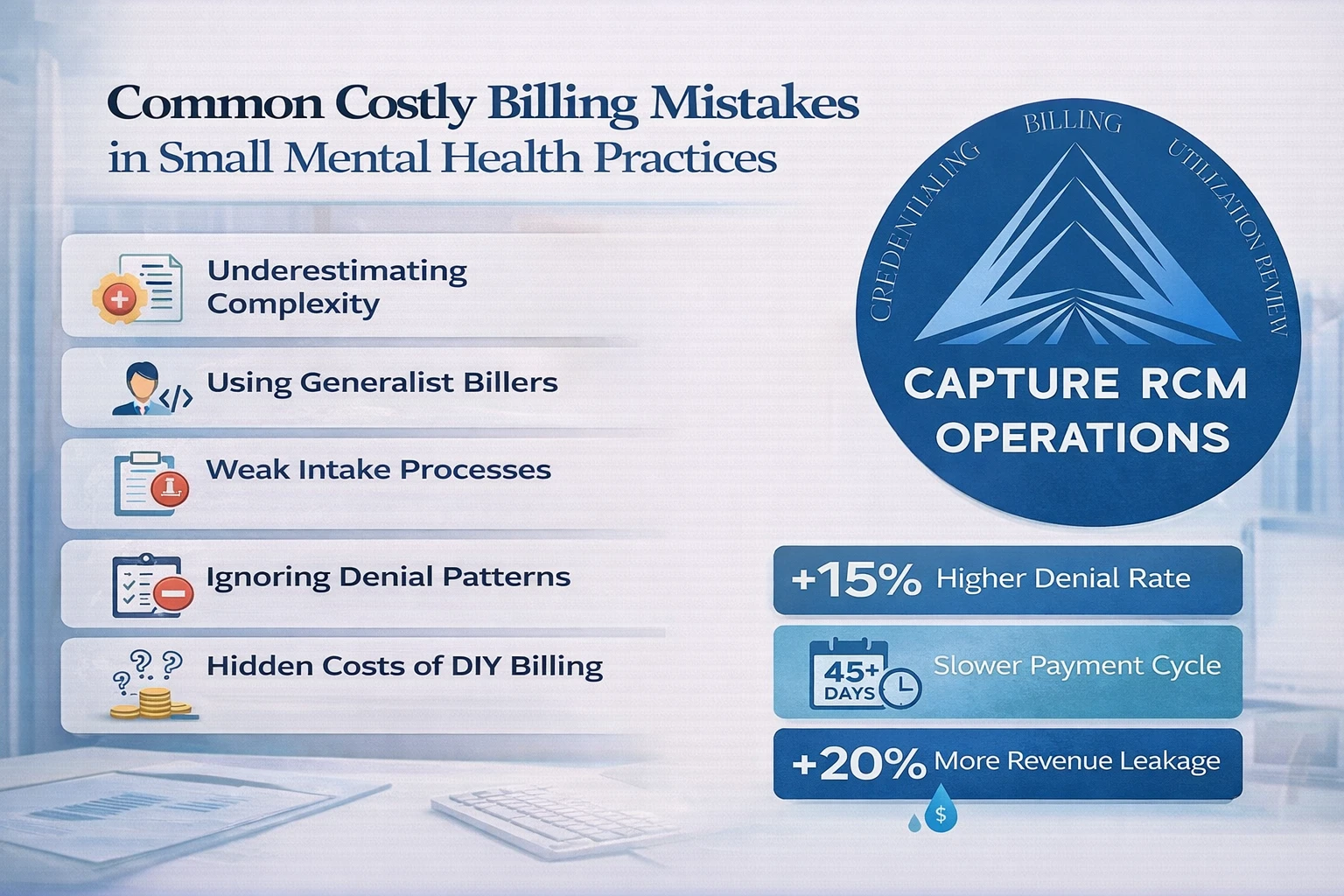
Treating Denials as One-Off Issues Instead of Patterns
Denials are often handled reactively—staff fix the issue, resubmit the claim, and move on. However, this approach ignores the underlying patterns that cause repeated revenue loss.
A more effective strategy involves:
- Categorizing denials by type (authorization, coding, eligibility, etc.)
- Tracking payer-specific trends
- Identifying recurring operational gaps
Example: If multiple claims are denied due to missing authorizations, the issue is not billing—it’s a breakdown in intake or scheduling workflows.
Data point: Practices that actively track and manage denial trends can recover up to 20–25% more revenue compared to those that do not.
Denial management is not just about recovery—it’s about prevention.
Underestimating the Hidden Costs of In-House Billing
At first glance, in-house billing appears more affordable. However, many small practices overlook indirect costs that impact overall profitability.
These include:
- Staff training and onboarding
- Turnover and knowledge gaps
- Time spent on claim follow-ups
- Lost revenue from denied or underpaid claims
- Compliance risks and potential audits
Real-world example: A two-provider mental health practice may save on outsourcing fees but lose 10% or more of potential revenue due to inefficiencies and errors. Over time, that loss outweighs any perceived savings.
The true cost of billing is not just what you spend—it’s what you fail to collect.
Limited Visibility Into Financial Performance
Small practices often lack real-time insight into their revenue cycle performance. Without clear reporting, it becomes difficult to identify problems early or make informed decisions.
Key metrics frequently overlooked:
- Days in accounts receivable (AR)
- Clean claim rate
- Denial rate by payer
- Net collection rate
Without this data, practice owners are operating without a clear financial picture.
Example: A practice may believe cash flow issues are seasonal, when in reality they stem from a growing backlog of unpaid claims.
Effective mental health billing services provide transparency, allowing owners to manage revenue proactively rather than reactively.
Missing Opportunities to Improve Cash Flow and Growth
Billing inefficiencies don’t just affect revenue—they limit growth. Without predictable cash flow, it becomes difficult to hire staff, expand services, or invest in new programs.
Signs your billing process is limiting your practice:
- Payments consistently delayed beyond 45–60 days
- Increasing accounts receivable balances
- Staff spending more time on billing than patient support
- Frequent rework due to claim errors
Practices that optimize billing systems often see faster reimbursement cycles and improved financial stability.
This creates the foundation for sustainable growth.
Build vs. Buy: Making the Right Decision for Your Practice
One of the most important decisions small practice owners face is whether to keep billing in-house or outsource to a specialized provider.
When In-House Billing May Be Effective
- You have experienced behavioral health billing staff
- Denial rates are consistently below 5–7%
- AR days are under 35–40 days
- You have systems in place for reporting and accountability
When Outsourcing Becomes the Smarter Option
- Denials exceed 8–10%
- Payments are delayed beyond 45 days
- Staff is overwhelmed or stretched across multiple roles
- Revenue performance is inconsistent or declining
Outsourcing provides access to specialized expertise, established workflows, and scalable systems designed specifically for behavioral health.
Rather than adding overhead, it often improves net revenue by reducing leakage and accelerating collections.
Best Practices to Strengthen Mental Health Billing Services
Regardless of whether billing is in-house or outsourced, certain best practices consistently improve performance:
- Standardize workflows across intake, billing, and follow-ups
- Implement real-time eligibility and authorization checks
- Use automated tools for claim scrubbing and tracking
- Monitor key performance metrics regularly
- Conduct routine audits to identify inefficiencies
These practices create a more predictable and efficient revenue cycle.
The goal is not just to process claims—but to build a system that consistently captures the full value of services delivered.
Frequently Asked Questions (FAQs)
What are mental health billing services?
Mental health billing services manage the full revenue cycle for behavioral health practices. This includes insurance verification, coding, claim submission, denial management, and payment collection.
Why do mental health claims get denied more often?
Denials often occur due to missing authorizations, incomplete documentation, incorrect coding, or failure to meet medical necessity requirements. Behavioral health billing has stricter documentation standards than many other specialties.
Is outsourcing billing more expensive than in-house billing?
Not necessarily. While outsourcing has a direct cost, it often increases overall revenue by reducing denials, improving collections, and shortening payment cycles. Many practices see a net financial gain.
How can I tell if my billing process is inefficient?
Common indicators include high denial rates, long payment cycles (over 45 days), increasing accounts receivable, and staff spending excessive time on billing tasks.
What is a healthy accounts receivable (AR) range?
For most mental health practices, a healthy AR range is between 30–40 days. Higher numbers typically indicate inefficiencies in billing or follow-up processes.
How quickly can improvements in billing impact cash flow?
Some improvements, such as better eligibility verification and faster claim submission, can show results within 30–60 days. Larger operational changes may take 90 days or more.
What should I look for in a mental health billing partner?
Look for specialization in behavioral health, transparent reporting, strong denial management processes, and the ability to scale with your practice.
Make a More Informed Billing Decision
If your practice is experiencing delayed payments, rising denials, or operational strain, it’s worth reevaluating your billing strategy. The decision to build internally or outsource should be based on performance—not assumptions.
A well-structured billing system improves more than revenue—it supports better patient care by freeing your team from administrative burdens.
Call (380) 383-6822 or explore our mental health billing services to learn how you can reduce inefficiencies, improve collections, and create a more predictable financial future for your practice.