

Running a behavioral health practice requires more than strong clinical care. Small practice owners also have to manage staffing, compliance, payer relationships, documentation standards, and financial performance at the same time. As patient volume grows, billing often becomes one of the biggest operational pressure points.
That is why many owners begin evaluating whether professional mental health billing services could create a more stable and scalable revenue cycle. The decision is not simply about outsourcing administrative work. It is about protecting cash flow, reducing operational risk, and building a practice that can grow sustainably.
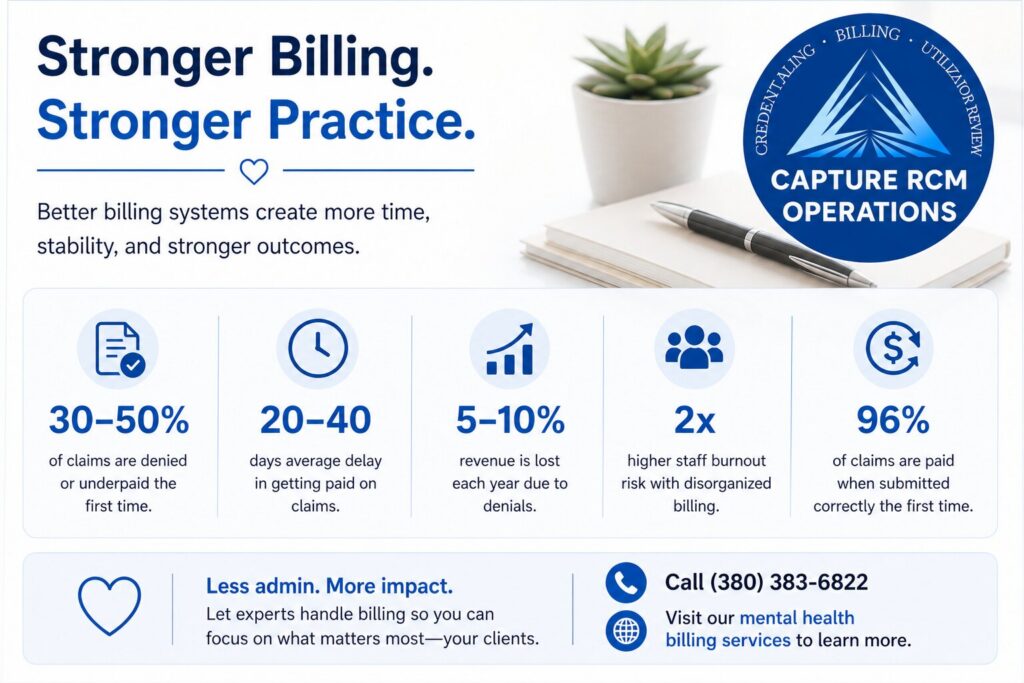
For behavioral health organizations, billing errors can create delayed reimbursements, denied claims, compliance exposure, and staff burnout. Small inefficiencies repeated across dozens or hundreds of claims each month can quietly cost practices thousands of dollars annually.
Why Behavioral Health Billing Is More Complex Than Many Owners Expect
Mental health billing is different from standard medical billing in several important ways. Insurance requirements often change frequently, authorization rules vary by payer, and documentation standards are heavily scrutinized.
Behavioral health providers also deal with:
- Time-based CPT coding
- Telehealth billing changes
- Prior authorization requirements
- Multi-session treatment structures
- Coordination between therapists, psychiatrists, and group services
- Frequent payer policy updates
Small practices frequently try to manage all of this with a very lean administrative team. In some cases, one employee handles scheduling, insurance verification, patient intake, claims submission, and collections simultaneously.
That approach may work temporarily, but growth exposes weaknesses quickly.
According to industry reporting from organizations like MGMA and HFMA, denied claims remain one of the largest preventable sources of lost healthcare revenue. Even a modest increase in denial rates can create serious cash flow issues for smaller behavioral health organizations.
The Hidden Cost of In-House Billing
Many practice owners initially prefer in-house billing because it feels more controllable. There is direct oversight, internal communication may seem easier, and owners often believe it reduces expenses.
However, the true cost of internal billing goes far beyond payroll.
Common Internal Billing Expenses
| Cost Category | Operational Impact |
|---|---|
| Salaries and benefits | Higher fixed overhead |
| Billing software | Monthly operational expense |
| Clearinghouse fees | Recurring transaction costs |
| Staff training | Time and compliance burden |
| Employee turnover | Revenue disruption |
| Claim follow-up | Labor-intensive collections process |
| Compliance updates | Increased administrative strain |
For example, replacing a billing employee is rarely immediate. During staffing transitions, claims may sit unworked for weeks, authorizations may lapse, and accounts receivable can grow quickly.
Small practices are especially vulnerable because they often depend heavily on one or two administrative employees. If those employees leave, collections performance can decline almost immediately.
Build vs Buy: Evaluating Mental Health Billing Services Strategically
The build-versus-buy decision should be approached like any other business investment. Owners need to evaluate operational capacity, growth plans, staffing stability, and long-term financial goals.
Situations Where In-House Billing May Work Well
An internal billing model may make sense if:
- Claim volume is stable and manageable
- The practice has experienced billing leadership
- Staff turnover is low
- Reporting systems are already strong
- Owners want maximum operational oversight
- Revenue cycle processes are highly organized
Some established practices successfully maintain internal billing departments for years. However, those practices usually invest heavily in training, workflow systems, compliance oversight, and reporting infrastructure.
Without those systems, internal billing often becomes reactive rather than strategic.
Situations Where Outsourcing Often Makes More Sense
Outsourced mental health billing services can become valuable when practices experience:
- Rapid patient growth
- Frequent claim denials
- Delayed reimbursements
- Staffing instability
- Credentialing bottlenecks
- Expansion into additional service lines
- Difficulty tracking KPIs
Outsourcing does not eliminate oversight. Instead, it allows owners to shift operational responsibility to specialists whose primary focus is revenue cycle management.
For many small practices, that shift creates more financial visibility and accountability rather than less.
Key Financial Metrics Small Practices Should Monitor
One of the biggest operational mistakes behavioral health practices make is failing to track revenue cycle performance consistently.
Without reporting, owners often do not recognize financial leakage until cash flow problems become severe.
Important Revenue Cycle KPIs
Clean Claim Rate
Measures the percentage of claims accepted on first submission. A low clean claim rate usually indicates workflow or documentation issues.
Days in Accounts Receivable
Tracks how long it takes to collect payments. High AR days often signal payer delays or weak follow-up systems.
Denial Rate
Shows how many claims are rejected or denied. Industry benchmarks vary, but rising denial rates should always trigger operational review.
Net Collection Rate
Measures how much collectible revenue the practice actually receives.
Authorization Accuracy
Critical for higher-acuity behavioral health services like PHP and IOP programs.
Strong billing operations monitor these numbers consistently and use them to improve workflows over time.
Compliance Risks Behavioral Health Practices Cannot Ignore
Behavioral health billing carries significant compliance responsibilities. Payer audits have increased across healthcare, and documentation requirements continue evolving.
Common compliance vulnerabilities include:
- Incorrect modifier usage
- Missing treatment documentation
- Authorization gaps
- Improper telehealth billing
- Inconsistent session coding
- Credentialing errors
Small practices often underestimate how easily these issues can compound.
For example, if documentation standards are inconsistent across providers, claim approvals may initially go through without issue. However, retrospective audits can later result in repayment demands or recoupments.
Professional billing teams often provide another layer of operational protection by helping practices maintain stronger documentation alignment and payer compliance.
Operational Benefits Beyond Revenue Collection
Many practice owners evaluate billing support only through the lens of collections. In reality, operational efficiency may be just as valuable.
Outsourcing can reduce the administrative burden placed on clinicians and office staff. That often improves morale, scheduling consistency, and patient experience.
Areas Often Improved Through Outsourced Billing
- Faster insurance verification
- More consistent claims submission
- Improved denial management
- Reduced provider administrative workload
- Better reporting visibility
- Streamlined payer communication
- More predictable collections timelines
In behavioral health settings, administrative overload can contribute heavily to staff burnout. Reducing operational friction creates benefits that extend well beyond financial performance.
Questions Small Practice Owners Should Ask Before Outsourcing
Not every billing vendor specializes in behavioral health. Some operate as high-volume general medical billing companies with limited understanding of mental health workflows.
Before partnering with a billing provider, owners should evaluate specialization, transparency, and communication standards carefully.
Important Questions to Ask
Do you specialize in behavioral health billing?
Mental health reimbursement structures differ significantly from many other specialties.
How are denials tracked and resolved?
Owners should understand how aggressively claims are followed.
What reporting is included?
Reliable KPI visibility is essential.
Who communicates with insurance companies?
Clarify whether payer follow-up is proactive or reactive.
How do you support credentialing?
Credentialing delays directly affect revenue generation.
What compliance support is provided?
Strong billing partnerships help reduce operational risk.
What technology platforms do you support?
Compatibility with EHR systems matters.
The right billing relationship should function as an operational extension of the practice rather than simply a vendor transaction.
A Practical Framework for the Build vs Buy Decision
Small practices can simplify the evaluation process by assessing five operational categories.
| Category | Internal Billing | Outsourced Billing |
|---|---|---|
| Staffing Dependence | High | Lower |
| Scalability | Limited | Stronger |
| Compliance Monitoring | Internal burden | Shared expertise |
| Reporting Infrastructure | Variable | Often standardized |
| Revenue Stability | Depends on staffing | Usually more consistent |
The decision ultimately depends on operational maturity and growth goals.
Practices preparing to scale often benefit from outsourcing sooner rather than later because it prevents operational bottlenecks from developing during expansion.
How Billing Infrastructure Supports Practice Growth
Growth creates operational complexity quickly in behavioral health.
Adding clinicians means:
- New credentialing requirements
- Additional payer enrollments
- Increased claims volume
- More scheduling coordination
- Expanded compliance oversight
Without strong billing infrastructure, growth can actually reduce profitability.
A practice may add patients and providers while still struggling with delayed collections and increasing administrative strain.
Professional behavioral health billing services can help practices create systems that support:
- Multi-provider expansion
- Faster onboarding
- Better forecasting
- Revenue tracking
- Denial reduction
- Operational scalability
That stability gives owners more time to focus on patient care, hiring, and strategic planning rather than constant revenue troubleshooting.
FAQ: Mental Health Billing Services for Small Practices
What are mental health billing services?
Mental health billing services manage the administrative and financial processes involved in submitting insurance claims, tracking reimbursements, handling denials, and maintaining compliance for behavioral health providers.
Is outsourcing billing more cost-effective for small practices?
In many cases, yes. Outsourcing can reduce staffing overhead, improve collections, and lower the operational disruption caused by employee turnover or claim backlogs.
How do billing companies help reduce claim denials?
Specialized billing teams review coding accuracy, authorization requirements, documentation standards, and payer rules before claims are submitted. They also follow up aggressively on denied or delayed claims.
Can outsourced billing improve cash flow?
Yes. Faster claims submission and more consistent follow-up often reduce accounts receivable aging and improve reimbursement timelines.
What should a small practice look for in a billing partner?
Behavioral health specialization, transparent reporting, compliance experience, denial management processes, credentialing support, and strong communication standards are all important.
Do mental health billing services help with credentialing?
Many billing providers also support provider credentialing and payer enrollment processes, helping practices reduce delays when onboarding clinicians.
Is outsourcing billing secure and HIPAA compliant?
Reputable billing companies use HIPAA-compliant systems and workflows to protect patient information and maintain regulatory compliance.
How long does it take to transition to outsourced billing?
Transition timelines vary depending on practice size and existing systems. Many small practices complete onboarding within several weeks when workflows and documentation are organized.
Building a Stronger Revenue Cycle for Long-Term Growth
Small behavioral health practices operate in an increasingly complex reimbursement environment. What works operationally during early growth stages may no longer support long-term stability.
Evaluating mental health billing services strategically allows practice owners to make decisions based on scalability, operational efficiency, compliance protection, and financial predictability.
The right billing infrastructure does more than process claims. It supports sustainable growth, reduces administrative strain, and helps practices build stronger financial foundations over time.
Call (380) 383-6822 or explore our mental health billing services to learn more about our mental health billing services in your area.