
Introduction: For ABA Practice Owners, Time Is Money
As ABA practices scale into insurance-based care, operational choices get more complex—and more expensive. One of the first major pivots is deciding how to handle credentialing.
Do you build an in-house team from scratch? Or partner with an outside credentialing service?
There’s no universal right answer—but there is a smart answer for your specific stage of growth.
In this post, we’ll explore the true cost-benefit of both models, so you can invest your time and money where it makes the biggest impact.
1. Credentialing Isn’t Just a Task—It’s an Ongoing Process
Let’s start by naming what credentialing actually involves—because many practice owners underestimate how much is packed into this process.
Credentialing includes:
- Initial payer enrollment (per provider, per payer)
- CAQH attestation and maintenance
- State license verification
- NPI registration and updates
- Re-credentialing every 2–3 years per payer
- Panel management, including closed panels and payer communications
- Appeals and re-submissions when delays or denials happen
For ABA practices in growth mode, credentialing is rarely a “one-and-done” situation. It’s a living workflow tied to every new hire and every payer you accept.
2. The Appeal—and Cost—of In-House Credentialing
Some ABA owners instinctively default to hiring for credentialing. It feels safer: more control, real-time access, and the chance to integrate it into the broader admin team.
But here’s what it often entails:
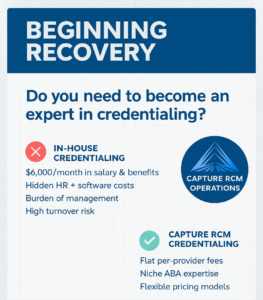
❌ Salary + Hidden Costs
A full-time credentialing coordinator can cost $55,000–$75,000 annually once you factor in benefits, PTO, and taxes.
You’ll also need to invest in credentialing software, training time, and administrative oversight.
❌ Management Burden
Unless you have a fully staffed billing and HR team, this hire likely reports directly to you. That means your time is still tied up in credentialing—whether you realize it or not.
❌ Risk of Turnover
Credentialing isn’t flashy work. It’s detail-heavy and deadline-driven. If your new hire quits, you’re starting over mid-process—and so are your reimbursements.
❌ Lack of Specialized Payer Knowledge
Even experienced hires may not know the ins and outs of state-specific Medicaid or BCBS policies. And in credentialing, a missed detail can delay months of payments.
That said, if your practice is large, stable, and committed to building an internal revenue cycle team, in-house might still make sense—just budget for redundancy and backup coverage.
3. The Case for Outsourcing: Built-In Expertise, Reduced Risk
Outsourced credentialing often comes with its own list of fears: loss of control, unreliable vendors, or impersonal service. But when done right, it can actually reduce your risk and administrative burden.
At Capture RCM Operations, credentialing is handled by ABA-specialized experts who manage:
- Provider onboarding across all major payers
- Real-time tracking of credentialing status
- Issue resolution with payers (without you chasing them)
- Re-credentialing timelines, tracked and completed on schedule
And because they work nationally, they’ve already solved for payer delays and credentialing blockers across different states.
✅ Fixed Pricing, Flexible Support
Capture RCM uses transparent pricing—flat per-provider fees or subscription models that scale with your practice. No salary guesswork, no benefit packages, no HR overhead.
✅ Faster Reimbursement, Shorter Delays
Delays in credentialing mean lost income. Outsourced services speed up enrollment, so your new hires can start billing weeks—or even months—faster.
✅ Specialized ABA Insight
Unlike generic credentialing vendors, Capture RCM focuses specifically on ABA. That means less explaining, fewer missteps, and better alignment with payers who have strict documentation rules for behavioral health.
4. Cost Comparison: In-House vs. Capture RCM
Let’s break it down with a simple model based on a practice onboarding three new BCBAs this quarter.
| Category | In-House Credentialing | Capture RCM Credentialing |
|---|---|---|
| Monthly Cost | ~$6,000 (salary + benefits) | Flat per-provider rate |
| Onboarding Time per Provider | 60–90 days (avg) | 30–45 days (avg with Capture) |
| Risk of Billing Delay | High if errors occur | Low due to payer expertise |
| Time You Spend Managing It | 8–12 hours/week | 1–2 hours/week |
| Flexibility as You Grow | Hire more staff | Add providers without hiring |
While the price tag might look similar at first glance, outsourced credentialing often wins in hidden savings—especially time and speed to revenue.
5. Still Deciding? Ask These Questions First.
If you’re still torn between in-house and outsourcing, walk through these reflection points:
- Do you want to become an expert in credentialing?
If not, outsourcing might give you peace of mind. - How fast are you scaling?
Faster growth = more credentialing = higher complexity. That often tips the scale toward outsourcing. - Can you afford to delay revenue?
If every month counts toward sustainability, speed matters. - Are you already managing multiple admin tasks?
Credentialing might not be where your energy makes the most impact. - Do you know how to evaluate credentialing performance?
If not, choosing a partner with proven ABA experience can eliminate the learning curve.
Ready to Take Credentialing Off Your Plate?
Whether you’re onboarding your third provider or your thirtieth, credentialing should never be the bottleneck that slows your revenue or stresses your team.
Capture RCM Operations supports ABA practices across the U.S. with credentialing services designed for insurance-based growth. No guesswork. No delays. Just expert execution that lets you focus on what matters most—your clients.
Explore our Credentialing Services Or call (380) 383-6822 to talk to a credentialing expert today.
Credentialing FAQs for ABA Practice Owners
What happens if I get credentialing wrong?
Credentialing mistakes can delay billing by weeks—or worse, cause retroactive claim denials. In some cases, you may not be reimbursed at all for services rendered during a lapse.
Can I outsource credentialing temporarily?
Yes. Many practices outsource during high-growth phases or transitions, then bring it in-house later once stable. Others outsource permanently to minimize operational overhead.
Is credentialing the same as contracting with payers?
They’re related, but not identical. Credentialing verifies provider qualifications. Contracting sets payment terms. Both are needed before billing insurance.
How long does credentialing take?
It depends on the payer. Some commercial plans approve within 30–45 days, while Medicaid panels can take 60–120 days. Capture RCM works to shorten this wherever possible.
What makes ABA credentialing different from general medical?
Payers often have specific documentation requirements, license types, and supervision rules unique to ABA. Working with a credentialing team that understands these nuances can prevent costly errors.