
In 2026, clinical directors in behavioral health are facing a dramatically different compliance landscape than they were just a few years ago. Payer audits are more frequent. Documentation requirements are more rigid. Denials tied to insufficient medical necessity are climbing. Even well-structured programs are seeing treatment extensions questioned—and services flagged for retroactive review.
In this high-scrutiny environment, clinical directors are increasingly turning to utilization review services as a strategic solution—not just to manage prior authorizations, but to build defensible systems that align clinical care with reimbursement rules.
Whether you operate a PHP, IOP, or high-volume outpatient program, the pressure is rising. Clinical leaders must now ask: Is our current documentation model strong enough to withstand external review—and do we have the internal infrastructure to prove it?
Compliance Expectations Are Higher Than Ever
Payers are no longer content with minimal documentation or simple progress updates. Today, they expect clinical teams to provide:
- Justification for level of care
- Evidence of progress tied to specific goals
- Risk documentation that meets criteria
- Clear rationale for continued treatment
And they’re asking for it before, during, and after the course of care.
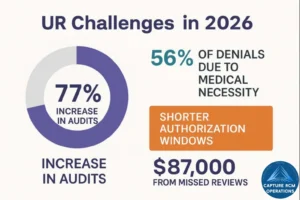
2025 brought a wave of new utilization management protocols from national and regional payers. In 2026, most large insurers have doubled down on concurrent reviews, with shorter authorization windows and new language expectations in continued stay requests.
What that means for clinical directors: even one vague note or delayed review can cost your organization thousands in denied claims—or worse, raise red flags during an audit.
Utilization Review Services Create a Protective Layer Around Clinical Care
Utilization review (UR) is the structured submission of treatment information to payers to verify that services meet medical necessity. Done well, it allows care to continue seamlessly while meeting every requirement of a payer’s policy.
UR services support clinical teams by:
- Tracking review schedules for each client
- Submitting timely initial and continued stay reviews
- Ensuring that documentation matches payer-specific criteria
- Drafting appeals for denied authorizations
- Communicating directly with insurance reviewers
In small or mid-sized behavioral health organizations, these tasks are often fragmented—some assigned to clinicians, some to billing staff, and some left unowned. That fragmentation is a liability.
Partnering with a dedicated UR team brings accountability, expertise, and audit-readiness to what would otherwise be an error-prone manual process.
Real-World Impact: Missed Reviews, Denied Care, Lost Revenue
Even highly effective clinical teams face disruptions when UR isn’t handled correctly. Consider the following example:
Case Insight:
A multi-location outpatient provider offering IOP in two states faced a pattern of missed continued stay reviews due to staff turnover. Over a three-month period, 17 clients received services without valid authorization. Despite delivering quality care, the practice lost over $87,000 in denied claims and had to submit a corrective action plan to remain in-network with a major commercial payer.
None of this was tied to poor clinical work. The issue was structural: they lacked a system to track, submit, and respond to UR requests.
Now, they work with a third-party UR partner who:
- Maintains a schedule of reviews for every client
- Ensures documentation includes necessary language
- Submits reviews 48–72 hours before deadlines
- Logs outcomes and trends for executive review
The result? Their denial rate dropped by 46% and their compliance audit passed without citations.
What Clinical Directors Should Expect from a Professional UR Partner
If you’re evaluating whether to build internal UR infrastructure or work with a utilization review provider, use these quality markers:
1. Behavioral Health Specialization
UR in mental health and substance use treatment is different from medical UR. Your partner should be fluent in ASAM, LOCUS, and payer-specific behavioral health protocols.
2. Timeliness and Tracking
The team should provide a live tracking system or portal showing every client’s authorization status, review window, and remaining units.
3. Documentation Alignment
UR reviewers should guide your clinicians on the phrasing, structure, and specificity required to secure approvals—without rewriting notes or interfering in clinical decision-making.
4. Direct Payer Contact
Your UR service should manage phone calls, requests for additional info, and reviewer queries directly—so your team isn’t pulled into payer conversations that delay care.
5. Denial Management
When reviews are denied, a strong partner doesn’t just flag it. They write the appeal, send it to the appropriate contact, and loop in clinical leadership only when necessary.
Capture RCM’s Utilization Review Services are purpose-built for behavioral health providers who need compliant, scalable UR support without adding administrative overhead to clinical teams.
Operational Benefits Extend Beyond Compliance
UR services don’t just reduce denials. They create tangible efficiency gains and reduce stress for clinical teams.
Key operational benefits:
- Less clinician burnout
Clinicians focus on care, not submitting forms or chasing authorizations. - Stronger payer relationships
Reviews are submitted in the format and timeline payers prefer, improving trust and speed. - Smarter resource planning
UR data helps identify clients likely to step down soon, assisting in staffing and admissions planning. - Better documentation quality
As feedback loops improve, clinicians naturally improve how they document progress and risk.
Embedding UR in Your Clinical Culture
One mistake clinical leaders make is outsourcing UR completely and keeping it disconnected from clinical teams. While separation of duties is helpful, documentation and UR must stay aligned.
Here’s how to build a collaborative UR culture:
- Train clinicians during onboarding on how their documentation affects UR outcomes.
- Use clinical templates that include phrasing prompts for risk, progress, and barriers.
- Review denial reports quarterly and share trends across teams.
- Celebrate approval improvements as part of clinical performance—not just billing wins.
UR success is a shared outcome. When providers feel informed—not micromanaged—documentation and compliance both improve.
Retrospective Audits Are on the Rise—Is Your Team Ready?
One of the most significant payer shifts in 2026 is the increase in retrospective audits. These reviews allow payers to revisit previously approved and paid services to determine whether they still meet the criteria for reimbursement.
A weak UR process leaves you exposed to:
- Recoupment demands
- Corrective action plans
- Loss of in-network contracts
Strong UR services create a documented trail of approvals, aligned with clinical records, and submitted within required timelines. This documentation becomes a shield during audits—protecting both your license and your bottom line.
Frequently Asked Questions
What’s the difference between utilization review and utilization management?
Utilization review refers specifically to the review process of treatment authorizations—initial and continued stay. Utilization management is broader, encompassing internal strategies to ensure appropriate, cost-effective care. UR is often a function within utilization management.
Do UR services replace clinical judgment?
No. UR teams do not direct care. They translate clinical decisions into the format payers require. The goal is to get approvals based on services already deemed necessary by your team—not to change treatment plans.
How much time does it take to train clinicians on UR expectations?
With the right support, most clinicians can integrate payer-aligned documentation into their workflow within 1–2 weeks. Templates and quick-reference guides help significantly. Capture RCM offers clinician-focused documentation training as part of our UR service onboarding.
What types of payers require utilization review?
Most commercial insurers and Medicaid managed care plans require UR for higher levels of care, such as PHP and IOP. Some now require it for extended outpatient therapy, particularly after 20+ sessions.
How do UR services get paid?
UR services are typically billed as part of a flat-rate RCM package or per-review model. In either structure, the ROI is measurable—lower denial rates, faster approvals, and fewer administrative burdens on your clinical team.
Clinical Leadership Needs Operational Support
As a clinical director, you’re responsible for protecting both the quality of care and the systems that support it. In 2026, those systems must include structured utilization review workflows that match payer scrutiny—and proactively prevent revenue loss.
Call (380) 383-6822 or visit Capture RCM’s Utilization Review Services to see how our behavioral health UR experts support clinical compliance, reduce denials, and prepare your team for the next wave of payer expectations.