
When claim denials pile up, the issue often isn’t billing—it’s the gap between clinical documentation and payer expectations. That’s where utilization review (UR) services come in. For billing managers at behavioral health facilities, understanding and optimizing the UR timeline is critical to safeguarding revenue.
Done correctly, utilization review services do more than check boxes—they act as a revenue assurance system that supports compliance, reimbursement, and operational efficiency.
What Is Utilization Review, and Why Is It So Important?
Utilization review is a structured, payer-facing process that demonstrates medical necessity for the level of care being provided. It ensures that treatment decisions meet payer criteria and that services will be reimbursed.
Without timely and accurate UR submissions, even clinically appropriate treatment can be denied.
Key functions of UR services include:
- Verifying level-of-care requirements
- Submitting initial and continued stay reviews
- Coordinating with providers and payers to document medical necessity
- Tracking payer responses and approvals
Stat to Know:
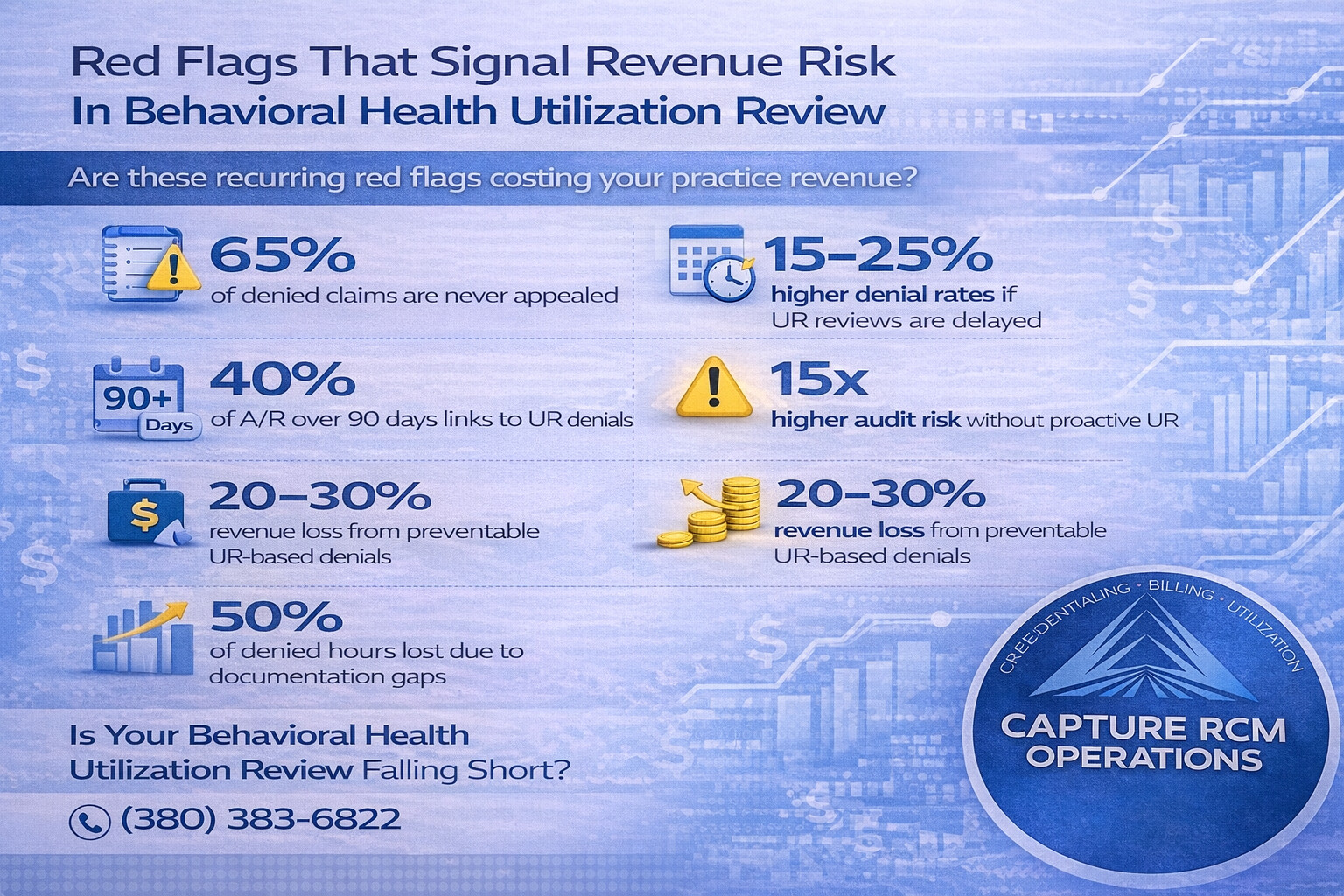
Over 20% of behavioral health claim denials are directly related to missing or delayed UR documentation.
Step 1: The Admission Phase – Setting the Stage for Reimbursement
The utilization review process begins before the patient ever receives care. UR teams must work in parallel with admissions and clinical staff to lay the groundwork for approval.
Core Actions at Admission:
- Confirm insurance benefits and authorization requirements
- Determine whether pre-authorization is needed for the first day of care
- Align documentation with payer-specific medical necessity criteria (e.g., ASAM, InterQual)
- Gather comprehensive intake notes from clinicians
This front-loaded work prevents one of the most common errors in behavioral health billing: starting treatment without payer authorization.
Step 2: Initial Reviews – Your First Opportunity to Secure Coverage
Most payers require an initial clinical review to be submitted within 24–72 hours of admission. This is your first—and sometimes only—chance to demonstrate why the client qualifies for that level of care.
Key Elements of a Strong Initial Review:
- Presenting symptoms and diagnoses
- Risk factors (e.g., suicide ideation, medical instability, legal risk)
- Level of care rationale (why PHP, IOP, etc.)
- Current medications and lab results (when applicable)
- Expected course of treatment
Tip:
Standardize your initial reviews using payer-specific templates and ensure all documentation uses language that maps to that payer’s criteria.
Step 3: Continued Stay Reviews – Where Most Denials Happen
Continued stay reviews are typically due every 3–7 days, depending on the level of care and the insurance company. These reviews are where clinical documentation and UR workflows often break down.
Why Do Denials Happen Here?
- The review is submitted late (or not at all)
- It lacks updated clinical information
- It fails to demonstrate ongoing medical necessity
- The documentation doesn’t match provider notes
Best Practice:
Create an internal calendar with payer deadlines for each active client. Assign responsibility for review prep, provider sign-off, and submission tracking to ensure nothing falls through.
Step 4: UR-to-Billing Alignment – The Revenue Protection Step Most Facilities Skip
It’s not enough for UR to be accurate. It has to align with billing and claims.
Critical Touchpoints to Synchronize:
- UR approvals must match the dates of service being billed
- Denials should be reported to billing staff immediately
- Appeal rights must be logged and acted upon within payer timelines
- Approved days must be reconciled before claims are submitted
Missed Opportunity Alert:
A UR team may secure an approval, but if billing doesn’t reconcile it correctly—or submits the wrong DOS (Date of Service)—payment can still be delayed or denied.
Step 5: Partnering with a UR Services Provider – What to Look For
Outsourcing utilization review is increasingly common, but not all vendors are built for behavioral health. Look for a partner who:
- Specializes in behavioral and mental health payer protocols
- Offers real-time UR tracking and reporting
- Guarantees fast turnaround (24–48 hours)
- Coordinates directly with both clinical and billing teams
- Supports appeals and retro authorizations
Capture RCM’s utilization review services are designed with billing managers in mind—delivering documentation, compliance, and peace of mind across every step of the revenue cycle.
UR Workflow Checklist for Billing Managers
Use this practical checklist to identify and close gaps in your utilization review workflow:
At Admission
- ✅ Verify insurance and required UR protocols
- ✅ Flag if initial auth is needed pre-treatment
- ✅ Collect clinical documentation that supports medical necessity
Within 24–72 Hours
- ✅ Submit initial review with payer-specific criteria
- ✅ Log due date for first continued stay review
Weekly or Per Payer Cycle
- ✅ Submit continued stay reviews on time
- ✅ Confirm that documentation reflects patient’s current condition
- ✅ Update payer approvals in billing system
Ongoing
- ✅ Sync UR data with billing claims
- ✅ Track denials and appeal timelines
- ✅ Review missed approvals monthly to identify process gaps
Frequently Asked Questions About Utilization Review Services
What’s the difference between UR and medical billing?
UR is the clinical documentation process that justifies care to the payer. Billing is the financial process of coding and submitting claims. The two must align, but they serve different functions.
What happens if a continued stay review is submitted late?
In most cases, the payer will deny coverage for days that lacked timely review. This leads to partial denials or complete payment loss—even if care was appropriate.
Can UR services help us recover revenue from past denials?
Yes. A qualified UR team can conduct retroactive reviews and support appeals, especially for payers that allow retro-auths within a certain window (often 30–90 days).
Who should be responsible for UR in our organization?
Ideally, a dedicated UR specialist or external vendor. While clinical teams provide documentation, UR requires payer-specific knowledge, deadlines, and formatting that clinicians aren’t typically trained for.
How do UR services reduce administrative burden?
By taking ownership of review scheduling, documentation, submission, and appeals, UR services free your in-house team to focus on billing, collections, and client-facing work.
Strengthen Your Revenue Cycle with Proactive UR Services
Utilization review isn’t just a clinical task—it’s a strategic tool to improve reimbursement, reduce denials, and protect your revenue cycle. When your UR timeline is airtight and aligned with billing, you gain control over cash flow, compliance, and payer relationships.
📞 Call (380) 383-6822 or visit our Utilization Review Services page to find out how Capture RCM can streamline your UR process—and help your billing department breathe easier.