
Aging A/R isn’t just a billing headache—it’s a signal that something upstream in your revenue cycle is broken. For Billing Directors in behavioral health, utilization review services represent a strategic lever to correct course.
From reducing payer denials to improving appeal success rates, utilization review (UR) can protect your reimbursement pipeline at multiple points. In this guide, we break down what UR means in practice, how to evaluate your current gaps, and how to integrate utilization review into your billing workflow for faster collections and healthier cash flow.
For deeper integration support, visit our Utilization Review Services page.
What Are Utilization Review Services in Behavioral Health?
Utilization review services involve real-time, ongoing assessment of a patient’s care to determine if it meets payer requirements for medical necessity. In behavioral health settings—especially PHP, IOP, and ABA programs—this function is critical.
Effective UR services:
- Evaluate treatment plans against medical necessity criteria (e.g., InterQual, ASAM)
- Communicate directly with payers for authorization and continued stay
- Flag documentation gaps before claims are submitted
- Provide summaries that strengthen reimbursement and appeal packets
In short: UR sits at the intersection of clinical care and payer compliance. And for billing leaders, that means UR is an upstream safeguard against denial-driven delays.
Step 1: Audit Where Denials Are Costing You
Every Billing Director should be tracking denial reasons, especially if you manage high-acuity or multi-level care programs. Common denial categories that point to UR issues include:
- “Lack of medical necessity”
- “Clinical documentation insufficient”
- “Level of care not supported”
- “Prior authorization not obtained or invalid”
Even a small uptick in these denials can snowball into days in A/R spikes, increased write-offs, and provider frustration.
Step 2: Tighten the Link Between UR and Billing
Too often, UR is siloed within clinical or compliance teams. That’s a missed opportunity. Instead, build structured feedback loops between UR reviewers and billing teams.
UR ↔ Billing Integration Points:
- Daily or weekly UR summaries sent to billing for pre-checks
- Standardized templates for documenting medical necessity
- Shared appeals support tools between UR and A/R follow-up staff
By connecting the clinical justification process to the billing cycle, you increase clean claim rates and reduce revenue leakage.
Step 3: Treat UR Data as a Revenue Defense Strategy
A robust UR program doesn’t just say “yes” or “no” to treatment plans—it produces documentation that defends your claim.
Strong UR documentation:
- Matches payer-specific language
- Justifies frequency and duration of treatment
- Links diagnosis, symptoms, and response to care
This data becomes invaluable when denials arise and you need to appeal quickly and with confidence.
Quick Tips for Maximizing UR in Appeals
- Save all UR reviewer notes alongside patient files
- Pull payer-specific guidelines for each level of care
- Pre-draft appeal language using UR justifications
Step 4: Choose a UR Partner With Behavioral Health Focus
Generalist UR services often miss key nuances of behavioral health documentation and payer behavior. For example:
- ABA therapy requires progress tracking that maps to specific CPT codes.
- PHP/IOP levels have strict daily documentation standards.
- Mental health residential stays are often capped and need strong continued-stay rationales.
Capture RCM specializes in UR for behavioral health, ensuring that reviews match both clinical intent and payer expectations.
Learn more on our Utilization Review Services page.
Step 5: Monitor KPIs That Link UR to Collections Performance
To justify investment in UR services, Billing Directors should track outcomes that connect UR quality with revenue results:
| KPI | UR Impact |
|---|---|
| Denial Rate (Medical Necessity) | Should decrease over time with UR alignment |
| First-Pass Resolution Rate | Should increase as clean claim volume rises |
| Average Days in A/R | Should drop as rework and appeal volume shrink |
| Reimbursement Rate | Should improve on services previously underpaid due to lack of justification |
Step 6: Use UR to Train Clinical Teams Upstream
A good UR process doesn’t just fix documentation—it teaches clinicians how to improve it. Consider scheduling feedback loops where UR findings are:
- Shared in team meetings
- Used to refine EHR templates
- Embedded into intake and discharge protocols
This creates a self-healing system where documentation improves before it becomes a claim problem.
Step 7: Don’t Wait for Denials—Be Proactive
Utilization review is most effective before a claim is submitted. If you’re relying on post-denial appeals to recover revenue, you’re fighting from behind.
Proactive UR systems:
- Conduct reviews in real-time or near-real-time
- Align services with payer requirements from day one
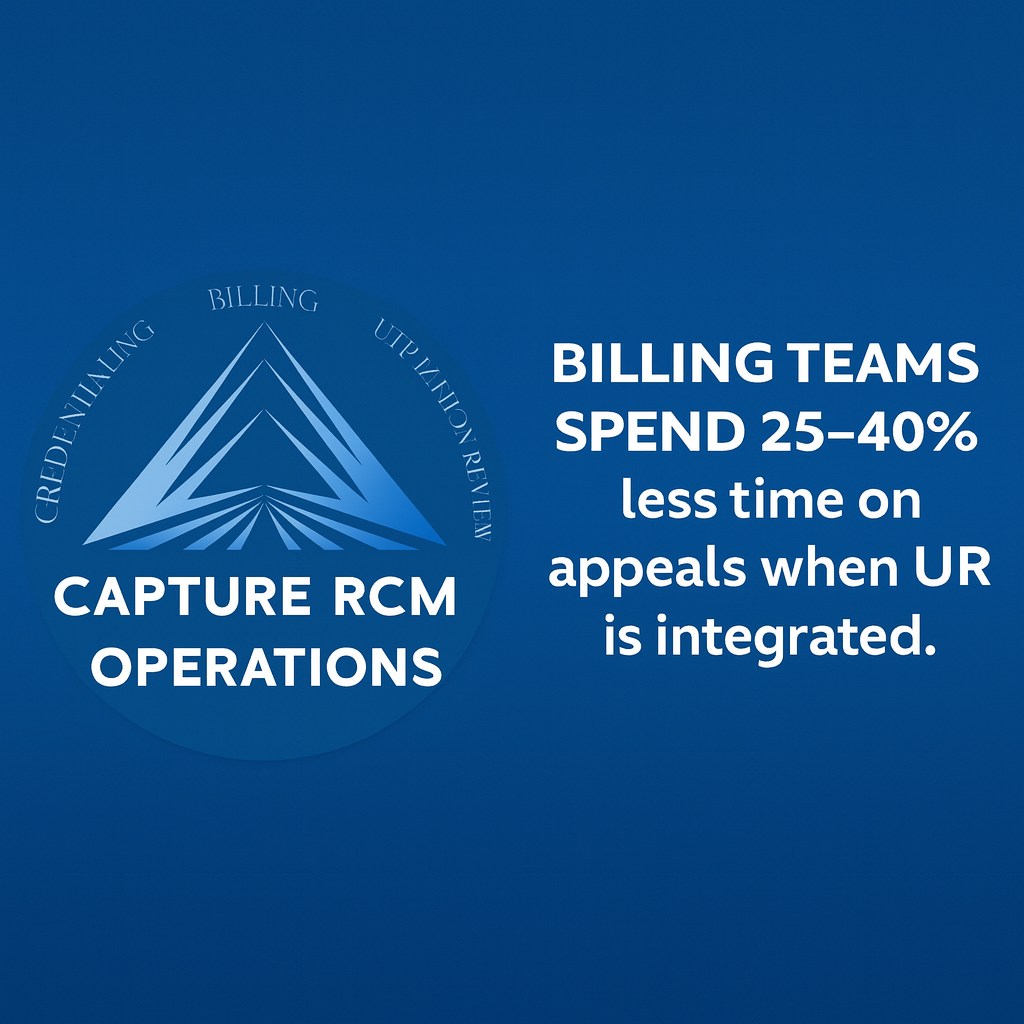
- Reduce appeal costs and delays
Capture RCM’s UR services are built for proactive impact—ensuring your billing team spends more time submitting clean claims, and less time chasing lost revenue.
FAQ: Utilization Review for Behavioral Health Billing
What makes UR different in behavioral health?
Behavioral health payers scrutinize documentation differently than medical payers. Many require:
- Detailed symptom tracking
- Response-to-treatment notes
- ASAM or InterQual alignment for continued stay
UR services translate these clinical details into payer-approved language.
Do I need UR for outpatient services like IOP?
Yes—especially for levels of care like IOP, where documentation gaps often lead to underpayment or denial. UR ensures that the clinical rationale for intensive services is consistently documented and defendable.
Can UR services help reduce staff workload?
Absolutely. A structured UR partner handles payer communication, organizes documentation, and reduces the number of appeals billing staff have to write. That saves time—and payroll costs.
How quickly can I expect to see ROI?
Many practices see a measurable drop in denials and days in A/R within 60–90 days of integrating utilization review. ROI also comes from fewer write-offs and faster collections.
What’s the difference between internal vs outsourced UR?
Internal UR requires trained clinical staff, ongoing payer education, and resource-heavy coordination. Outsourced UR (like Capture RCM’s service) provides:
- Payer-savvy reviewers
- Real-time documentation analysis
- Seamless integration with billing
That’s coverage without overburdening your team.
Final Takeaway
If you’re a Billing Director dealing with aging A/R, it’s time to elevate utilization review to a front-line strategy. It’s not just about meeting payer requirements—it’s about creating clean, defensible claims that get paid fast.
Whether you need to reduce denials, improve documentation, or tighten your appeals game, Capture RCM’s Utilization Review Services are designed to support your full revenue cycle.
Ready to Reduce A/R Delays?
Let’s turn your UR process into a billing advantage.
Call (380) 383-6822 or visit Capture RCM Utilization Review Services to explore how we help behavioral health billing teams improve collections, compliance, and cash flow.