
Introduction
For many small practice owners, managing billing internally starts as a practical decision. In the early stages of a mental health practice, a small team—or even the provider themselves—may handle claims, insurance verification, and patient billing. However, as the practice grows, billing complexity increases quickly.
Insurance requirements, payer rules, and documentation standards change frequently in behavioral health. What once felt manageable can become a time-consuming administrative burden that distracts from patient care and limits practice growth.
This is why many practice owners begin evaluating services, billing, mental health providers to determine whether outsourcing revenue cycle management makes financial and operational sense. A specialized billing partner can help improve collections, reduce claim denials, and free up valuable clinical time.
If you’re exploring your options, reviewing professional mental health billing services early in the process can provide a helpful benchmark for what a high-performing billing partner should deliver.
This guide outlines how to evaluate billing services strategically so you can choose the right partner for your practice.
Understand the Real Cost of In-House Billing
One of the biggest misconceptions among practice owners is that internal billing is “cheaper” because it avoids vendor fees. In reality, the cost of in-house billing is often much higher than expected.
Internal billing typically requires:
- Billing staff salaries and benefits
- Clearinghouse and billing software subscriptions
- Staff training and certification
- Insurance follow-up and denial management
- Compliance monitoring and documentation review
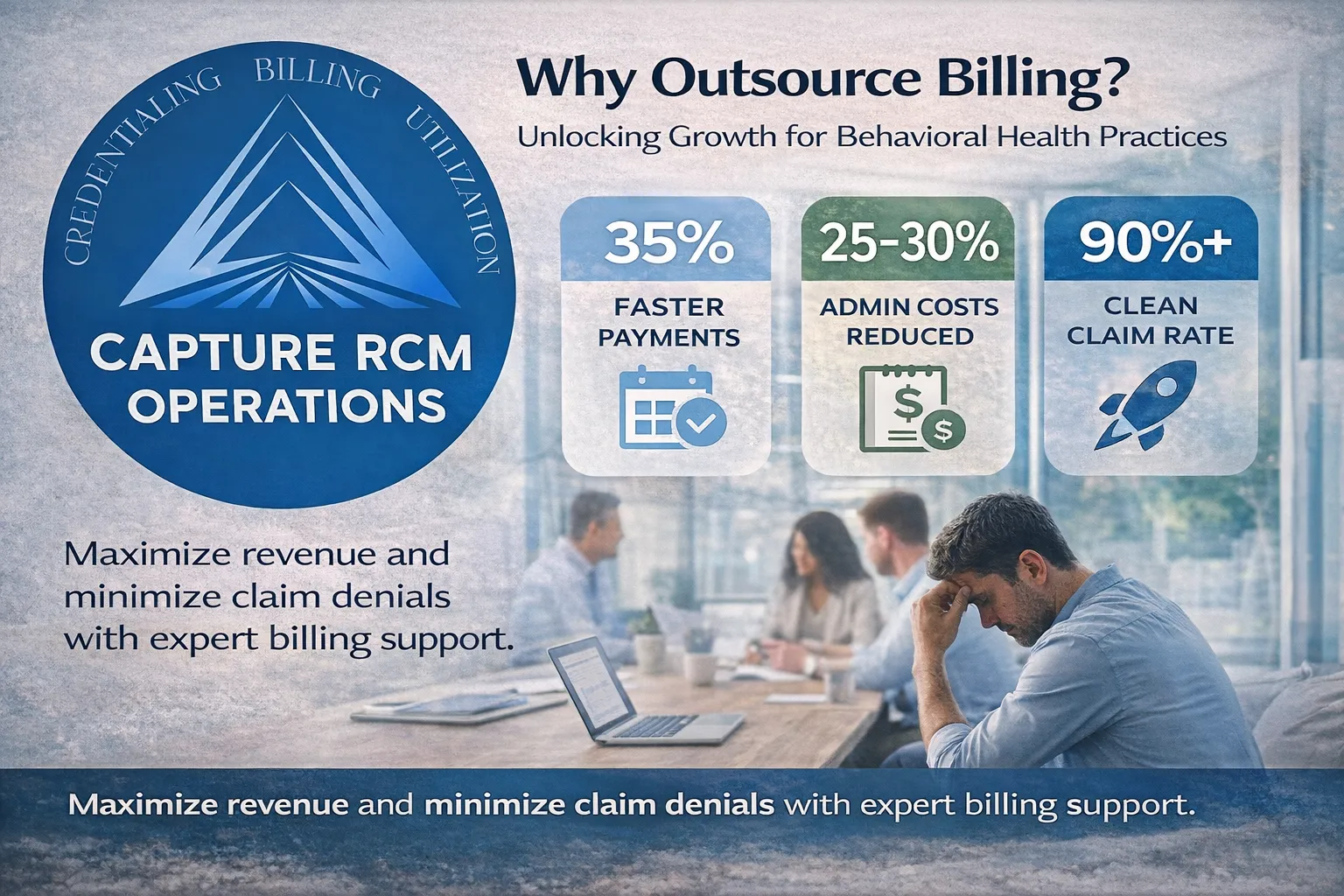
According to the Medical Group Management Association (MGMA), administrative costs in medical practices can consume 25–30% of total revenue, and billing functions represent a large portion of that overhead.
Staff turnover also adds hidden expenses. When a billing specialist leaves, the practice must recruit, hire, and train a replacement. During that transition, claim processing often slows down, which directly impacts cash flow.
Outsourcing billing can convert these unpredictable operational costs into a more stable, performance-based expense. Many practices also recover revenue that was previously lost due to billing errors or missed claims.
For practice owners, the key comparison isn’t just “staff salary vs vendor fee.” The real question is: Which approach produces better revenue performance and fewer administrative disruptions?
Look for Behavioral Health Billing Expertise
Mental health billing differs significantly from general medical billing.
Practices dealing with therapy, psychiatric services, and behavioral health programs face unique challenges such as:
- Session-based CPT coding
- Time-based therapy billing
- Frequent authorization requirements
- Telehealth compliance regulations
- Complex documentation standards
A billing company that focuses primarily on primary care or hospital billing may not fully understand the nuances of behavioral health reimbursement.
When evaluating vendors, ask whether they specialize in mental health billing services. A specialized partner should demonstrate experience with:
- Psychotherapy CPT codes (90834, 90837, etc.)
- Medication management billing
- Teletherapy reimbursement rules
- Group therapy billing
- Insurance authorization workflows
Experienced behavioral health billing teams often reduce claim denials because they understand how insurers review mental health claims.
For small practices, this specialization can significantly improve reimbursement accuracy and speed.
Evaluate Technology and Billing Infrastructure
Modern billing operations rely heavily on technology. The systems used by your billing partner can directly influence revenue performance and administrative efficiency.
A professional billing provider should offer technology capabilities such as:
- Automated eligibility verification
- Electronic claim submission
- Real-time claim tracking
- Insurance payer integration
- Denial management dashboards
- Financial performance reporting
Practices using automated billing workflows often experience 10–15% faster reimbursement cycles compared to manual billing processes.
Technology integration is also critical. The billing service should be able to work smoothly with your electronic health record (EHR) and practice management system.
Before selecting a vendor, ask questions such as:
- Which EHR systems do you integrate with?
- Do you provide real-time reporting dashboards?
- How are denied claims tracked and resolved?
Clear visibility into financial performance allows practice owners to stay informed without managing billing tasks directly.
Review Compliance and Regulatory Protections
Billing errors can lead to compliance risks, payer audits, and financial penalties. Behavioral health practices must follow strict documentation and billing guidelines to ensure proper reimbursement.
When evaluating billing vendors, compliance should be a major consideration.
A reliable billing partner should provide:
- HIPAA-compliant data management
- Secure patient information handling
- Insurance verification procedures
- Authorization tracking systems
- Documentation compliance checks
Mental health billing also requires adherence to payer-specific rules regarding session length, telehealth modifiers, and medical necessity documentation.
A qualified billing provider should demonstrate strong processes for identifying potential compliance risks before claims are submitted.
For example, some billing services conduct pre-submission claim reviews to ensure documentation and coding meet insurer requirements.
This proactive approach helps prevent claim denials and reduces the likelihood of audits.
Measure Performance Using Key Revenue Metrics
When comparing billing vendors, objective performance metrics are essential.
Professional billing services should track and report key revenue cycle indicators such as:
- Clean claim rate
- Average days in accounts receivable (A/R)
- First-pass claim resolution rate
- Denial rate and recovery rate
- Net collection percentage
In high-performing behavioral health practices, a clean claim rate above 95% is generally considered a strong benchmark.
Similarly, the industry target for accounts receivable is typically under 40 days.
When interviewing billing providers, ask how they measure performance and how frequently they report results to clients.
Transparent reporting allows practice owners to verify that billing services are delivering measurable value.
Compare Billing Pricing Models Carefully
Billing companies use several different pricing structures. Understanding these models helps practice owners evaluate the financial impact of outsourcing.
Common billing pricing structures include:
Percentage of Collections
This is the most common model for outsourced billing.
The billing service receives a percentage of collected revenue, typically between 5% and 10% depending on practice size and complexity.
This model aligns incentives because the billing company only earns more when collections increase.
Flat Monthly Fee
Some billing companies charge a fixed monthly fee regardless of revenue volume.
This structure can work for stable practices but may not scale well as the practice grows.
Hybrid Pricing
Hybrid models combine a base monthly fee with performance-based incentives.
These agreements may offer predictable costs while still encouraging strong revenue performance.
When evaluating pricing, practice owners should focus on net revenue improvement, not just service cost. Many practices increase collections enough to offset billing fees entirely.
Assess Communication and Client Support
Billing services become an extension of your practice operations. Communication quality and responsiveness are therefore critical factors.
A strong billing partner should provide:
- Dedicated account management
- Regular financial review meetings
- Fast response to claim questions
- Clear documentation requests
Poor communication can lead to delayed claims, missing documentation, or unresolved denials.
During vendor evaluations, ask how client communication works. Some questions to consider include:
- Will we have a dedicated account manager?
- How quickly are support questions answered?
- How often will financial reports be reviewed?
Consistent communication helps ensure billing operations remain aligned with practice goals.
Consider Scalability for Practice Growth
Billing needs change as a practice grows.
Many small practices eventually expand to include:
- Multiple clinicians
- New payer contracts
- Additional service lines
- Telehealth programs
- Intensive outpatient services
A billing provider should be able to scale with your practice.
For example, a billing partner experienced with behavioral health programs can support practices expanding into services such as group therapy, medication management, or specialized treatment programs.
Without scalable billing support, administrative complexity can slow practice growth.
Choosing a vendor capable of supporting expansion ensures your billing infrastructure remains stable as your practice evolves.
Build a Structured Vendor Evaluation Process
Practice owners often review multiple billing providers before making a decision.
Creating a structured evaluation process can help ensure an objective comparison.
A typical vendor review process may include:
- Requesting vendor proposals
- Reviewing billing workflows and technology
- Comparing performance metrics
- Evaluating pricing models
- Conducting reference checks
Some practices also request a sample financial report to understand how billing performance will be communicated.
Taking a structured approach helps practice owners select a partner based on measurable value rather than marketing promises.
Frequently Asked Questions
How do mental health billing services improve revenue?
Mental health billing services improve revenue by reducing claim denials, improving coding accuracy, and ensuring claims are submitted correctly the first time. Specialized billing teams also follow up on unpaid claims and manage insurance communication more efficiently than most small in-house teams.
Is outsourcing billing better for small practices?
For many small practices, outsourcing billing can improve financial stability and reduce administrative workload. Instead of managing staffing, software, and compliance internally, practice owners can rely on a dedicated billing team focused on revenue cycle performance.
What percentage do billing services typically charge?
Most billing companies charge between 5% and 10% of collected revenue, depending on practice size, service complexity, and claim volume.
How long does it take to transition to a new billing service?
The transition process typically takes 30–60 days. During this period, the billing provider integrates with your EHR system, reviews existing claims, and begins managing new submissions.
What should I ask before hiring a billing service?
Key questions include:
- Do you specialize in mental health billing?
- What performance metrics do you track?
- How do you handle denied claims?
- What reporting tools do you provide?
- How do you ensure compliance with insurance rules?
These questions help ensure the billing partner has the expertise needed to support your practice.
Final Thoughts
Choosing the right services, billing, mental health partner can have a significant impact on the financial health of your practice.
By carefully evaluating vendor expertise, technology, compliance systems, and performance metrics, small practice owners can identify billing partners capable of improving revenue while reducing administrative burden.
Outsourcing billing isn’t simply about delegating tasks—it’s about building a financial infrastructure that supports sustainable growth and operational efficiency.
Call to Action
If your practice is evaluating outsourced billing solutions, a specialized revenue cycle partner can help improve collections, reduce claim denials, and simplify administrative workflows.
Call (380) 383-6822 or visit our mental health billing services to learn more about our services, billing, mental health services in your area.