
You’ve built something real. Your outpatient services are stable, maybe thriving. And now you’re eyeing residential or detox—higher impact, higher complexity, and yes, higher revenue. But here’s the catch: if your billing process isn’t rock-solid, scaling will expose every crack.
Auditing your billing before you expand isn’t just about catching errors. It’s about making sure your growth is sustainable, compliant, and profitable. Let’s break it down.
1. Map Your Current Billing Workflow—Honestly
Start by documenting every step of your billing process—from intake to claims submission to denial follow-ups. Who does what? Where do things get delayed? What tools are in play?
Look for:
- Manual handoffs that cause delays or errors
- Staff confusion around payer requirements
- Inconsistent documentation that slows reimbursements
If your process only works because your team knows how to “make it work,” that’s not scalable. Expansion will multiply friction, not smooth it out.
Use a whiteboard or digital workflow tool and trace each billing touchpoint. Identify dependencies, failure points, and workarounds currently in place. Then ask yourself: if we doubled the volume, what breaks first?
2. Analyze Denials Like a Detective
Denials are not just back-end problems—they’re upstream indicators. Run a report of the last six months of denials and categorize them:
- By payer
- By service type
- By denial reason (e.g., missing documentation, coding mismatch, no authorization)
Next, calculate your current appeal rate and success rate. Are you writing off too many denials without a fight? Or spending too much time chasing non-payers because of preventable errors?
Residential and detox claims often have tighter scrutiny. If your current denial rate is above 10%, it’s a sign that foundational billing elements need work.
3. Review Contracts With Residential in Mind
Billing issues often come from poor contract visibility. Before launching a higher level of care, review every payer contract line by line.
Specifically look for:
- Inclusion of residential or detox as billable services
- Reimbursement rates for per diem or bundled services
- Authorization timelines and requirements
- Definitions of medical necessity
Make a spreadsheet of service-to-payer matchups. If you see blanks or vague terms, your billing is at risk. Reach out to payers for amendments or clarifications now—before claims start getting rejected.
4. Test Your Team’s Billing Readiness
Your team may be great with outpatient billing. But detox and residential introduce new layers: medical coding, ASAM alignment, authorizations with tighter turnaround.
Conduct a readiness audit:
- Does your billing software support multi-level service lines?
- Can your staff manage concurrent authorizations?
- Is there a protocol for pre-admission benefit verification for detox?
If any of these get a hesitant yes or a blank stare, don’t leave them to figure it out on the fly. Train them now or partner with a specialized billing service.
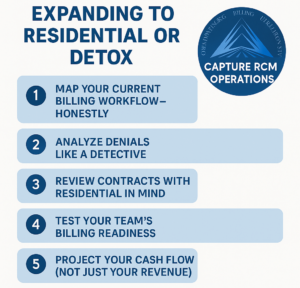
5. Project Your Cash Flow (Not Just Your Revenue)
It’s tempting to model growth based on full census and reimbursement rates. But cash flow tells a more honest story.
Build a projection that includes:
- Billing lag time (from date of service to date of claim)
- Days in AR (aging report breakdown)
- Denial holdbacks and appeal delays
- Payer mix and contractual rates
Most programs underestimate how much cash is locked up in AR. Before you expand, confirm you can weather a 60- to 90-day lag in collections.
You’re not just building bigger—you’re building smarter.
Bonus: Conduct a Mock Expansion Billing Test
Choose a week and simulate what billing would look like if your census doubled. Push those claims through your existing workflow. Watch how your team handles:
- Documentation volume
- Claim batching and scrubbing
- Real-time eligibility and authorizations
Note where the slowdowns happen. That’s where you need infrastructure upgrades before you grow.
FAQ: Billing Readiness Before Expansion
What’s the biggest billing mistake programs make before expanding?
Assuming their current outpatient billing process will automatically scale. Higher levels of care introduce more documentation, tighter authorizations, and more payer scrutiny. If you haven’t tested that load, you’re flying blind.
How long does a billing audit take?
A solid internal audit can take 2–3 weeks, depending on your size and data access. A professional partner like Capture RCM Operations can streamline this with structured assessments and tools.
Do I need different contracts for residential or detox billing?
Not always, but your existing contracts must explicitly cover those services. If they don’t, or if language is vague, you risk denials or underpayment.
Should I wait to hire billing help until after I expand?
No—that’s reactive. Secure experienced billing support before you go live. It protects your cash flow and reputation from day one.
What’s a sign my billing system can’t scale?
If you rely on a few team members with tribal knowledge or frequent manual workarounds, that’s a red flag. Systems should carry the process—not just people.
Ready to Build With Confidence?
Capture RCM Operations works with programs nationwide who are scaling services and want billing that keeps pace. Whether you’re prepping for detox, residential, or another high-touch offering, we can help you build a revenue cycle that supports your mission.
👉 Explore our billing services
📞 Or call us directly at (380) 383-6822 to talk through your audit needs.
You don’t have to guess. Let’s build smart from the start.