
Expanding into new payer networks or geographic markets can unlock significant revenue opportunities for behavioral health organizations. But with that opportunity comes risk—financial, operational, and regulatory.
For CEOs and behavioral health executives weighing in-network vs. out-of-network strategies, the credentialing process is more than an administrative hurdle. It’s a make-or-break function that can either accelerate growth or expose your organization to unnecessary delays, denials, and compliance pitfalls.
That’s where outsourced credentialing services come in—helping align payer strategy, reduce revenue leakage, and ensure your infrastructure can scale without breaking.
Credentialing Is Not Just Paperwork—It’s a Business Risk Variable
Most CEOs recognize credentialing as a prerequisite to joining networks. But fewer treat it as a strategic lever.
Credentialing impacts:
- Payer mix balance (e.g., commercial vs. Medicaid)
- Revenue timelines (i.e., how soon you can bill)
- Regulatory exposure (e.g., expired licensure or incomplete CAQH)
- Provider satisfaction and retention (especially when enrollment delays cause frustration or underutilization)
When entering new markets, these variables compound. Credentialing becomes both a tactical function and a risk mitigation tool.
1. Align Credentialing With Your Payer Mix Strategy
One of the most common mistakes organizations make when expanding is treating all payer networks as equal. They aren’t.
Each plan brings different reimbursement rates, denial behaviors, authorization requirements, and payment timelines. Without strategic credentialing alignment, your organization could inadvertently:
- Increase your patient load without proportional revenue
- Get locked into contracts that underpay for high-acuity services
- Lose negotiating leverage with more valuable payers
Credentialing services can help by:
- Evaluating which payers fit your existing or planned service lines
- Prioritizing networks based on fee schedules, utilization, and demand
- Mapping credentialing timelines to your expansion calendar
This ensures your growth doesn’t dilute margins or create operational strain.
2. Accelerate Market Entry With Proactive Enrollment Management
Credentialing timelines can range from 30 to 180 days—depending on the payer, state, and service line. In practice, that means credentialing delays can hold up entire program launches or expansions.
When internal teams are juggling clinical operations, HR, and compliance, enrollment tracking often becomes reactive—only noticed once a claim is denied or a provider is sitting idle.
Credentialing partners offer:
- Pre-submission checks (ensuring forms, CAQH, and licensure are ready)
- Daily or weekly payer follow-ups
- Real-time dashboards for credentialing progress by provider, payer, and location
This compresses time-to-revenue and protects your growth projections from hidden credentialing bottlenecks.
3. Reduce Audit and Denial Risk With Centralized Oversight
When expanding into multiple regions or adding new service lines, it becomes exponentially harder to track:
- Which providers are credentialed where
- Who is eligible to bill under which contracts
- When recredentialing is due
Even minor oversights—like an expired DEA license or missing malpractice coverage—can trigger denials, overpayment recoupments, or audit flags.
Credentialing services bring:
- Centralized documentation tracking
- Automated alerts for renewals and expirations
- Standardized internal credentialing policies across sites
This helps your compliance, billing, and executive teams sleep better at night.
4. Improve Payer Negotiations With Market Data and Strategy
Credentialing is often treated as a back-office function—but it’s also a strategic negotiation asset. Especially for organizations expanding into high-demand or low-access markets, your credentialing posture can influence:
- Your reimbursement rate negotiations
- Whether payers expedite your credentialing
- Whether they waive panel closure excuses
Experienced credentialing vendors often maintain payer databases with:
- Regional reimbursement benchmarks
- Common denial reasons by payer
- Panel capacity indicators
- Negotiation success trends by service type (e.g., ABA vs. SUD vs. psychiatry)
This data allows CEOs to pursue not just participation—but profitable participation.
5. Support Multi-State Rollouts With Regulatory Clarity
Behavioral health licensure, Medicaid enrollment, and payer requirements vary dramatically by state. Launching a new site, program, or provider line in a different state brings complex, often opaque credentialing processes.
Without experienced support, organizations risk:
- Launch delays due to missed filing steps
- Inadvertent fraud (e.g., billing out-of-network before credentialing is complete)
- Losing providers to burnout or job dissatisfaction during credentialing wait periods
Credentialing services with national reach can:
- Pre-verify state-specific licensure and supervision rules
- Handle both commercial and state Medicaid enrollments
- Create replicable playbooks for site expansion
That means faster launches and fewer surprises.
6. Reduce Burnout by Protecting Clinical and Admin Teams
In many organizations, credentialing falls to office managers, HR, or clinical leads—people whose plates are already full. The result? Errors, rework, and frustrated providers who can’t bill.
By offloading credentialing to a dedicated partner, you protect:
- Clinical hours (so providers focus on patient care)
- Admin bandwidth (so your teams aren’t doing chase work)
- Provider satisfaction (so new hires feel supported from day one)
This contributes to retention, operational efficiency, and scalability.
7. Create Repeatable Infrastructure for Long-Term Growth
If your organization is preparing for acquisition, private equity interest, or franchising, having a credentialing system that scales is non-negotiable.
Professional credentialing services create:
- Audit-ready documentation standards
- Cross-site visibility for multi-state teams
- Replicable workflows for new hires and new locations
That institutional memory protects valuation and accelerates expansion timelines.
Credentialing ROI: What the Numbers Show
Credentialing doesn’t just reduce headaches—it drives financial results:
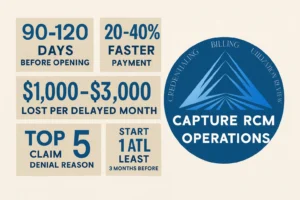
- The AMA estimates that practices lose $1,000–$3,000 per provider per month in revenue due to credentialing delays.
- Credentialing errors are one of the top five causes of denied claims across behavioral health practices.
Outsourced credentialing reduces time-to-payment by 20–40% in multi-provider practices. - If you’re expanding, the cost of inaction—or doing it all in-house—is often higher than the investment in credentialing support.
FAQs About Credentialing Services for Behavioral Health Growth
What’s the difference between in-house and outsourced credentialing?
In-house credentialing relies on internal staff to manage forms, submissions, tracking, and follow-ups. Outsourced credentialing assigns a dedicated team to handle these tasks full-time—usually with better payer relationships, systems, and audit protocols.
How far in advance should we start credentialing before opening a new site?
Ideally, credentialing should begin 90–120 days before your planned opening or new hire start date—especially for Medicaid or major commercial plans.
Can credentialing services help with recredentialing or expiring contracts?
Yes. Ongoing maintenance is a core part of most credentialing services. They track recredentialing windows, license renewals, and notify your team proactively.
Do credentialing services negotiate rates or just manage paperwork?
Some credentialing partners, like Capture RCM, offer payer negotiation support or consult on network strategy—particularly valuable when entering new geographic regions or specialty niches.
Will credentialing services handle both individual and group enrollment?
Yes. Reputable vendors manage both provider-level and facility-level enrollments, including CAQH setup, Medicaid group applications, and taxonomy/NPI management.
Ready to Protect Revenue and Accelerate Growth?
Credentialing should never be an afterthought. If you’re preparing to expand, launch new sites, or reassess your payer mix, Capture RCM’s credentialing services are purpose-built for behavioral health operators like you.
We combine regulatory clarity, payer strategy, and enrollment execution—so you can focus on scaling your impact, not chasing paperwork.
Call (380) 383-6822 or visit our credentialing services page to learn more.