
For behavioral health CEOs, payer contracting decisions are no longer just back-office concerns—they are boardroom-level strategic decisions. The mix of in-network and out-of-network contracts directly shapes revenue reliability, operational risk, and long-term growth. Yet many organizations overlook a key asset in this equation: credentialing.
Credentialing is often viewed as a compliance necessity. But when approached strategically—especially with the help of experienced credentialing services—it becomes a powerful lens into your payer ecosystem. From reimbursement optimization to capacity-driven negotiations, credentialing data can reveal high-value opportunities that would otherwise go unnoticed.
This guide outlines how CEOs and executive teams can leverage credentialing services to make smarter payer contracting decisions, accelerate growth, and reduce risk.
Leverage Credentialing Data to Audit Your Current Payer Strategy
Before signing new contracts or expanding to new geographies, CEOs need clarity on what their current payer mix is producing—and what it’s costing them. Most practices only monitor top-line reimbursement or denial rates, which hides subtler problems like:
- Providers credentialed with payers you no longer prioritize
- High-value payers that are underutilized due to enrollment gaps
- New providers waiting months to be credentialed, creating unbilled services
Credentialing services provide a snapshot of your active enrollments, pending statuses, and upcoming expirations. That insight allows CEOs to identify where misalignment is dragging down performance and where untapped value exists.
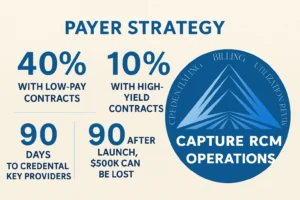
For example, if 40 percent of your providers are credentialed with a low-paying commercial plan, and only 10 percent with a high-yield regional payer, realignment may be warranted.
Identify Revenue Delays Tied to Credentialing Gaps
Credentialing lags are one of the most underestimated causes of cash flow problems in behavioral health. A provider who is hired but not yet credentialed can’t bill in-network—leading to delays, write-offs, or missed opportunities to serve insured patients.
Credentialing services help CEOs understand:
- Which providers are billing-capable versus pending
- How long each payer typically takes to credential
- How these delays impact expected collections
With that data, leadership teams can make more accurate forecasts, plan launches more effectively, and avoid creating artificial underperformance due to backend issues.
For instance, a new IOP program projected to generate $500,000 in revenue could fall short if key providers are still uncredentialed with primary payers 90 days after launch.
Map Payer Behavior to Enrollment and Negotiation Outcomes
Not all payer contracts offer the same value—especially when you consider real-world behavior. A payer that offers high rates on paper but slow credentialing, high denial rates, or frequent recredentialing audits can drain internal resources and create compliance exposure.
Credentialing services collect and analyze this data over time, helping CEOs make better strategic decisions. You’ll gain insights into:
- Which payers have the highest clean claim rates after credentialing
- Which contracts require burdensome pre-authorization or documentation
- Which payers routinely delay enrollment, slowing down revenue
This insight allows CEOs to renegotiate contracts with data in hand—or choose to exit relationships that introduce more friction than financial return.
Sequence Expansion Strategy Based on Credentialing Feasibility
When planning to expand across state lines, open new facilities, or launch new service lines, credentialing feasibility should be built into the timeline—not treated as an afterthought.
Credentialing services help executive teams:
- Determine which payers will delay or accelerate go-live timelines
- Sequence provider onboarding in line with payer approval windows
- Identify high-yield plans that are still open for enrollment in new regions
This prevents the common mistake of launching a program before the revenue infrastructure is in place. A strategic credentialing roadmap also allows for smoother staffing, marketing, and billing integration—without costly surprises.
Spot Market Leverage Based on Network Demand Gaps
Credentialing doesn’t just respond to payer decisions—it can shape them. In markets where behavioral health providers are in short supply, payers are often more willing to fast-track enrollment, open previously closed panels, or negotiate better rates.
Credentialing services analyze:
- Network adequacy gaps by region and specialty
- Payer panel saturation and recent approval trends
- Opportunities to leverage provider types (e.g., BCBA, LCSW, psychiatric NP) in negotiations
For example, if a payer has limited ABA providers in a specific county, enrolling a full-time BCBA may offer leverage for better reimbursement or faster turnaround.
These signals give CEOs the data they need to act before competitors do—or to prioritize regions where enrollment velocity supports business goals.
Protect Long-Term Revenue With Credentialing Infrastructure
Credentialing errors—such as expired licenses, incorrect taxonomy codes, or missing CAQH attestations—can quietly damage revenue for months. These issues often don’t emerge until claims are denied, audits begin, or payers flag inconsistencies.
Credentialing services reduce this risk by:
- Creating centralized documentation systems
- Tracking expirations and recredentialing dates
- Validating forms before submission to avoid rework
This ensures that every provider enrolled is billing-eligible, properly linked to your group NPI, and compliant with the latest requirements.
The result is not only revenue protection—but operational credibility with payers, investors, and partners.
Use Credentialing Performance Metrics to Guide Strategic Planning
For many organizations, credentialing performance is reactive. Denials flag issues too late, and internal teams often lack the bandwidth to create actionable reports.
Credentialing services change that by delivering executive-level visibility into metrics like:
- Average days to credential by payer or location
- Credentialing backlog per site or service line
- Percent of providers fully credentialed vs. partially active
- Recredentialing success rate and timing trends
These metrics allow CEOs to:
- Improve provider onboarding efficiency
- Adjust growth timelines based on real operational data
- Justify decisions to expand, renegotiate, or reallocate internal resources
For growing practices, especially those preparing for a transaction or acquisition, this level of infrastructure creates confidence—and often increases valuation.
Scale With Confidence Using Credentialing as a Strategic Asset
If your practice is expanding rapidly, planning for new sites, or pursuing PE-backed growth, your credentialing process needs to scale with you. Fragmented systems, one-off spreadsheets, and inconsistent follow-ups create bottlenecks and compliance vulnerabilities.
Credentialing services offer:
- Multi-location credentialing dashboards
- Standardized processes across providers and states
- Audit-ready documentation for every enrollment
This builds a repeatable, scalable foundation that supports growth—without sacrificing billing efficiency or compliance.
Frequently Asked Questions (FAQs)
How does credentialing affect payer contracting strategy at the executive level?
Credentialing impacts which payers your providers can bill, how quickly new services go live, and how much reimbursement you receive. When monitored strategically, it helps CEOs optimize their payer mix, avoid bottlenecks, and negotiate from a position of strength.
Is it common for practices to lose revenue due to credentialing gaps?
Yes. Practices often experience billing delays, unprocessed claims, or denied authorizations because a provider was not yet credentialed—or wasn’t credentialed correctly. Credentialing errors can lead to thousands in preventable write-offs or delayed payments.
Can credentialing services actually help with payer negotiations?
While they don’t replace your contracting team, credentialing services provide the data that informs negotiations—like how quickly payers credential, which plans are hard to access, or where your provider types are in demand. This helps prioritize your contracting strategy.
How early should credentialing begin for new hires or expansions?
Credentialing should begin 90 to 120 days before a provider’s start date—or before a new service launch. Some state Medicaid programs or commercial plans have approval windows that extend beyond 90 days, so proactive planning is key.
Does outsourcing credentialing reduce internal workload?
Significantly. It offloads document gathering, form submission, payer follow-up, recredentialing management, and audit prep. This allows internal staff to focus on strategic growth and clinical operations instead of administrative processing.
Unlock Strategic Value Hidden in Your Credentialing Process
At Capture RCM Operations, we help behavioral health CEOs turn credentialing from a cost center into a growth driver. Whether you’re scaling across states, reevaluating your payer mix, or preparing for a transaction, our credentialing services offer clarity, speed, and strategic advantage.
Call (380) 383-6822 or visit our credentialing services page to learn more about our credentialing services services in United States.