
Billing managers in behavioral health organizations face a unique challenge: maintaining accurate, compliant billing processes while managing high claim volumes and strict payer requirements. Even small inefficiencies can quickly snowball into significant financial losses.
Hidden costs often appear in the form of denied claims, delayed reimbursements, and administrative inefficiencies. Over time, these issues can strain staff resources and reduce overall profitability. Understanding the root causes—and implementing systematic improvements—is essential for organizations relying on specialized mental health billing services.
The True Financial Impact of Claim Denials
Claim denials represent one of the most expensive operational problems in healthcare revenue cycle management. Industry research indicates that 5–10% of healthcare claims are denied initially, and a significant portion are never successfully appealed.
For mental health providers, denial rates can be even higher due to documentation requirements and payer-specific billing rules.
Common denial causes include:
- Incorrect CPT or modifier usage
- Missing prior authorization
- Incomplete clinical documentation
- Patient eligibility issues
- Incorrect payer submission processes
Each denied claim triggers additional work for the billing department. Staff must review documentation, correct errors, resubmit claims, and potentially file appeals.
Example of Revenue Loss
Consider a behavioral health clinic submitting 1,200 claims per month with an average reimbursement value of $140 per session.
If the denial rate reaches 12%, and even 25% of denied claims go unrecovered, the clinic could lose:
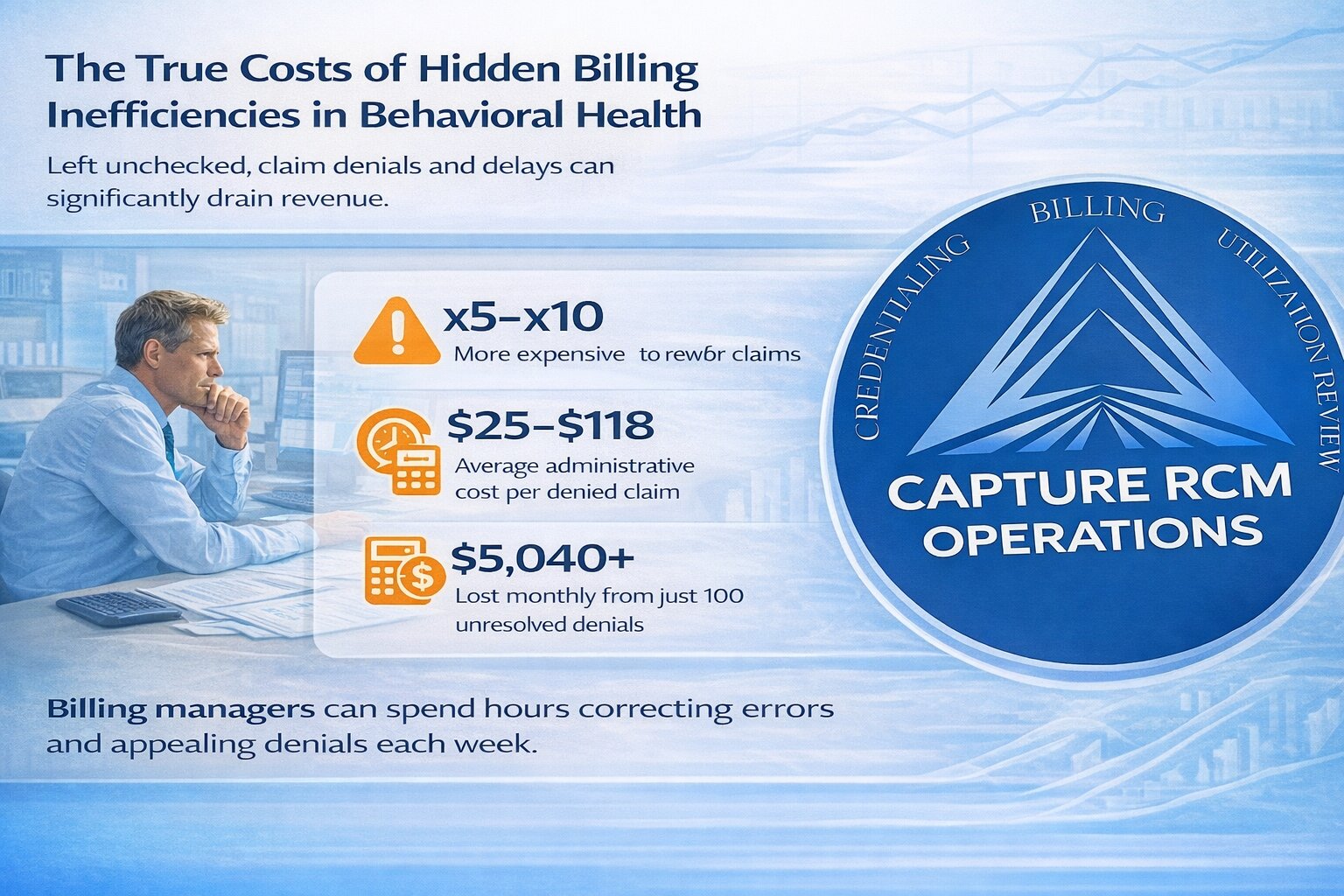
1,200 × 12% × 25% × $140 = $5,040 per month
That translates to over $60,000 annually in lost revenue, purely from unresolved denials.
How Inefficient Billing Workflows Increase Operational Costs
Billing inefficiencies rarely stem from one single problem. Instead, they develop across the entire revenue cycle.
Mental health billing typically involves multiple steps:
- Patient eligibility verification
- Insurance benefit confirmation
- Prior authorization approval
- Accurate clinical documentation
- CPT coding and claim creation
- Claim submission and payer follow-up
When these processes lack coordination, billing managers spend significant time correcting errors.
Signs of Inefficient Billing Workflows
Billing managers should look for these warning signs:
- Claims submitted without verification of benefits
- High volumes of manual claim corrections
- Delayed documentation from providers
- Lack of automated claim scrubbing tools
- Limited visibility into denial trends
A fragmented workflow increases administrative workload and slows reimbursement cycles.
Why Mental Health Billing Complexity Raises Risk
Mental health billing carries unique challenges that increase the risk of errors compared to other healthcare specialties.
Key complexities include:
Time-Based CPT Codes
Therapy sessions are often billed based on duration. For example:
- 90834 – 45-minute psychotherapy session
- 90837 – 60-minute psychotherapy session
If documentation does not support the billed session length, payers may deny the claim.
Prior Authorization Requirements
Many insurance providers require authorization for services such as:
- Intensive outpatient programs (IOP)
- Partial hospitalization programs (PHP)
- Extended therapy sessions
Missing authorization can result in automatic claim denial regardless of clinical necessity.
Telehealth Billing Regulations
Telehealth has expanded dramatically in behavioral health, but payer policies differ widely.
Billing managers must ensure:
- Correct telehealth modifiers
- Approved provider credentials
- Compliance with payer-specific policies
These complexities make experienced services, billing, mental health support critical for maintaining accuracy and compliance.
Administrative Burden on Billing Managers
Billing managers often find themselves caught between clinical teams, administrative staff, and insurance companies.
In many behavioral health organizations, the billing department must manage:
- Claim submission and corrections
- Insurance verification
- Authorization tracking
- Payment posting
- Denial appeals
Industry studies suggest reworking a denied claim can cost providers $25–$118 per claim in administrative labor.
When denial rates rise, billing teams spend more time troubleshooting problems instead of improving revenue cycle strategy.
Slow Reimbursement Cycles Create Cash Flow Problems
Delayed reimbursements can significantly impact operational stability.
Typical healthcare claim timelines include:
- Clean claims: 15–30 days
- Corrected claims: 30–60 days
- Appealed claims: 60–120 days
If billing inefficiencies cause repeated claim corrections, the payment timeline stretches considerably.
This can create financial pressure for practices, particularly those with high staffing costs such as:
- Licensed therapists
- Psychiatrists
- Clinical supervisors
- Administrative support staff
When revenue is delayed, organizations may struggle with payroll management, growth investments, or operational planning.
Compliance Risks in Behavioral Health Billing
Beyond financial losses, inefficient billing can also expose organizations to compliance risks.
Mental health billing must follow strict regulatory requirements, including:
- HIPAA documentation standards
- CMS billing guidelines
- Insurance payer policies
- State behavioral health regulations
Improper billing practices—whether intentional or accidental—can trigger audits, penalties, or reimbursement clawbacks.
For example, inaccurate documentation supporting a 90837 psychotherapy session could lead to claim denials or payer audits.
Billing managers must ensure that coding accuracy and documentation standards remain consistent across the organization.
Best Practices for Improving Mental Health Billing Efficiency
Billing managers can significantly reduce hidden costs by implementing structured revenue cycle improvements.
1. Strengthen Front-End Insurance Verification
Eligibility verification should occur before every appointment.
This ensures:
- Active insurance coverage
- Correct payer identification
- Accurate copay and deductible information
Preventing eligibility errors significantly reduces claim denials.
2. Standardize Clinical Documentation Requirements
Providers should follow consistent documentation standards for therapy sessions.
Documentation should clearly include:
- Session duration
- Clinical interventions used
- Medical necessity justification
- Treatment progress
Standard templates help maintain compliance and reduce coding errors.
3. Implement Automated Claim Scrubbing
Claim scrubbing software identifies errors before submission.
These systems can detect:
- Missing modifiers
- Invalid CPT codes
- Incomplete patient data
- Insurance submission errors
Clean claims are far more likely to receive first-pass acceptance.
4. Track Denial Trends and Root Causes
Denial management should focus on prevention rather than correction.
Billing managers should analyze:
- Payer-specific denial patterns
- Frequently denied CPT codes
- Authorization issues
- Documentation deficiencies
Regular reporting helps identify systemic problems early.
5. Conduct Routine Revenue Cycle Audits
Quarterly billing audits provide valuable insight into operational efficiency.
Audits can uncover:
- Underbilling opportunities
- Coding inconsistencies
- Compliance risks
- Documentation gaps
Organizations that conduct regular audits often experience improved claim acceptance rates and faster reimbursement cycles.
Why Specialized Mental Health Billing Services Matter
Many behavioral health organizations find that outsourcing or partnering with specialists improves revenue performance.
Specialized billing partners provide:
- Behavioral health coding expertise
- Authorization management systems
- Denial resolution workflows
- Regulatory compliance monitoring
This expertise allows billing managers to focus on strategic oversight rather than constant claim corrections.
FAQ: Mental Health Billing Services
What are mental health billing services?
Mental health billing services manage the entire revenue cycle for behavioral health providers. This includes insurance verification, claim submission, coding, payment posting, and denial management.
These services help ensure accurate billing, faster reimbursements, and improved financial performance for mental health practices.
Why do mental health claims get denied more often?
Mental health claims are frequently denied due to:
- Incomplete documentation
- Incorrect CPT coding
- Missing prior authorizations
- Payer-specific billing requirements
Because behavioral health billing is highly specialized, even small documentation issues can trigger claim denials.
How can billing managers reduce claim denials?
Billing managers can reduce denials by:
- Implementing automated claim scrubbing tools
- Ensuring accurate insurance verification
- Standardizing provider documentation templates
- Monitoring denial trends and payer patterns
These proactive strategies improve claim accuracy and first-pass acceptance rates.
How long should mental health claim reimbursements take?
Clean claims are typically reimbursed within 15–30 days, depending on the payer. However, claims requiring corrections or appeals can take 60–120 days to resolve.
Efficient billing processes significantly reduce reimbursement delays.
When should practices consider outsourcing billing?
Organizations should consider outsourcing billing when they experience:
- High claim denial rates
- Staff burnout from administrative workload
- Delayed reimbursements
- Difficulty keeping up with payer regulations
Partnering with specialized billing experts can improve operational efficiency and revenue stability.
Strengthen Your Mental Health Billing Operations
Reducing hidden billing costs requires a structured approach to revenue cycle management. With the right systems, expertise, and workflows, billing managers can significantly reduce denials and accelerate reimbursements.
Call 380-383-6822 or explore our mental health billing services to learn more about our services, billing, mental health services in your area.