

Even the most established IOP programs are bleeding revenue from one sneaky place: bad billing around H0015. It’s not always catastrophic. Sometimes it’s just $80 here, $140 there. But stack that across three months of group sessions and suddenly you’re looking at five figures not showing up on your aging report.
If you’re exploring new RCM partnerships, here’s what seasoned operators need to know: H0015 can be your most reliable revenue generator—or your quietest liability.
Explore our substance use disorder billing services to see how we keep every IOP hour accounted for.
What H0015 Really Pays For
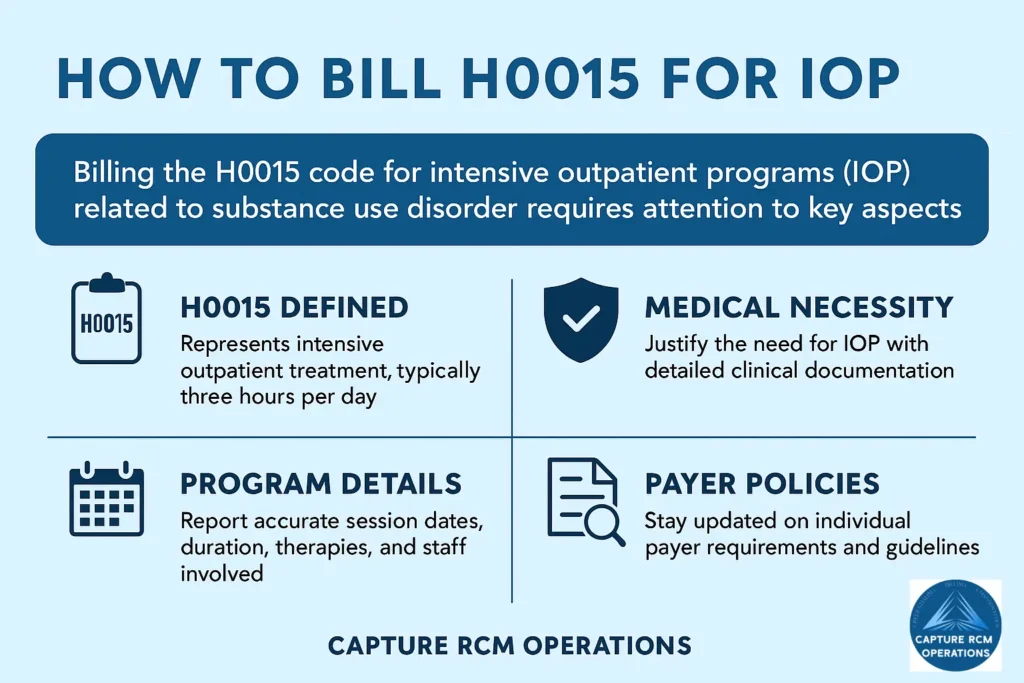
H0015 is more than a code. It’s a bundled promise:
- At least 3 hours of treatment per day
- At least 3 days per week
- Backed by an individualized treatment plan
This is where things fall apart. If even one of those pieces isn’t rock solid—especially documentation—your clean claim turns into a red flag.
3 Hours of What? Here’s What Counts (and What Doesn’t)
Not everything that fills time in your IOP day gets reimbursed. The payer only wants to pay for what they consider “active clinical services.”
✔️ Billable:
- Group therapy (documented + goal-linked)
- Individual sessions
- Psychoeducation groups
❌ Not billable under H0015:
- Breaks
- Recreational activities
- Self-directed workbook time
- Lunch or peer hangouts (yes, it happens)
If It’s Not Documented, It Didn’t Happen
IOP billing lives or dies on your documentation. The number of claims denied due to vague or generic group notes is rising—and once payers smell weak documentation, expect audits.
Here’s what gets your claim through:
- Time-stamped start/end
- Staff credentials
- Specific goals addressed
- Clinical interventions (not just “client participated”)
Denials Aren’t Just Annoying—They’re a Red Flag
Frequent denials around H0015 aren’t just admin headaches—they signal systemic issues in your billing or clinical alignment. If you’re seeing:
- “Insufficient documentation”
- “No proof of medical necessity”
- “Service not covered as billed”
…your RCM vendor might be submitting claims without really checking what’s behind them.
Looking for substance use disorder billing in Ohio? We work directly with providers across Ohio, Kentucky, South Carolina, and more nationwide to catch these issues before they cost you.
Stop Undercoding or Splitting H0015 the Wrong Way
Here’s a spicy truth: Some billers are still undercoding H0015—or worse, splitting it into separate CPT codes like 90853 and 90832 in ways payers don’t allow.
Stick with the bundled code unless:
- Payer explicitly instructs otherwise
- Program is offering less than 3 hours/day (rare)
- You’re doing split-level care with clear justification
Otherwise? You’re risking duplicate billing flags and leaving reimbursement on the table.
Modifiers, POS Codes, and State-Specific Rules—Yep, They Matter
H0015 billing isn’t plug-and-play across all payers. Medicaid in Indiana doesn’t act like BCBS in North Carolina.
Get these details wrong and your claim sits in limbo:
- Modifier HQ (for group)
- POS code 49 (for non-hospital outpatient)
- Authorization tracking
- State-based frequency limits
💡 Looking for substance use disorder billing in North Carolina or Indiana? We’ve built payer-specific rules into our workflows for North Carolina and Indiana providers—so you don’t have to second-guess every submission.
If You’re Doing Everything Right But Still Not Getting Paid…
That’s a vendor problem.
At Capture RCM Operations, we’ve seen too many IOPs deliver great care—only to get paid like they’re running glorified support groups. It’s not about charging more. It’s about charging accurately, consistently, and compliantly.
📞 Ready to make every IOP hour count?
Call (380) 383-6822 or visit us online to learn more about our substance use disorder billing services in the United States. We’ll help you protect your revenue without second-guessing your documentation.