
When you’re scaling fast—expanding locations, adding programs, bringing in new leadership—billing stops being a backend task. It becomes a strategic lever.
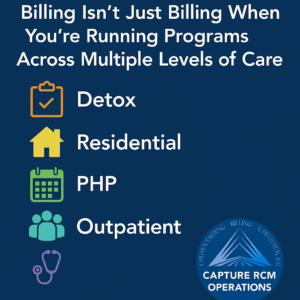
But here’s the part most teams underestimate: billing complexity scales faster than patient volume. And if you’re running programs across detox, residential, PHP, IOP, and outpatient, the margin for error tightens at every level.
This isn’t just billing. It’s the nervous system of your entire business.
Complexity Grows Faster Than Revenue
You can staff a new location, launch a new track, or onboard a new EHR in weeks. But if your billing architecture isn’t evolving in tandem, you’re scaling chaos.
Each level of care brings unique billing challenges:
- Detox requires rapid turnarounds on authorizations.
- Residential often gets flagged for medical necessity.
- PHP and IOP trigger different reimbursement logic and scheduling patterns.
- Outpatient programs see high volume and frequent insurance turnover.
If you’re treating billing like a monolith, you’re leaving money on the table at every level.
Most Billing Partners Just Aren’t Built for Multi-Level Programs
Billing vendors often brag about volume: how many claims they submit, how fast they get paid. But high-volume doesn’t equal high-strategy.
You need a partner who can:
- Seamlessly transition claims as clients move through levels of care.
- Preempt documentation gaps before they become denials.
- Surface payer trends and denial patterns across states and plans.
Ask your billing team or vendor:
- Can you segment performance by level of care?
- What’s your clean claim rate across each program?
- How do you handle clients who move from RTC to OP mid-week?
If they can’t answer clearly, it’s not your growth that’s the problem—it’s your infrastructure.
Strategic Billing Powers Clinical Freedom
Clinicians shouldn’t have to translate care into insurance language. They should chart for outcomes, not approvals.
But that only works when your billing team:
- Provides clear documentation feedback loops
- Flags issues before the claim ever goes out
- Integrates with clinical leadership
At Capture RCM, we treat billing like a relay race, not a game of telephone. We close the loop fast, with clarity and partnership.
Because when billing works, clinical teams can focus on care. And that’s when outcomes improve.
Billing Strategy Isn’t Just Revenue—It’s Reputation
A denial isn’t just a finance problem. It’s a trust problem.
Imagine telling a parent that their child has to discharge early because of an authorization lapse. Or asking a therapist to explain a denied claim from four weeks ago. These aren’t just operational misses—they’re brand hits.
Sophisticated billing protects your reputation. It means:
- Real-time dashboards that alert teams to risks
- Clean transitions across care levels
- Fewer client and family frustrations
Your billing should be as polished and performance-driven as your clinical model. Because the market’s watching.
You Can’t Afford a Generic Billing Team
This is a C-suite problem. Not a back-office one.
If you’re:
- Growing fast
- Managing multiple programs across states
- Reporting to investors or a board
- Focused on outcomes AND margin
…then your billing partner needs to be part of your strategic team, not just your AR vendor.
Capture RCM was built for this. We don’t just plug holes. We design systems that scale, report that informs, and partnerships that build clinical and financial confidence.
Frequently Asked Questions (FAQ)
Q: What makes billing more complicated across multiple levels of care?
A: Each level of care has its own documentation, authorization, and reimbursement requirements. Transitioning between levels adds additional complexity in coding and claim sequencing.
Q: Why can’t our internal team just manage this in-house?
A: Many internal teams lack the tools, data visibility, and strategic depth to handle payer complexity across programs. What works for a single-site OP center rarely scales.
Q: What KPIs should we watch to assess our billing performance?
A: Clean claim rate, denial rate by level of care, days to payment, authorization turnaround time, and payer-specific trends are key.
Q: How quickly can Capture RCM onboard our programs?
A: Most new clients are onboarded in 30–60 days with a customized implementation roadmap and real-time KPI monitoring.
Q: Do you integrate with our existing EHR?
A: Yes. We work with most major behavioral health EHRs and build custom workflows where needed.
Let’s Talk Strategy
📞 Ready to stop plugging holes and start building systems? Call us at (380) 383-6822 or get the details here. Your billing should be a growth engine—not a risk.