
Behavioral health billing leaders are under constant pressure to control A/R aging, claim denials, and inconsistent payer reimbursement timelines. While demand for behavioral health services continues to rise, reimbursement processes are becoming more complex and time-consuming.
For billing directors, these operational challenges often appear as growing A/R balances, repeated denials, and stalled claims that take months to resolve. Addressing these issues requires more than additional staff or short-term fixes. It requires a strategic overhaul of Behavioral Health Revenue Cycle Management workflows.
Many organizations begin by strengthening their infrastructure through professional Behavioral Health Revenue Cycle Management services that are specifically designed for the complexities of behavioral health billing.
Understanding why revenue cycles fail—and how to rebuild them strategically—can significantly improve reimbursement speed, reduce A/R aging, and strengthen financial stability.
Why Behavioral Health Revenue Cycle Management Often Breaks Down
Revenue cycle failures rarely occur due to a single mistake. Instead, they emerge from systemic inefficiencies across multiple operational stages.
Common structural weaknesses include:
- Inconsistent insurance eligibility verification
- Poor authorization tracking processes
- Documentation gaps that trigger payer denials
- Delayed claim follow-up procedures
- Limited reporting visibility into denial patterns
When these issues exist across departments, claims move slowly through the reimbursement pipeline.
According to healthcare revenue cycle research:
- The average healthcare denial rate ranges from 10–15%
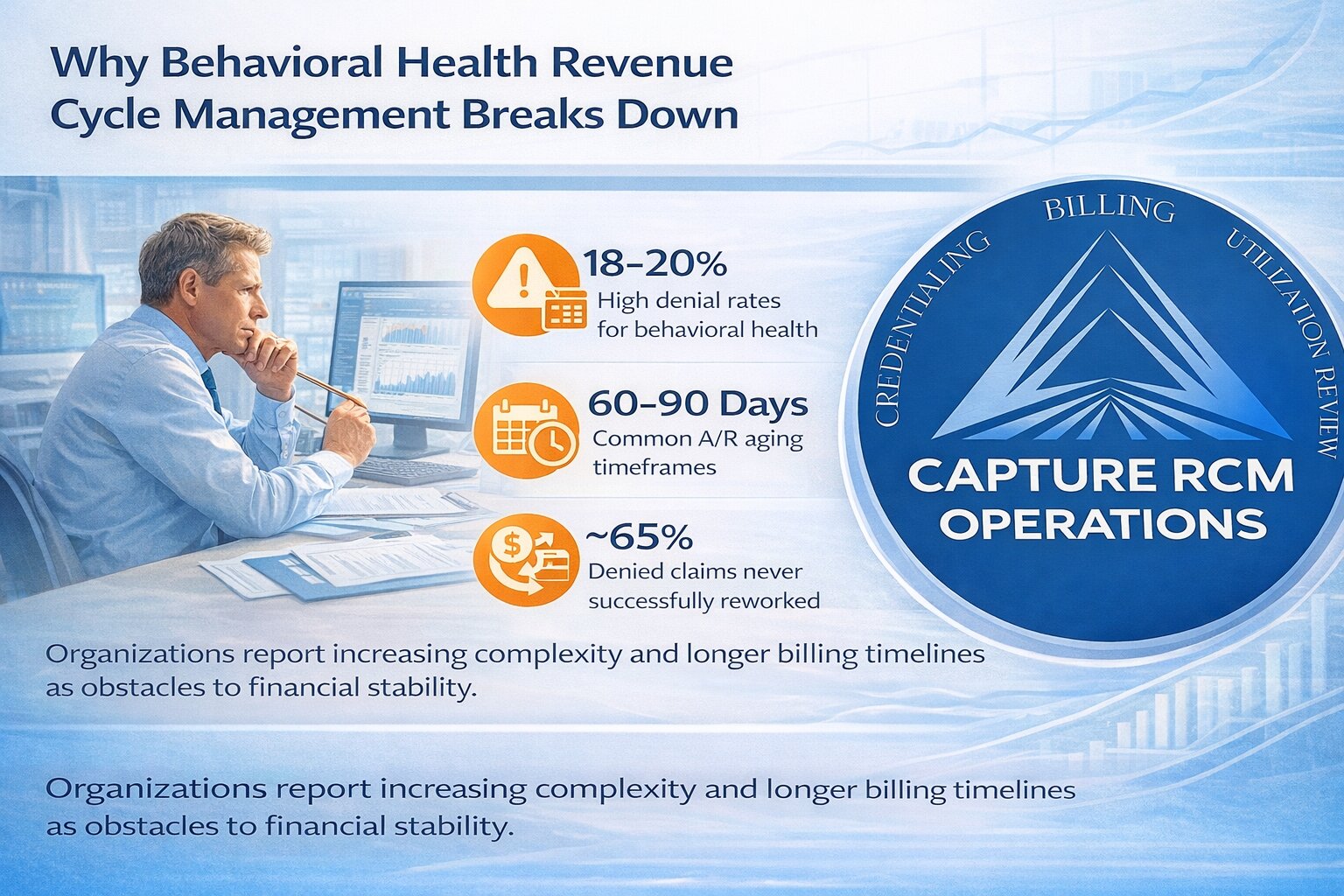
- Behavioral health programs often experience denial rates exceeding 18–20%
- Nearly 65% of denied claims are never successfully reworked
These breakdowns increase accounts receivable balances and delay collections. Over time, even high-performing behavioral health organizations can experience severe revenue instability.
For billing directors, solving these problems requires identifying operational bottlenecks across the entire revenue cycle.
A/R Aging Signals Structural Revenue Cycle Problems
Accounts receivable aging is one of the most visible indicators of revenue cycle inefficiency.
Healthy healthcare organizations typically maintain:
- 30–40 days in A/R as an industry benchmark
- Less than 15% of claims older than 90 days
However, behavioral health organizations experiencing revenue cycle breakdowns often report:
- A/R aging exceeding 60–90 days
- Significant balances in 120-day aging buckets
- High volumes of unresolved denials
These patterns rarely result from staff performance issues. Instead, they reflect operational inefficiencies earlier in the billing workflow.
For example:
- Incorrect eligibility verification leads to denied claims weeks later.
- Missing prior authorizations invalidate high-value services.
- Coding errors trigger payer rejection cycles.
By the time billing teams receive these claims, the reimbursement process has already slowed dramatically.
Strategic Behavioral Health Revenue Cycle Management focuses on correcting upstream workflow failures before claims are submitted.
Authorization Management: A Major Cause of Revenue Loss
Authorization management is one of the most complex challenges in behavioral health billing.
Services such as:
- Intensive Outpatient Programs (IOP)
- Partial Hospitalization Programs (PHP)
- Applied Behavior Analysis (ABA)
- Residential treatment services
often require detailed prior authorization approval from insurance payers.
If authorization approvals are not properly documented or renewed on time, claims may be denied entirely.
Authorization failures commonly occur when:
- Clinical and billing teams operate in separate systems
- Authorization expiration dates are not tracked
- Payer requirements change without internal updates
For example, if a patient receives treatment beyond the authorized number of sessions, the payer may reject the entire claim—even if services were medically necessary.
Implementing centralized authorization tracking systems can significantly reduce these costly errors.
Billing departments that maintain real-time authorization oversight typically see major improvements in reimbursement reliability.
Clean Claims Are the Foundation of Faster Payments
Insurance companies prioritize claims that meet all documentation and coding requirements.
These are known as clean claims—claims submitted without errors that require no additional review.
However, behavioral health claims frequently encounter submission issues such as:
- Missing documentation
- Incorrect CPT codes
- Incomplete service notes
- Improper use of modifiers
- Eligibility verification errors
Each error can delay reimbursement by weeks or even months.
Healthcare revenue cycle research indicates:
- Up to 80% of medical bills contain errors
- Clean claims are processed two to three times faster than corrected claims
One of the most effective solutions is implementing pre-submission claim scrubbing processes.
These systems review claims before submission and flag potential errors for correction. As a result, organizations can achieve first-pass claim acceptance rates exceeding 90%.
For billing directors focused on reducing A/R aging, improving claim quality is one of the most impactful strategies available.
Lack of Revenue Cycle Data Creates Operational Blind Spots
Many billing departments lack the financial analytics needed to diagnose revenue cycle problems.
Without performance data, organizations cannot accurately determine:
- Which payers generate the most denials
- Which CPT codes trigger frequent claim rejections
- How long claims remain unpaid
- Whether follow-up processes are effective
Revenue cycle leaders should regularly monitor metrics such as:
- Days in accounts receivable
- First-pass claim acceptance rate
- Denial rate by payer
- Average reimbursement time
- Net collection percentage
For example, if a specific payer consistently delays reimbursements beyond 60 days, billing teams can escalate follow-up earlier.
Organizations that implement data-driven Behavioral Health Revenue Cycle Management strategies often see significant improvements in collections and operational efficiency.
Proactive Denial Management Recovers Lost Revenue
Many billing teams focus on denial resolution only after problems appear in aging reports. This reactive approach allows recurring issues to persist.
Proactive denial management focuses on identifying root causes.
Billing directors should routinely analyze:
- Payer-specific denial patterns
- Documentation requirements
- Authorization compliance issues
- Coding inconsistencies
Correcting these underlying issues reduces denial rates across the entire revenue cycle.
Healthcare financial management data shows that providers who actively manage denial trends can recover up to 90% of previously denied claims.
For behavioral health organizations, this recovery can represent hundreds of thousands of dollars in reclaimed revenue.
Rebuilding Behavioral Health Revenue Cycle Management Systems
When revenue cycles begin to fail, incremental adjustments rarely produce lasting results.
Instead, billing leaders should focus on rebuilding the entire revenue cycle framework.
Key rebuilding strategies include:
Standardized Insurance Verification
Insurance verification must occur before services are delivered. Automated eligibility systems help confirm patient coverage, benefits, and payer requirements.
This prevents claims from being submitted for services that are not covered.
Structured Authorization Management
Authorization management should be centralized and continuously monitored. Alerts for expiring authorizations ensure services remain within approved treatment plans.
This prevents large claim denials tied to expired approvals.
Pre-Submission Claim Quality Audits
Claim scrubbing technology can review claims before submission to detect coding errors and documentation gaps.
This improves first-pass acceptance rates and reduces administrative rework.
Dedicated Denial Resolution Workflows
Billing teams should follow structured procedures for correcting and resubmitting denied claims. Clear workflows reduce delays and improve revenue recovery.
Real-Time Revenue Cycle Reporting
Transparent financial reporting allows billing leaders to monitor A/R aging, payer performance, and reimbursement trends.
These insights allow teams to intervene early and prevent operational bottlenecks.
Together, these improvements transform Behavioral Health Revenue Cycle Management into a proactive financial strategy rather than a reactive administrative task.
Strategic Revenue Cycle Leadership Strengthens Financial Performance
Billing directors play a central role in protecting organizational revenue.
When revenue cycle systems operate effectively, organizations experience measurable improvements such as:
- Faster reimbursement cycles
- Lower claim denial rates
- Reduced administrative costs
- Higher net collection percentages
- Improved compliance with payer regulations
More importantly, efficient revenue cycles provide the financial stability behavioral health providers need to expand programs, hire staff, and improve patient access to care.
For organizations navigating increasingly complex payer environments, strategic Behavioral Health Revenue Cycle Management is no longer optional—it is essential.
Frequently Asked Questions
What is Behavioral Health Revenue Cycle Management?
Behavioral Health Revenue Cycle Management refers to the financial process that manages patient billing, insurance claims, payments, and compliance for behavioral health services. It includes eligibility verification, authorization management, claim submission, denial resolution, and financial reporting.
Why does A/R aging increase in behavioral health billing?
A/R aging often increases due to claim denials, delayed reimbursements, missing authorizations, or documentation issues. Without structured revenue cycle processes, claims remain unpaid for extended periods.
How can billing directors reduce claim denials?
Billing directors can reduce denials by improving insurance verification, implementing authorization tracking systems, performing pre-submission claim audits, and analyzing denial trends to identify root causes.
What is a healthy A/R benchmark for healthcare organizations?
Most healthcare organizations aim to maintain 30–40 days in accounts receivable. When A/R exceeds 60–90 days, it typically indicates operational inefficiencies within the revenue cycle.
Should behavioral health organizations outsource revenue cycle management?
Many behavioral health providers outsource revenue cycle management to access specialized billing expertise and improve operational efficiency. Outsourcing can help reduce claim errors, accelerate reimbursements, and strengthen compliance processes.
Strengthen Revenue Performance with Expert Revenue Cycle Support
If your billing department is struggling with growing A/R aging, persistent claim denials, or slow reimbursement timelines, rebuilding your revenue cycle infrastructure can significantly improve financial performance.
Strategic revenue cycle management solutions help billing teams streamline workflows, reduce administrative burden, and accelerate collections.
Call 380-383-6822 or visit our Behavioral Health Revenue Cycle Management services to learn more about our Behavioral Health Revenue Cycle Management services in your area.