


Cash flow challenges are one of the most persistent operational pressures for behavioral health practice owners. Even with consistent patient demand, revenue doesn’t always translate into predictable income. Delays, denials, and administrative inefficiencies quietly erode financial performance.
Behavioral Health Revenue Cycle Management is not just about billing—it’s about building a system that protects revenue at every stage. When structured correctly, it improves collections, shortens payment cycles, and gives practice owners the financial clarity needed to grow.
Early in the process, many practices stabilize operations by implementing structured Behavioral Health Revenue Cycle Management solutions that address gaps across intake, billing, and payer communication.
Why Payment Delays Continue to Impact Behavioral Health Practices
Behavioral health has one of the most complex reimbursement environments in healthcare. Unlike procedural specialties, billing often depends on time-based services, medical necessity documentation, and strict authorization rules.
Several factors contribute to delays:
- Frequent payer policy changes
- Session-based billing with documentation dependencies
- Authorization limits tied to medical reviews
- Manual processes still used in many practices
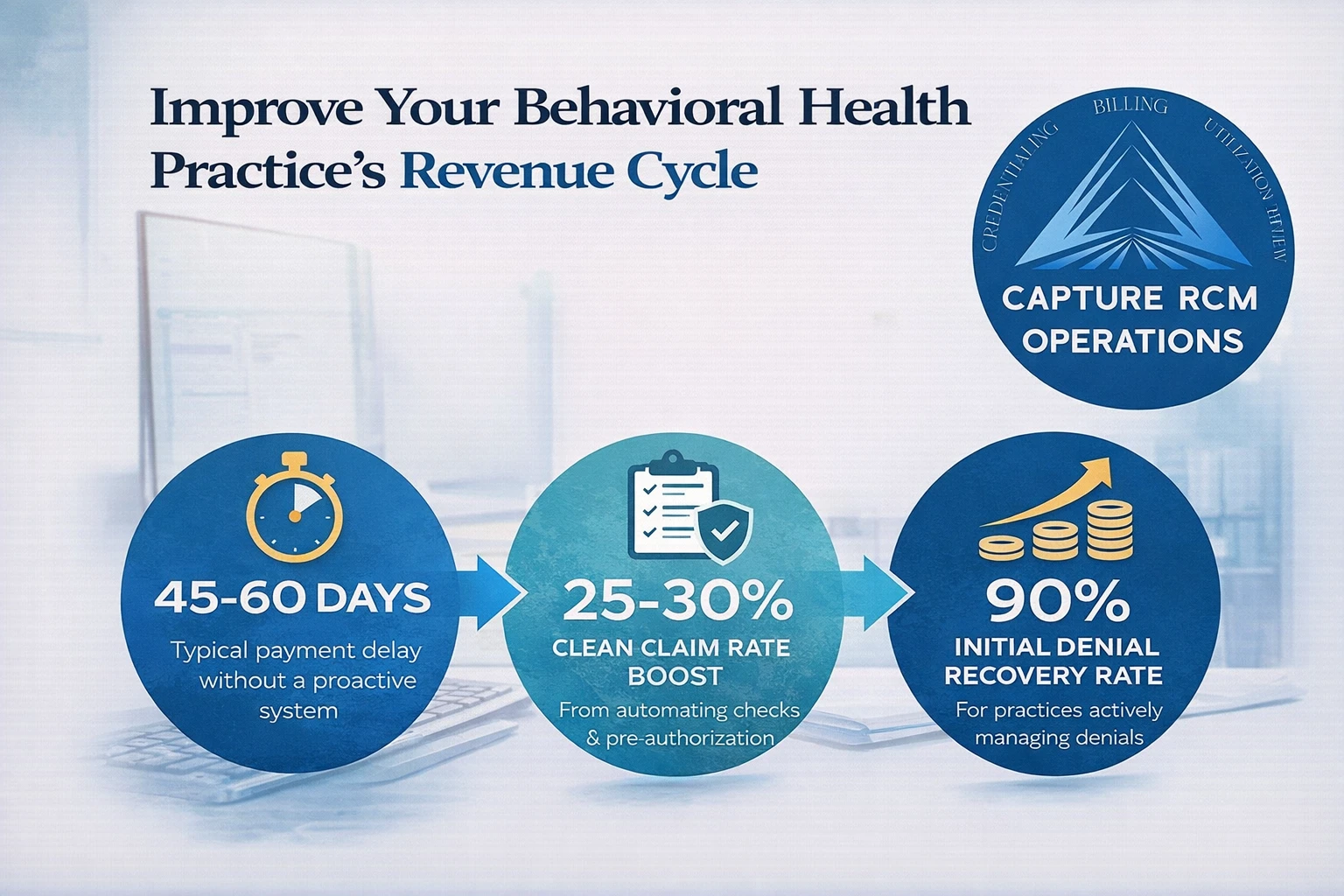
Example: A growing Intensive Outpatient Program (IOP) may deliver services consistently but experience a 45–60 day delay in payments due to missing authorizations or incomplete documentation. This creates a cash flow gap that impacts staffing and operations.
Without a proactive system, these issues compound over time, making revenue unpredictable.
Strengthening Front-End Processes to Prevent Revenue Leakage
Revenue cycle success begins before the first appointment. Front-end breakdowns are one of the leading causes of denied or delayed claims.
High-performing practices focus on:
- Real-time insurance verification
- Clear benefit and eligibility checks
- Accurate patient demographic capture
- Pre-authorization before service delivery
When these steps are standardized, practices often see immediate improvement in claim acceptance rates.
Operational insight: Practices that automate eligibility verification reduce front-end errors significantly and improve clean claim rates by up to 25–30%.
The goal is simple: prevent problems before they reach the billing stage.
Building Efficient Behavioral Health Revenue Cycle Management Workflows
Inconsistent workflows create inefficiencies that slow down payments. A structured Behavioral Health Revenue Cycle Management process ensures that every claim moves through the system without unnecessary delays.
Key workflow improvements include:
- Automated claim scrubbing to catch errors early
- Standardized coding protocols across clinicians
- Timely claim submission within payer deadlines
- Clear documentation guidelines aligned with billing requirements
For example, aligning clinical documentation with CPT coding reduces the likelihood of medical necessity denials—a common issue in therapy-based services.
When workflows are optimized, practices reduce rework, improve staff productivity, and accelerate reimbursements.
Reducing Claim Denials With Data-Driven Strategies
Denials are one of the most expensive and time-consuming challenges in revenue cycle management. However, they are also one of the most controllable.
Successful practices treat denials as actionable data.
Key strategies include:
- Tracking denial reasons across payers
- Identifying recurring issues (e.g., missing modifiers, expired authorizations)
- Implementing corrective actions at the source
Data point: Industry benchmarks suggest that 5–10% of claims are denied on first submission. Without proper management, a significant portion of that revenue is never recovered.
By contrast, practices that actively manage denials can recover up to 90% of initially denied claims.
This requires accountability, reporting, and consistent follow-through—not just reactive fixes.
Improving Accounts Receivable (AR) Performance
Accounts receivable is a direct reflection of how efficiently a practice converts services into revenue. Long AR cycles often signal deeper operational issues.
To improve AR performance:
- Monitor aging reports weekly
- Segment claims by payer and value
- Prioritize high-dollar and older claims
- Establish consistent follow-up schedules
Real-world scenario: A behavioral health group reduced its average AR days from 68 to 32 simply by implementing structured follow-up protocols and assigning accountability to specific team members.
The result was improved cash flow without increasing patient volume.
Enhancing Payer Communication and Contract Performance
Payer relationships play a critical role in revenue cycle outcomes. Poor communication or unclear contract terms can lead to underpayments and delays.
Best practices include:
- Regularly reviewing payer contracts
- Verifying reimbursement rates against payments
- Escalating unresolved claims efficiently
- Maintaining updated payer contact workflows
Many practices unknowingly accept underpayments due to lack of contract visibility. Over time, this can result in significant revenue loss.
A strong Behavioral Health Revenue Cycle Management strategy ensures that every claim is paid accurately—not just quickly.
Leveraging Technology to Reduce Administrative Burden
Manual billing processes are no longer sustainable for growing practices. Technology plays a key role in improving accuracy and efficiency.
High-impact tools include:
- Practice management systems with integrated billing
- Automated eligibility and claims processing
- Real-time reporting dashboards
- Denial tracking and analytics tools
These systems reduce human error and allow teams to focus on higher-value tasks such as denial resolution and financial planning.
Operational insight: Practices that adopt integrated RCM technology often reduce administrative workload by 20–30%, while improving billing accuracy.
Scaling Revenue Operations Without Increasing Overhead
Growth introduces complexity. More patients, more payers, and more services mean more opportunities for errors and delays.
Practice owners often reach a point where internal billing teams struggle to keep up.
At this stage, scaling requires:
- Standardized processes across locations or programs
- Dedicated billing expertise
- Scalable systems that adapt to growth
Outsourcing or partnering with a specialized RCM provider can help practices maintain efficiency while expanding.
Instead of adding overhead, practices gain access to expertise and infrastructure designed specifically for behavioral health billing.
Creating Predictable Cash Flow for Long-Term Stability
The ultimate goal of Behavioral Health Revenue Cycle Management is not just faster payments—it’s predictability.
Predictable cash flow allows practice owners to:
- Plan hiring and expansion with confidence
- Invest in new programs or services
- Reduce financial stress and operational uncertainty
This requires continuous monitoring and improvement, not a one-time fix.
Key metrics to track:
- Days in AR
- Clean claim rate
- Denial rate
- Net collection rate
Practices that consistently monitor these metrics are better positioned to adapt and grow.
Frequently Asked Questions (FAQs)
What is Behavioral Health Revenue Cycle Management?
Behavioral Health Revenue Cycle Management refers to the end-to-end process of managing patient revenue—from initial scheduling and insurance verification to final payment collection. It includes billing, coding, claims submission, denial management, and payer communication.
Why is revenue cycle management more complex in behavioral health?
Behavioral health billing often involves time-based services, strict authorization requirements, and detailed documentation for medical necessity. These factors create more opportunities for errors and delays compared to other medical specialties.
How can I reduce claim denials in my practice?
Start by identifying the root causes of denials. Common solutions include improving front-end verification, standardizing documentation, and using claim scrubbing tools before submission. Regular denial audits are also critical.
What is a healthy accounts receivable (AR) benchmark?
For most behavioral health practices, a healthy AR range is between 30–40 days. Anything beyond that may indicate inefficiencies in billing, follow-ups, or payer processing.
Should I outsource my revenue cycle management?
Outsourcing can be beneficial if your internal team is overwhelmed, experiencing high denial rates, or struggling with cash flow. A specialized partner can improve efficiency, reduce errors, and increase collections.
How quickly can revenue cycle improvements impact cash flow?
Some improvements—like better eligibility verification and faster claim submission—can show results within 30–60 days. Larger process changes may take 90 days or more to fully impact revenue performance.
What metrics should I monitor regularly?
Key metrics include:
- Clean claim rate
- Denial rate
- Days in AR
- Net collection rate
- First-pass resolution rate
Tracking these consistently helps identify issues early and maintain financial stability.
Take Control of Your Revenue Cycle
If your practice is dealing with delayed payments, increasing denials, or inconsistent cash flow, the issue is rarely patient volume—it’s process efficiency.
A structured, expert-driven approach to revenue cycle management can transform your financial performance. It reduces administrative burden, improves collections, and creates a more predictable path to growth.
Call (380) 383-6822 or explore our Behavioral Health Revenue Cycle Management services to learn how you can reduce payment delays, recover lost revenue, and build a stronger, more scalable financial foundation for your practice.