
Billing directors in behavioral health organizations face a persistent challenge: maintaining stable cash flow while navigating complex payer requirements, documentation rules, and reimbursement delays. Rising accounts receivable (A/R) aging, denied claims, and administrative inefficiencies can quickly create financial strain—even for organizations with strong patient demand.
This is why Behavioral Health Revenue Cycle Management has become a critical operational strategy. A structured revenue cycle framework helps organizations align clinical documentation, billing workflows, payer compliance, and financial reporting.
When executed effectively, revenue cycle management improves reimbursement timelines, reduces denial rates, and strengthens financial stability. Many organizations implement comprehensive Behavioral Health Revenue Cycle Management services to streamline these processes and provide consistent oversight across billing operations.
The following problem-solution framework outlines how billing directors can reduce A/R aging, improve collections, and stabilize the financial performance of behavioral health organizations.
The Problem: A/R Aging Disrupts Financial Stability
Accounts receivable aging is one of the most critical indicators of revenue cycle health. When claims remain unpaid for extended periods, organizations experience unpredictable cash flow and increased administrative costs.
Behavioral health organizations are particularly vulnerable to rising A/R aging due to several industry-specific challenges:
- Complex insurance authorization requirements
- Frequent payer documentation reviews
- Time-based psychotherapy billing codes
- Behavioral health coverage limitations in insurance plans
- Manual claim follow-up processes
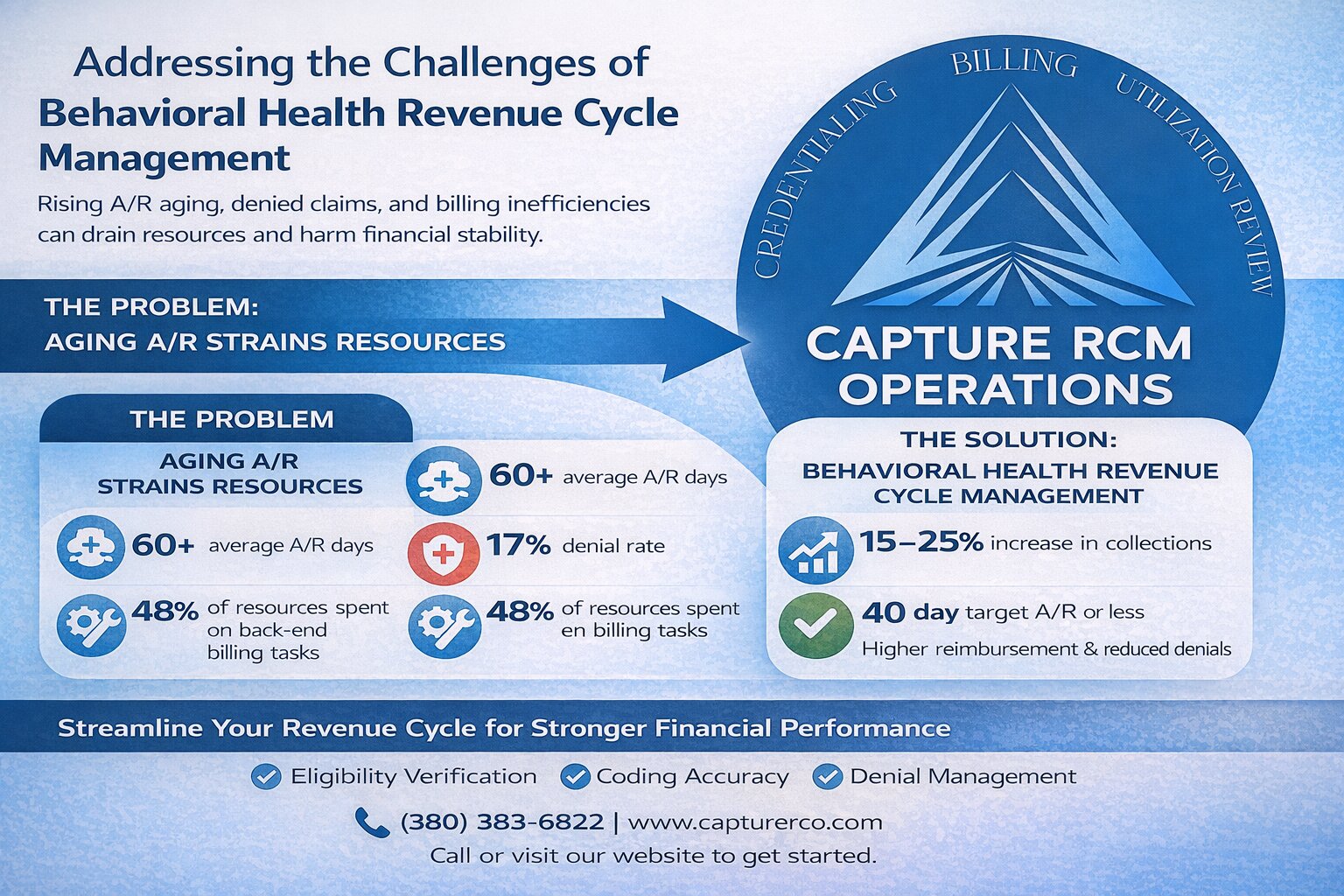
Industry benchmarks suggest that behavioral health providers should aim to keep A/R below 40 days. However, many organizations experience averages of 50–60 days or more, especially when billing workflows lack structured oversight.
As A/R aging increases, billing teams spend more time recovering delayed payments and less time improving operational efficiency.
Without a proactive revenue cycle strategy, these problems compound quickly, affecting both operational planning and long-term financial stability.
The Solution: Behavioral Health Revenue Cycle Management
Behavioral Health Revenue Cycle Management (RCM) is a systematic approach to managing every stage of the financial lifecycle of patient care.
Instead of treating billing as a back-office task, revenue cycle management integrates financial workflows into clinical operations from the moment a patient schedules an appointment.
A comprehensive behavioral health RCM strategy typically includes:
- Patient eligibility verification
- Insurance authorization management
- CPT coding accuracy and documentation alignment
- Claim submission and tracking
- Denial management and appeals
- Financial performance monitoring
Organizations that implement structured RCM strategies often reduce denial rates by 15–25% while improving reimbursement timelines.
For billing directors, this structured approach provides both visibility and control over revenue cycle performance.
Step 1: Strengthen Front-End Eligibility and Authorization Processes
Many billing problems begin long before claims are submitted. Eligibility verification errors and missing authorizations frequently lead to denied claims.
Front-end revenue cycle processes should include:
- Insurance coverage verification prior to appointments
- Behavioral health benefit verification
- Authorization requirement checks
- Documentation of payer-specific billing rules
If these steps are skipped or handled inconsistently, organizations risk submitting claims that insurers will automatically reject.
Automated eligibility verification tools can significantly reduce these errors. Studies show that organizations implementing automated verification processes can reduce coverage-related claim denials by up to 30%.
For billing directors, strengthening front-end verification is one of the fastest ways to improve overall revenue cycle performance.
Step 2: Improve Coding Accuracy for Behavioral Health Services
Coding accuracy plays a major role in claim approval rates. Behavioral health services rely heavily on time-based CPT codes, making documentation alignment critical.
Common psychotherapy billing codes include:
- 90834 – 45-minute psychotherapy session
- 90837 – 60-minute psychotherapy session
- 90846/90847 – family therapy sessions
If documentation does not clearly support the billed service, insurers may reject the claim or request additional records.
Behavioral Health Revenue Cycle Management frameworks typically include pre-submission claim review processes. These reviews verify that documentation supports the selected CPT codes.
Organizations implementing coding validation systems often improve first-pass claim acceptance rates by 10–15%.
Improved coding accuracy also reduces the time billing teams spend correcting and resubmitting claims.
Step 3: Implement Proactive Denial Management
Denied claims represent one of the largest sources of lost revenue in healthcare billing. In behavioral health organizations, denials often occur due to documentation inconsistencies, authorization errors, or coding issues.
Unfortunately, many billing departments address denials reactively rather than analyzing patterns.
A proactive denial management strategy should include:
- Categorizing denial reasons
- Tracking payer denial patterns
- Prioritizing recovery of high-value claims
- Adjusting workflows to prevent repeat denials
Healthcare revenue cycle research indicates that approximately 65% of denied claims are recoverable when addressed promptly.
Behavioral Health Revenue Cycle Management systems help billing directors identify recurring denial causes and implement corrective actions.
By focusing on root causes rather than individual claims, organizations can significantly reduce long-term denial rates.
Step 4: Monitor Revenue Cycle Performance Metrics
Effective revenue cycle oversight requires consistent performance monitoring. Billing directors should track key metrics that indicate financial efficiency.
Important revenue cycle indicators include:
- Clean claim rate
- Days in accounts receivable
- Denial rate
- Net collection rate
- Average reimbursement cycle time
High-performing behavioral health organizations typically maintain:
- Clean claim rates above 95%
- A/R below 40 days
- Denial rates below 5–7%
Regular review of these metrics allows leadership to detect operational problems early. For example, an increase in denial rates may indicate coding errors or changes in payer requirements.
Revenue cycle analytics provide the insight needed to make informed operational adjustments.
Step 5: Strengthen Collaboration Between Clinical and Billing Teams
Billing errors often originate from communication gaps between clinical staff and billing teams. When clinicians are unaware of billing requirements, documentation may not support reimbursement standards.
Examples of common issues include:
- Missing treatment plan updates
- Incomplete progress notes
- Incorrect session duration documentation
- Missing telehealth modifiers
Behavioral Health Revenue Cycle Management strategies emphasize collaboration between departments.
Regular meetings between clinical leaders and billing teams help address recurring issues and ensure documentation supports billing requirements.
Organizations that promote cross-department communication often experience fewer claim errors and faster reimbursement cycles.
Step 6: Leverage Technology for Revenue Cycle Transparency
Technology plays a central role in modern revenue cycle management. Billing directors rely on data analytics and automation tools to monitor financial performance.
Key revenue cycle technologies include:
- Automated eligibility verification systems
- Claims tracking dashboards
- Denial analytics reporting tools
- Authorization monitoring platforms
These tools provide real-time visibility into billing performance and help organizations identify bottlenecks quickly.
For example, analytics dashboards may reveal that a large percentage of unpaid claims are tied to a specific payer. Billing teams can then investigate whether documentation or authorization requirements have changed.
Organizations that implement revenue cycle analytics often increase collection rates by 10–15% within the first year.
Step 7: Consider Strategic Revenue Cycle Outsourcing
As behavioral health organizations grow, billing complexity increases. Managing insurance contracts, payer rules, and compliance requirements can overwhelm internal billing teams.
Many organizations address these challenges by partnering with specialized revenue cycle management providers.
Professional RCM partners provide:
- Behavioral health billing expertise
- Dedicated denial management teams
- Compliance monitoring and reporting
- Advanced revenue cycle analytics
Outsourced billing services also allow internal teams to focus on strategic oversight rather than daily claim processing.
For billing directors managing growing organizations, outsourcing revenue cycle management can provide the operational support needed to maintain financial stability.
Frequently Asked Questions
What is Behavioral Health Revenue Cycle Management?
Behavioral Health Revenue Cycle Management refers to the process of managing the financial lifecycle of behavioral health services—from patient scheduling and insurance verification to claim submission and payment collection.
Why do behavioral health organizations struggle with A/R aging?
Behavioral health billing involves complex payer requirements, authorization rules, and documentation standards. Without structured revenue cycle workflows, these complexities often lead to delayed reimbursements and increased accounts receivable aging.
What is the ideal A/R benchmark for behavioral health providers?
Most healthcare organizations aim to maintain accounts receivable under 40 days. Higher A/R levels often indicate billing inefficiencies or unresolved claim issues.
How can billing directors reduce claim denials?
Reducing denials typically involves improving eligibility verification, strengthening documentation standards, implementing coding validation processes, and tracking denial patterns through revenue cycle analytics.
Does technology improve revenue cycle performance?
Yes. Revenue cycle platforms that include automated verification, claim tracking, and denial analytics provide greater transparency and help organizations identify billing inefficiencies quickly.
Should behavioral health organizations outsource revenue cycle management?
Many organizations choose outsourcing to access specialized billing expertise, advanced analytics tools, and dedicated denial management resources. Outsourcing can improve revenue performance while reducing administrative burden.
If your organization is struggling with A/R aging, delayed reimbursements, or denial management challenges, a structured revenue cycle strategy can help stabilize financial performance and improve collections.
Call (380) 383-6822 or explore our Behavioral Health Revenue Cycle Management services to learn more.