


You didn’t open a therapy practice because you love insurance paperwork.
You opened it because you wanted to help people.
Yet somewhere between credentialing, documentation, claim submissions, eligibility checks, denied claims, and payer phone calls, many practice owners find themselves spending more time managing insurance than focusing on clients.
If you’ve recently started wondering whether getting help with insurance claims is worth it, you’re not alone.
Many behavioral health providers reach a point where they realize the administrative side of their practice has become larger than expected. They’re seeing clients all day and then spending evenings tracking payments, correcting claim errors, or trying to understand why reimbursements haven’t arrived.
That realization often leads providers to explore professional mental health billing services.
The good news is that outsourcing claims management is usually much simpler than most people expect.
In this guide, we’ll walk through what these services actually handle, how pricing typically works, what setup looks like, and how to decide whether it’s the right move for your practice.
The First Sign Isn’t Usually Lost Revenue
Most providers assume they’ll know it’s time for billing support when revenue starts declining.
In reality, the first warning sign is often exhaustion.
The therapist who stays late every night finishing claim corrections.
The group practice owner who spends weekends reviewing accounts receivable reports.
The clinical director who finds themselves checking payer portals during lunch breaks.
The burden grows gradually.
Because it grows slowly, many providers normalize it.
What starts as thirty minutes a week eventually becomes several hours every day.
The challenge isn’t just the time spent.
It’s the mental energy.
Every unresolved claim becomes another open tab in your brain.
Over time, those tabs add up.
Step 1: Understand What Insurance Claim Support Actually Handles
Many providers think claim support simply means someone presses “submit” on insurance claims.
The reality is far more comprehensive.
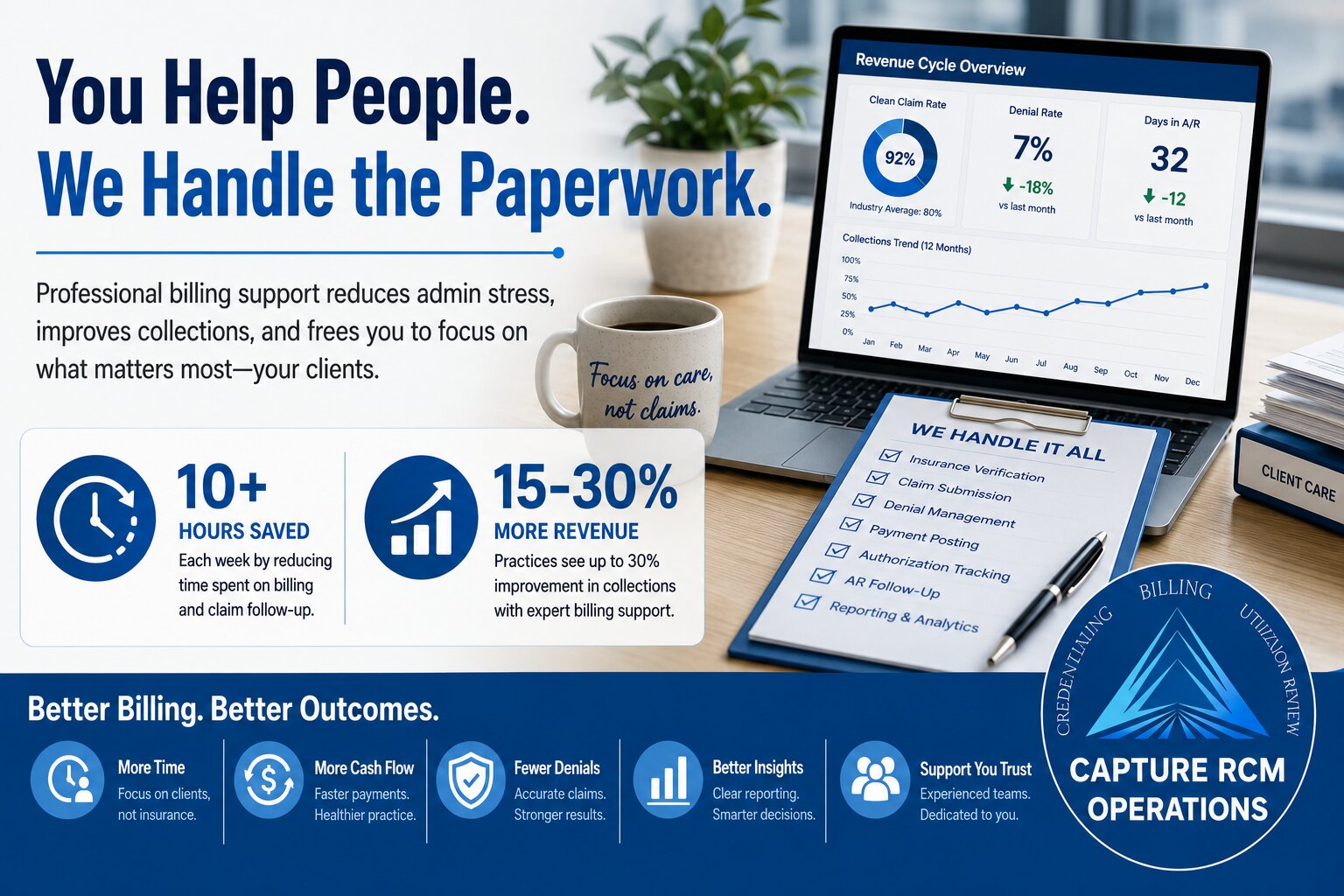
Most professional billing teams become involved throughout the revenue cycle.
This may include:
Insurance Verification
Before treatment even begins, benefits and eligibility can be reviewed to identify coverage requirements and potential issues.
Claim Submission
Claims are prepared and submitted accurately using payer-specific requirements and coding guidelines.
Denial Management
Denied claims are investigated, corrected, and resubmitted when appropriate.
Payment Posting
Payments from insurance companies are recorded and reconciled.
Appeals and Reconsiderations
When claims are denied incorrectly or require additional documentation, billing teams often coordinate appeals.
Authorization Tracking
Many behavioral health services require authorization or ongoing utilization reviews.
Monitoring these requirements helps prevent avoidable denials.
Accounts Receivable Follow-Up
Outstanding balances are tracked and pursued to reduce aging claims.
Reporting and Revenue Analysis
Detailed reporting helps providers understand collections, denial trends, and financial performance.
For many practice owners, seeing the full list is eye-opening.
They realize they have been carrying far more administrative responsibility than they originally recognized.
Step 2: Calculate the Real Cost of Doing Everything Yourself
Most providers ask:
“How much does outsourcing cost?”
That’s an important question.
But there’s another question that’s often more revealing:
“How much is my current process costing me?”
Many practice owners focus exclusively on the direct expense of hiring billing support.
They overlook costs such as:
- Unpaid claims
- Missed filing deadlines
- Delayed reimbursements
- Staff overtime
- Provider burnout
- Reduced client capacity
- Administrative turnover
- Lost growth opportunities
Imagine a therapist who spends ten hours each week managing billing.
If those ten hours could instead be used for client care, supervision, business development, or personal time, the value quickly becomes significant.
Sometimes the biggest expense isn’t the billing service.
It’s everything that’s being sacrificed without one.
Step 3: Learn How Pricing Usually Works
Billing support pricing varies depending on several factors.
Common considerations include:
- Number of providers
- Monthly claim volume
- Insurance complexity
- Service scope
- Existing workflow issues
- Specialty requirements
Most billing partnerships follow one of two primary structures.
Percentage of Collections
This model charges a percentage of successfully collected revenue.
Many providers appreciate this approach because compensation aligns with reimbursement performance.
When claims are paid correctly and efficiently, everyone benefits.
Flat Monthly Fee
Some organizations offer fixed pricing based on anticipated workload and service requirements.
This can create more predictable monthly budgeting.
The best option often depends on practice size, growth goals, and operational complexity.
Step 4: Know What Setup Really Looks Like
One of the biggest fears providers have is disruption.
Many imagine weeks of confusion, interrupted payments, and operational headaches.
Fortunately, onboarding is often far less dramatic.
Most implementations follow a structured process.
Discovery and Assessment
The billing team reviews your current workflows, payer mix, software systems, and claim performance.
This stage identifies existing strengths and areas needing improvement.
Technology Integration
Access is established for:
- Electronic health record systems
- Practice management platforms
- Clearinghouses
- Payer portals
- Reporting systems
Most modern billing teams are already familiar with commonly used platforms.
Workflow Mapping
Current procedures are reviewed to identify bottlenecks and inefficiencies.
Many providers discover denial patterns they didn’t realize existed.
Communication Planning
Clear communication processes are established so questions, updates, and escalations are handled efficiently.
Rather than creating confusion, onboarding often creates structure.
Step 5: Pay Attention to Denials
Denied claims are often where practices lose the most money.
Many providers submit claims successfully.
The problem begins after submission.
Insurance companies may reject, deny, or delay payment for reasons including:
- Missing documentation
- Authorization issues
- Coding discrepancies
- Eligibility concerns
- Coordination of benefits conflicts
- Payer-specific requirements
When these issues aren’t addressed quickly, revenue slows.
Over time, the impact compounds.
This is one reason many providers researching outsourced claims for therapists eventually seek professional support. They realize that reducing denials can dramatically improve cash flow without adding a single new client.
Think of denials like a small leak in a roof.
One drop doesn’t seem significant.
Ignore it long enough, and you’re suddenly dealing with major damage.
Step 6: Understand the Benefits Beyond Revenue
Most providers initially focus on financial outcomes.
Those benefits matter.
But many practice owners report something unexpected after transitioning billing responsibilities.
Relief.
The emotional weight begins to lift.
Common improvements include:
Better Work-Life Balance
Evenings become available again.
Weekends become less focused on administrative catch-up.
Improved Staff Satisfaction
Front-office teams often spend less time navigating insurance issues.
Greater Operational Visibility
Detailed reporting creates a clearer understanding of financial performance.
Stronger Growth Capacity
Administrative systems can support expansion more effectively.
More Clinical Focus
Providers spend more time helping clients and less time managing claims.
One practice owner described it perfectly:
“It felt like finally taking off a backpack I didn’t realize I’d been carrying.”
That’s often the hidden value.
Not just improved collections.
Improved capacity to focus on meaningful work.
Step 7: Decide Whether You’re Solving Today’s Problem or Tomorrow’s
Many providers wait until billing becomes a crisis.
They wait until:
- Cash flow becomes unpredictable
- Denials spike
- Staff become overwhelmed
- Growth stalls
But strong practices often make the transition before reaching that point.
Why?
Because proactive decisions are usually less stressful than reactive ones.
A growing practice creates increasing complexity.
Additional providers create more claims.
More claims create more opportunities for delays and denials.
Building strong billing systems early often makes future growth much easier.
What a Good Billing Partnership Should Feel Like
The goal isn’t simply finding someone to submit claims.
The goal is finding a partner who strengthens your operations.
A quality billing relationship should provide:
- Transparency
- Consistent communication
- Reliable reporting
- Revenue visibility
- Denial reduction strategies
- Ongoing support
You should feel more informed, not less.
More confident, not less.
More focused on patient care, not less.
If a billing solution creates confusion, it isn’t solving the right problem.
The Question Many Practice Owners Eventually Ask
At first, providers ask:
“Can someone help with my claims?”
Eventually, the question evolves.
It becomes:
“What could my practice become if I stopped spending so much time fighting insurance companies?”
That’s often the turning point.
Because billing support isn’t really about claims.
It’s about reclaiming time.
It’s about reducing stress.
It’s about creating room to grow.
And most importantly, it’s about allowing providers to focus on the people sitting across from them rather than the paperwork sitting on their desks.
Frequently Asked Questions
How much does insurance claim support usually cost?
Costs vary depending on practice size, claim volume, payer complexity, and service scope. Most organizations use either percentage-based pricing or flat monthly fees.
Is outsourcing billing only beneficial for large practices?
No. Solo therapists, small group practices, and large behavioral health organizations can all benefit from billing support.
How long does implementation take?
The timeline varies, but many transitions can begin within a few weeks depending on technology requirements and workflow complexity.
Will I lose visibility into my revenue?
A quality billing partner should increase visibility through reporting, analytics, and ongoing communication.
Can billing support reduce claim denials?
Yes. Many billing teams focus heavily on identifying denial trends, correcting issues, and improving claim accuracy.
Do patients notice when billing is outsourced?
In most cases, patients experience smoother billing processes, better communication, and fewer claim-related issues.
What is the biggest advantage of outsourcing claims management?
For many providers, the greatest benefit is reclaiming time and reducing administrative burden while improving revenue cycle performance.
How do I know if my practice is ready?
If billing responsibilities are affecting patient care, staff efficiency, work-life balance, or growth, it may be worth exploring professional support.
Call (380) 383-6822 or visit our mental health billing services to learn more about our services, billing, mental health services.