

A parent called me recently and sounded exhausted before she even finished her first sentence.
Her son was twenty years old. After months of progress, he had started using again. The family was doing everything they could to keep support in place. Appointments were being scheduled. Documentation had been submitted. Everyone was trying to focus on recovery.
Then another insurance letter arrived.
Denied.
Again.
The hardest part wasn’t the paperwork.
It was the feeling that every time they took one step forward, something pushed them two steps back.
If you’re staring at a denial notice with code CO-197 and wondering what happens next, I want you to hear this first:
You are not alone.
And despite how overwhelming it feels right now, this denial does not automatically mean treatment is ending or that all options have disappeared.
Many families find themselves learning more about insurance processes than they ever expected. Questions about claim denials often lead providers to seek stronger support through mental health billing services because even small administrative issues can create major disruptions in care.
Why Insurance Denials Feel Different When You’re a Parent
Most insurance letters are written as if they are discussing numbers.
Families know they are discussing people.
That’s why a denial often hits harder than anyone expects.
When your child is struggling, every appointment matters. Every week of care matters. Every sign of stability matters.
You aren’t reading a billing code.
You’re reading something connected to your child’s health, safety, and future.
Parents often tell me they experience a flood of emotions after receiving a denial notice:
- Fear that treatment will stop
- Anger toward the insurance company
- Guilt for not understanding the process
- Confusion about what the letter actually means
- Exhaustion from constantly fighting administrative battles
None of those reactions are irrational.
They’re human.
When you’re already worried about relapse, recovery, and your child’s wellbeing, another obstacle can feel unbearable.
What Does CO-197 Actually Mean?
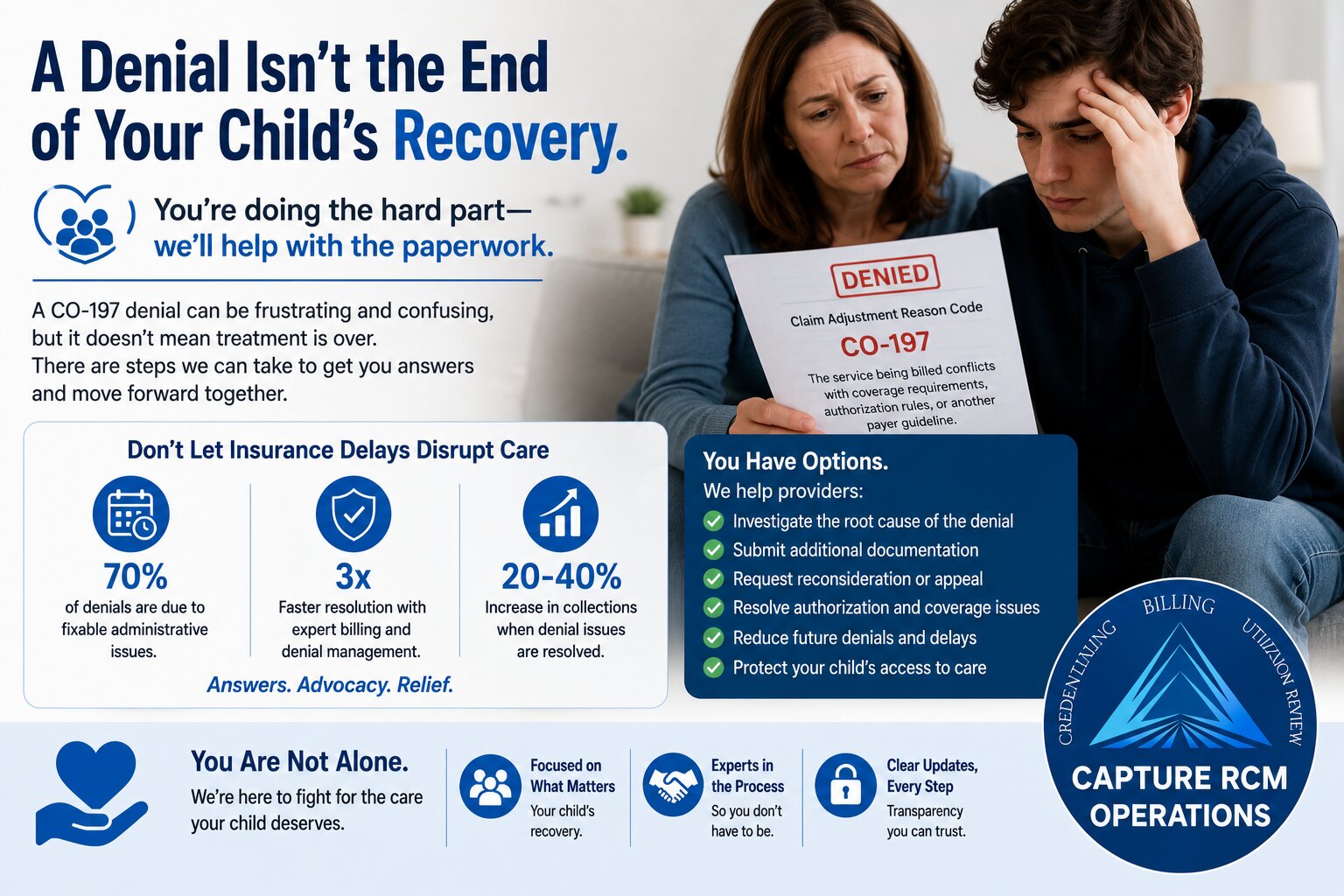
CO-197 is a claim adjustment reason code that generally indicates the service being billed conflicts with coverage rules, authorization requirements, benefit limitations, or another payer guideline.
Unfortunately, the code itself rarely tells the whole story.
That’s what makes it so frustrating.
Many parents expect the denial letter to clearly explain the problem and provide a simple solution.
Instead, they often receive a short description that creates more questions than answers.
Think of CO-197 like a check-engine light in your car.
The light tells you something requires attention.
It doesn’t tell you exactly which component caused the warning.
Additional investigation is usually necessary before anyone can determine the actual issue and identify the best path forward.
Why This Denial Shows Up More Often Than Families Realize
One of the biggest misconceptions surrounding insurance denials is the belief that they only happen when care is not medically necessary.
In reality, many denials have little to do with the quality of treatment being provided.
Insurance claims can be denied because of:
- Authorization discrepancies
- Missing documentation
- Eligibility verification issues
- Coordination of benefits problems
- Coding inconsistencies
- Timely filing limitations
- Payer policy updates
- Administrative errors
In some cases, treatment may have been entirely appropriate while the claim was denied because of a paperwork issue.
That distinction matters.
A denial is not always a statement about whether someone needs help.
Sometimes it is simply a statement about whether specific administrative requirements were met.
The Emotional Cost of Not Understanding What’s Happening
I often notice that parents suffer most during the period of uncertainty.
The unknown becomes its own source of stress.
Your mind starts filling in the blanks.
You wonder:
“Does this mean insurance won’t pay anymore?”
“Will treatment stop?”
“Are we going to owe thousands of dollars?”
“Did someone make a mistake?”
“Are we running out of options?”
Without clear answers, fear tends to take over.
I sometimes compare it to standing in a dark room and hearing a strange noise.
The longer you can’t identify the sound, the larger and more threatening it becomes.
Many denial letters create that same experience.
The uncertainty becomes heavier than the actual problem.
Why Parents Often Blame Themselves
One pattern I see repeatedly is self-blame.
Parents assume they should have understood the insurance process better.
They believe they should have asked different questions.
They wonder whether they missed something important.
Please hear me clearly:
Most families are not trained in healthcare billing.
You should not be expected to understand payer policies, denial codes, authorization requirements, and claim processing systems.
These systems are complicated even for professionals who work with them every day.
The fact that you’re confused does not mean you’ve failed.
It means you’re trying to navigate a system that was never designed to be easy.
What Usually Happens After a CO-197 Denial?
The next step is determining the underlying cause.
That process often involves reviewing:
- Authorization records
- Clinical documentation
- Eligibility information
- Insurance correspondence
- Claim submission details
- Payer-specific policies
Once the issue is identified, providers may be able to:
- Submit corrected claims
- Provide additional documentation
- Request reconsideration
- File an appeal
- Clarify coverage details
- Resolve administrative discrepancies
This is one reason conversations around IOP claims denial reasons continue to be important within behavioral health revenue cycle management. Understanding the underlying source of a denial often creates opportunities to correct the issue and move the process forward.
Recovery Is Hard Enough Without Administrative Obstacles
When a young adult starts using substances again, families are already carrying an enormous burden.
You’re monitoring safety.
You’re managing emotions.
You’re having difficult conversations.
You’re trying to maintain hope while preparing for setbacks.
Adding insurance complications to that situation can feel like carrying a backpack full of bricks during an uphill climb.
Every additional challenge feels heavier than it normally would.
That’s why families often need reassurance that the denial itself is not necessarily the crisis.
The crisis is the fear and uncertainty that follows when no one explains what comes next.
Why Specialized Billing Support Matters
Behavioral health billing is rarely straightforward.
Coverage requirements change.
Authorization standards evolve.
Documentation expectations vary between payers.
Even experienced providers can encounter denials that require investigation and follow-up.
Strong billing support helps providers:
- Identify denial trends
- Investigate root causes
- Improve claim accuracy
- Reduce reimbursement delays
- Strengthen documentation processes
- Improve communication with payers
Most importantly, it helps reduce interruptions that can affect patient care.
Families should spend their energy supporting recovery—not deciphering insurance language.
One Letter Does Not Predict the Future
I’ve watched families receive denial letters and immediately assume the worst.
The mind naturally jumps ahead.
“We’re losing coverage.”
“Treatment is over.”
“We’ve failed.”
Yet many of those same situations were eventually resolved.
Claims were corrected.
Appeals were approved.
Documentation issues were addressed.
Coverage questions were clarified.
The denial was real.
The fear was real.
But the catastrophic outcome they imagined never arrived.
That’s why I encourage parents to view a denial as information rather than a verdict.
Information can be investigated.
Information can be challenged.
Information can sometimes be corrected.
A denial is not a prediction about your child’s recovery.
It is not proof that help has run out.
And it is not evidence that your family is out of options.
There may still be several paths forward that simply haven’t become visible yet.
You Are Not Failing
If you’re reading denial letters while also worrying about a child who has started struggling again, you’re carrying more than most people realize.
You are navigating emotional stress, family concerns, healthcare systems, and financial uncertainty all at once.
That’s a tremendous amount of weight.
So if another denial arrived this week and left you feeling defeated, remember this:
You are not failing.
Your child is not failing.
And one insurance code does not get to decide the future of your family.
Sometimes the next step is simply understanding what happened, asking the right questions, and getting support from people who understand the system.
Hope doesn’t always arrive as a dramatic breakthrough.
Sometimes it arrives as clarity.
And clarity is often where solutions begin.
Frequently Asked Questions
Does CO-197 mean treatment is no longer covered?
Not necessarily. CO-197 often indicates a conflict with coverage requirements, authorization rules, or billing guidelines. Additional review is usually needed to determine the exact cause.
Can a CO-197 denial be appealed?
In many situations, yes. Depending on the underlying issue, providers may submit additional documentation, request reconsideration, or file a formal appeal.
Does a denial mean the provider made a mistake?
Not always. Denials can occur for many reasons, including payer requirements, eligibility issues, authorization concerns, documentation gaps, or administrative discrepancies.
How long does it take to resolve a denial?
The timeline varies depending on the payer and the specific issue involved. Some corrections can be resolved relatively quickly, while appeals may take longer.
Why do behavioral health claims get denied so often?
Behavioral health claims often involve detailed authorization requirements, documentation standards, and payer-specific guidelines. Even small discrepancies can trigger denials.
Should families contact the insurance company directly?
Families can certainly ask questions, but providers and billing specialists often have access to additional claim details and denial information that can help identify the root cause more efficiently.
What should I do if I receive multiple denial notices?
Multiple denials may indicate a recurring issue that needs investigation. Reviewing the denials carefully and working with experienced billing professionals can help identify patterns and potential solutions.
Call (380) 383-6822 or visit our mental health billing services to learn more about our mental health billing services.