


Cash flow instability is one of the most common—and most disruptive—challenges for behavioral health practice owners. You may be delivering consistent care, maintaining steady census, and still facing unpredictable revenue cycles that make planning difficult.
Behavioral Health Revenue Cycle Management brings structure and predictability to that process. Many practices begin identifying the root causes of cash flow inconsistency by reviewing their current behavioral health revenue cycle services and uncovering where revenue is being delayed, lost, or mismanaged.
Why Cash Flow Feels Unpredictable Even With Steady Volume
Unpredictable cash flow is rarely tied to patient demand. Most practices experiencing volatility have stable or even growing patient volumes.
The issue lies in how revenue moves—not how it’s generated.
Common causes include:
- Delays between service delivery and claim submission
- Inconsistent payer reimbursement timelines
- High denial rates and rework cycles
- Gaps in authorization management
Key Insight: If your revenue fluctuates while patient volume remains consistent, your revenue cycle lacks process discipline.
The Revenue Lag: Where Cash Flow Starts to Break Down
One of the biggest contributors to unpredictable cash flow is the delay between delivering care and receiving payment.
This lag is often caused by:
- Documentation not completed in real time
- Charges entered days after services are rendered
- Claims submitted in batches instead of daily
Example: A practice delivering $750,000 in monthly services may only collect $500,000 within that same month due to submission delays and payer processing timelines.
Operational Fix:
- Require documentation completion within 24 hours
- Submit claims within 24–48 hours
- Monitor lag time as a core KPI
Reducing revenue lag is one of the fastest ways to stabilize cash flow.
Behavioral Health Revenue Cycle Management Creates Consistency
A structured Behavioral Health Revenue Cycle Management system ensures that each step in the revenue cycle operates predictably.
This includes:
- Standardized intake and eligibility verification
- Real-time authorization tracking
- Clean, accurate claims submission
- Consistent follow-up processes
Result: Practices that implement structured RCM processes often see:
- 15–30% reduction in A/R days
- Faster payment cycles
- Improved financial forecasting accuracy
Consistency—not volume—is what drives predictable cash flow.
Authorization Issues Are Quietly Disrupting Revenue
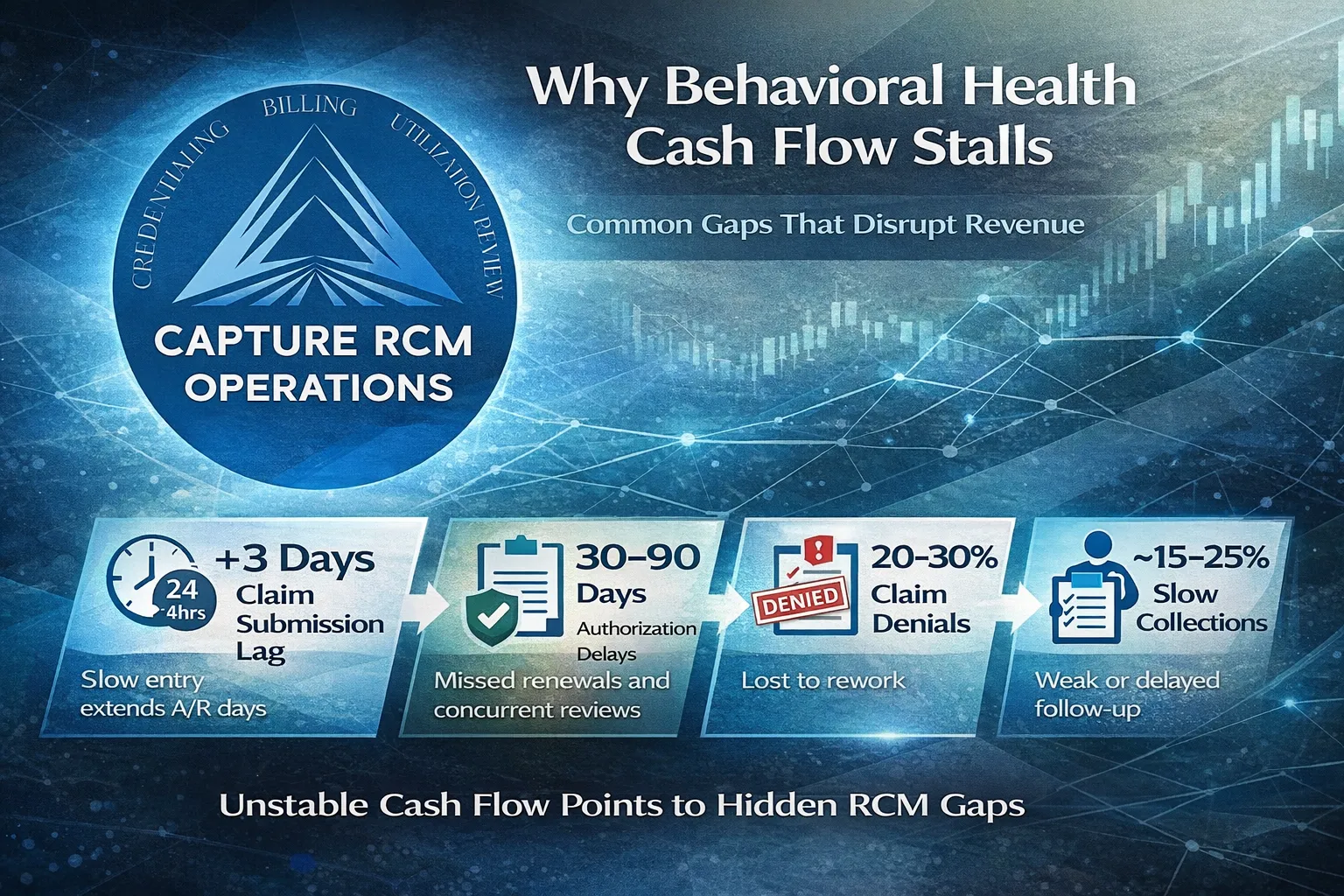
Authorization management is one of the most overlooked drivers of cash flow instability.
Behavioral health services often require ongoing authorization updates, and even small gaps can delay reimbursement.
Common issues:
- Authorization units exhausted without renewal
- Delays in concurrent review submissions
- Mismatch between authorized services and billed codes
Impact: Authorization-related delays can extend payment timelines by 30–90 days.
Strategic Fix:
- Centralize authorization tracking
- Assign dedicated ownership
- Implement automated alerts for expirations
Improving authorization workflows directly stabilizes revenue timing.
Denials Are Creating Hidden Cash Flow Gaps
Denied claims don’t just delay payment—they disrupt your entire revenue cycle.
Each denial requires:
- Investigation
- Correction
- Resubmission
- Additional follow-up
Data Insight: Practices can lose 20–30% of billing team capacity to denial rework.
Common denial drivers:
- Eligibility verification errors
- Documentation inconsistencies
- Authorization mismatches
Solution:
- Track denials by payer and category
- Identify recurring issues
- Implement process improvements at the source
Reducing denials improves both efficiency and cash flow predictability.
Follow-Up Discipline Determines How Fast You Get Paid
Even clean claims require consistent follow-up to ensure timely reimbursement.
Without structured follow-up:
- Claims sit unpaid for weeks
- Payer issues go unresolved
- Revenue remains tied up in A/R
Best Practice:
- Initiate follow-up within 7–10 days
- Maintain weekly follow-up cycles
- Prioritize high-value claims
Result: Practices with disciplined follow-up processes often see 15–25% faster collections.
Lack of Visibility Is Driving Financial Uncertainty
Many practice owners lack real-time insight into their revenue cycle performance. This makes it difficult to identify problems before they impact cash flow.
Common visibility gaps:
- No real-time A/R dashboards
- Limited insight into payer performance
- Delayed reporting cycles
Solution:
- Implement real-time KPI tracking
- Monitor A/R, denial rates, and collection timelines weekly
- Use data to guide operational decisions
When you can see your revenue clearly, you can manage it effectively.
Aligning Clinical and Billing Teams for Better Outcomes
Cash flow issues are often the result of misalignment between clinical and billing teams.
Examples include:
- Clinicians unaware of documentation requirements
- Billing teams correcting errors instead of preventing them
- Lack of communication between departments
Operational Fix:
- Standardize workflows across teams
- Provide joint training sessions
- Align accountability for revenue outcomes
When clinical and billing teams operate in sync, revenue flows more efficiently.
Building a Predictable Revenue System
Predictable cash flow is the result of a well-structured system—not reactive effort.
A high-performing Behavioral Health Revenue Cycle Management strategy includes:
- Accurate front-end processes
- Real-time authorization management
- Fast and clean claims submission
- Structured follow-up workflows
- Continuous performance monitoring
Practices that implement these systems consistently achieve stable, predictable revenue.
The Business Impact of Predictable Cash Flow
Stabilizing cash flow creates immediate and long-term benefits for practice owners.
These include:
- Improved financial planning and forecasting
- Ability to scale programs with confidence
- Reduced operational stress
- Enhanced patient care through stable resources
Bottom Line: Predictable revenue is the foundation of sustainable growth.
FAQs: Behavioral Health Revenue Cycle Management and Cash Flow
Why is my cash flow inconsistent even with steady patient volume?
Because revenue delays are typically caused by process inefficiencies—such as submission delays, denials, and authorization issues—not patient demand.
How quickly should claims be submitted to improve cash flow?
Claims should be submitted within 24–48 hours of service delivery to minimize delays and accelerate reimbursement.
What is the biggest driver of cash flow delays in behavioral health?
Authorization mismanagement and front-end errors are among the top contributors to delayed payments.
How can I improve cash flow without increasing patient volume?
Focus on optimizing your revenue cycle:
- Reduce claim submission lag
- Improve clean claim rates
- Strengthen follow-up processes
- Minimize denials
What KPIs should I monitor to improve cash flow?
Key metrics include:
- Days in A/R
- Clean Claim Rate
- Denial Rate
- Net Collection Rate
Tracking these regularly helps identify and resolve issues quickly.
How does denial reduction impact cash flow?
Fewer denials mean faster payments, less rework, and more efficient use of billing resources—directly improving cash flow.
Can better revenue cycle management improve patient care?
Yes. Stable cash flow supports staffing, program expansion, and operational consistency, all of which enhance patient care quality.
Stabilize Your Cash Flow With the Right Strategy
If your practice is experiencing unpredictable cash flow, the issue is not demand—it’s how revenue moves through your system. Addressing gaps in intake, authorizations, billing, and follow-up can significantly improve financial performance.
Call 380-383-6822 or explore our Behavioral Health Revenue Cycle Management services to improve collections, reduce delays, and build a more predictable, scalable revenue cycle.