

Behavioral Health Revenue Cycle Management is often evaluated by a single operational metric: days in accounts receivable. But for Billing Directors, that number is rarely the root problem—it’s the visible symptom of deeper process inefficiencies.
A/R aging doesn’t stall because teams aren’t working hard enough. It stalls because systems, workflows, and accountability structures aren’t aligned. If collections are slowing despite increased effort, it’s time to look upstream and address the real causes.
Many organizations begin uncovering these gaps by evaluating their current behavioral health revenue cycle services to identify inefficiencies early and correct them before they impact cash flow.
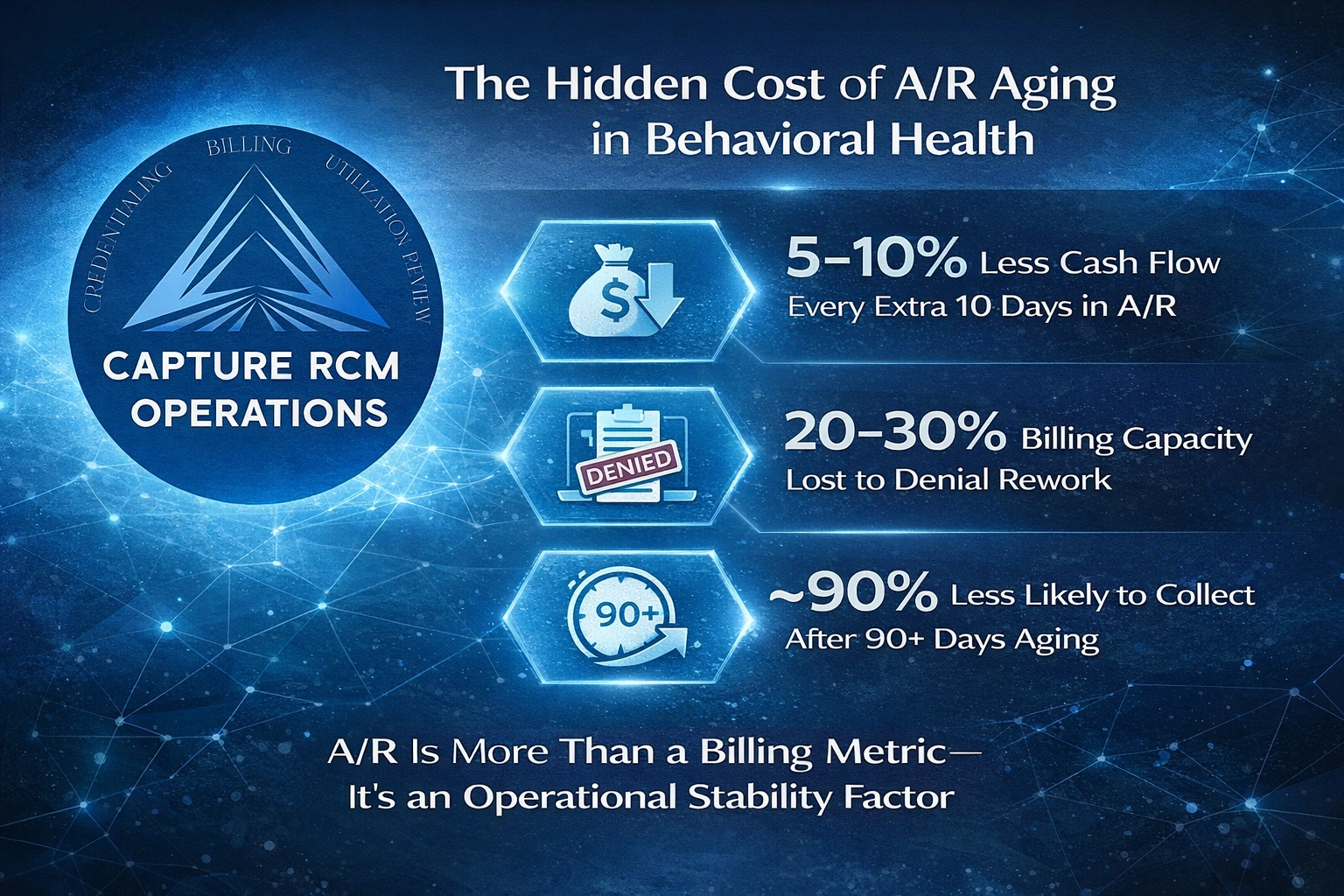
The Hidden Cost of A/R Aging in Behavioral Health
A/R delays don’t just affect cash flow—they directly impact operational stability, staffing decisions, and patient care quality.
Consider this:
- Every additional 10 days in A/R can reduce available operating cash by 5–10%
- Denial rework can consume up to 20–30% of billing team capacity
- Aging beyond 90 days significantly lowers the likelihood of full reimbursement
For behavioral health organizations operating on tight margins, these delays can disrupt hiring plans, limit program expansion, and create unnecessary financial stress.
Key Insight: A/R is not just a billing metric—it’s a reflection of how well your entire organization is functioning.
Front-End Breakdowns That Quietly Disrupt Collections
The most expensive billing mistakes happen before a claim is ever submitted.
Common front-end issues include:
- Incomplete or outdated insurance verification
- Missing or incorrect patient demographics
- Failure to confirm payer-specific requirements at intake
- Inconsistent financial responsibility communication
These issues often go unnoticed until claims are denied or delayed weeks later.
Example: A patient admitted without verified secondary insurance can create a cascade of coordination-of-benefits issues, delaying reimbursement by 45+ days.
Action Plan:
- Standardize intake checklists across all locations
- Require real-time eligibility verification at every visit
- Implement front-end QA reviews for high-value admissions
Authorization Mismanagement: The #1 Driver of Delayed Revenue
In behavioral health, prior authorizations are not optional—they are foundational.
Yet many organizations rely on manual tracking systems or shared ownership models that lead to missed updates.
Common pitfalls:
- Authorization limits not aligned with treatment plans
- Expired authorizations mid-episode of care
- Incorrect service codes tied to authorizations
Operational Impact: Even one missed authorization update can delay multiple claims across several weeks of treatment.
Solution Framework:
- Assign a dedicated authorization specialist or team
- Use centralized dashboards to track authorization status in real time
- Implement automated alerts for expiration thresholds
Organizations that proactively manage authorizations often reduce denial rates by 20–40%.
Documentation and Coding Gaps That Trigger Denials
Behavioral health billing is highly dependent on documentation integrity. Payers are increasingly auditing claims for medical necessity, session accuracy, and compliance.
Frequent issues include:
- Notes that do not justify the level of care billed
- Time discrepancies between documentation and CPT codes
- Missing signatures or incomplete treatment plans
Stat Insight: Up to 65% of denials in behavioral health can be traced back to documentation or coding issues.
Strategic Fix:
- Develop standardized documentation templates for each level of care
- Train clinicians on payer expectations—not just clinical best practices
- Conduct routine internal audits to identify patterns early
Aligning clinical documentation with billing requirements is one of the fastest ways to reduce A/R aging.
Claims Submission Delays and Inefficiencies
Even clean claims lose value when submission is delayed.
Common operational gaps:
- Charges entered days (or weeks) after service delivery
- Batch submissions instead of daily claim processing
- Lack of claim scrubbing before submission
Best Practice Benchmark:
- Claims should be submitted within 24–48 hours of service
- Clean claim rates should exceed 95%
Process Improvement Steps:
- Automate charge capture wherever possible
- Implement claim scrubbing tools to catch errors pre-submission
- Move from batch to daily submission workflows
Faster submission directly reduces A/R days and accelerates cash flow.
Weak Follow-Up Processes That Let Revenue Slip
Submitting a claim is not the finish line—it’s the starting point of collections.
Yet many billing teams lack structured follow-up protocols.
Common issues:
- Follow-ups delayed until 30+ days post-submission
- No prioritization of high-value claims
- Inconsistent payer communication strategies
High-Performance Model:
- First follow-up within 7–10 days
- Weekly touchpoints for unresolved claims
- Dedicated payer escalation pathways
Organizations that implement disciplined follow-up processes often see 15–25% faster collections.
Denial Management Without Prevention Strategy
Reworking denials is necessary—but it should not be the primary strategy.
Without root cause analysis, denial management becomes a cycle of repetition.
Top denial categories:
- Authorization-related denials
- Medical necessity disputes
- Eligibility and coverage issues
Critical Shift:
Move from reactive denial correction to proactive denial prevention.
Execution Steps:
- Track denials by payer, type, and frequency
- Identify top recurring denial drivers monthly
- Implement process changes at the source
Reducing denial volume—even by 10%—can significantly improve A/R performance.
Limited Visibility Into Revenue Cycle Performance
If leadership lacks real-time data, decision-making becomes reactive instead of strategic.
Warning signs:
- Reports generated monthly instead of weekly
- No visibility into payer-specific performance
- Lack of accountability tied to KPIs
Essential Metrics to Track:
- Days in A/R
- Clean Claim Rate
- Denial Rate
- Net Collection Rate
Best Practice:
Establish weekly revenue cycle reviews with clear ownership and action items.
Aligning Clinical and Billing Teams for Sustainable Results
One of the most overlooked causes of A/R delays is misalignment between clinical and billing departments.
Examples:
- Clinicians unaware of documentation requirements tied to reimbursement
- Billing teams correcting errors instead of preventing them
Solution:
- Create shared accountability structures
- Conduct joint training sessions
- Align incentives across departments
When clinical and billing teams operate as one system, A/R performance improves significantly.
Building a Scalable Behavioral Health Revenue Cycle Strategy
Fixing A/R isn’t about short-term fixes—it requires a scalable, system-wide approach.
A high-performing Behavioral Health Revenue Cycle Management strategy includes:
- Strong front-end processes
- Real-time authorization tracking
- Documentation aligned with payer expectations
- Fast and accurate claims submission
- Structured follow-up workflows
- Data-driven decision-making
Organizations that implement these systems consistently reduce A/R days, improve cash flow predictability, and create a foundation for growth.
FAQs: Behavioral Health Revenue Cycle Management and A/R
What is considered a healthy A/R range in behavioral health?
A healthy A/R range is typically 30–45 days. Anything above 60 days indicates inefficiencies that need immediate attention.
What is the most common cause of A/R delays?
Authorization issues and front-end errors are the leading causes. These problems originate before claims are submitted and compound over time.
How often should A/R be reviewed?
A/R should be reviewed weekly, not monthly. Frequent reviews allow teams to identify and resolve issues before they escalate.
What is a clean claim rate, and why does it matter?
A clean claim rate measures the percentage of claims accepted on first submission. A rate above 95% indicates strong front-end and billing processes.
How can denial rates be reduced?
Denial rates can be reduced by:
- Improving authorization tracking
- Standardizing documentation
- Conducting regular audits
- Addressing root causes instead of reworking claims
Should billing teams handle authorizations?
While billing teams can support the process, best practice is to assign dedicated authorization ownership to ensure accountability and accuracy.
How does A/R impact patient care?
Delayed revenue can limit staffing, reduce program availability, and create operational strain—ultimately affecting the quality of care delivered.
Take Control of Your A/R Performance
If your organization is experiencing persistent A/R delays, the issue is not effort—it’s structure. Addressing front-end gaps, improving authorization workflows, and implementing disciplined follow-up processes can significantly improve financial performance.
Call 380-383-6822 or explore our Behavioral Health Revenue Cycle Management services to reduce A/R days, improve collections, and build a more predictable revenue cycle.