

Running a behavioral health practice often means balancing clinical care, staffing, compliance, and financial management at the same time. For many practice owners, billing becomes one of the most stressful operational areas. Claims move slowly, accounts receivable grow, and it becomes difficult to predict monthly cash flow.
This is where Behavioral Health Revenue Cycle Management creates meaningful operational change. Instead of reactive billing processes, a structured revenue cycle system brings consistency to insurance verification, documentation workflows, claim submission, and payment collection.
When implemented effectively, revenue cycle management helps practices reduce denial rates, accelerate reimbursements, and stabilize financial performance. Many organizations adopt structured Behavioral Health Revenue Cycle Management services to replace fragmented billing processes with scalable operational systems.
For practice owners experiencing billing chaos, understanding how revenue cycle management works is the first step toward restoring financial control.
The Problem: Billing Chaos Creates Unpredictable Cash Flow
Billing chaos rarely appears suddenly. In most practices, it develops gradually as patient volume increases and operational complexity grows.
Early-stage practices often manage billing internally with a small administrative team. As more clinicians join the practice and insurance contracts expand, billing workflows become increasingly complicated.
Common challenges include:
- Missing insurance authorizations
- Incorrect CPT coding
- Incomplete clinical documentation
- Delayed claim submissions
- Manual claim follow-up
- Limited financial reporting visibility
These operational gaps often result in rising accounts receivable (A/R) and delayed reimbursements.
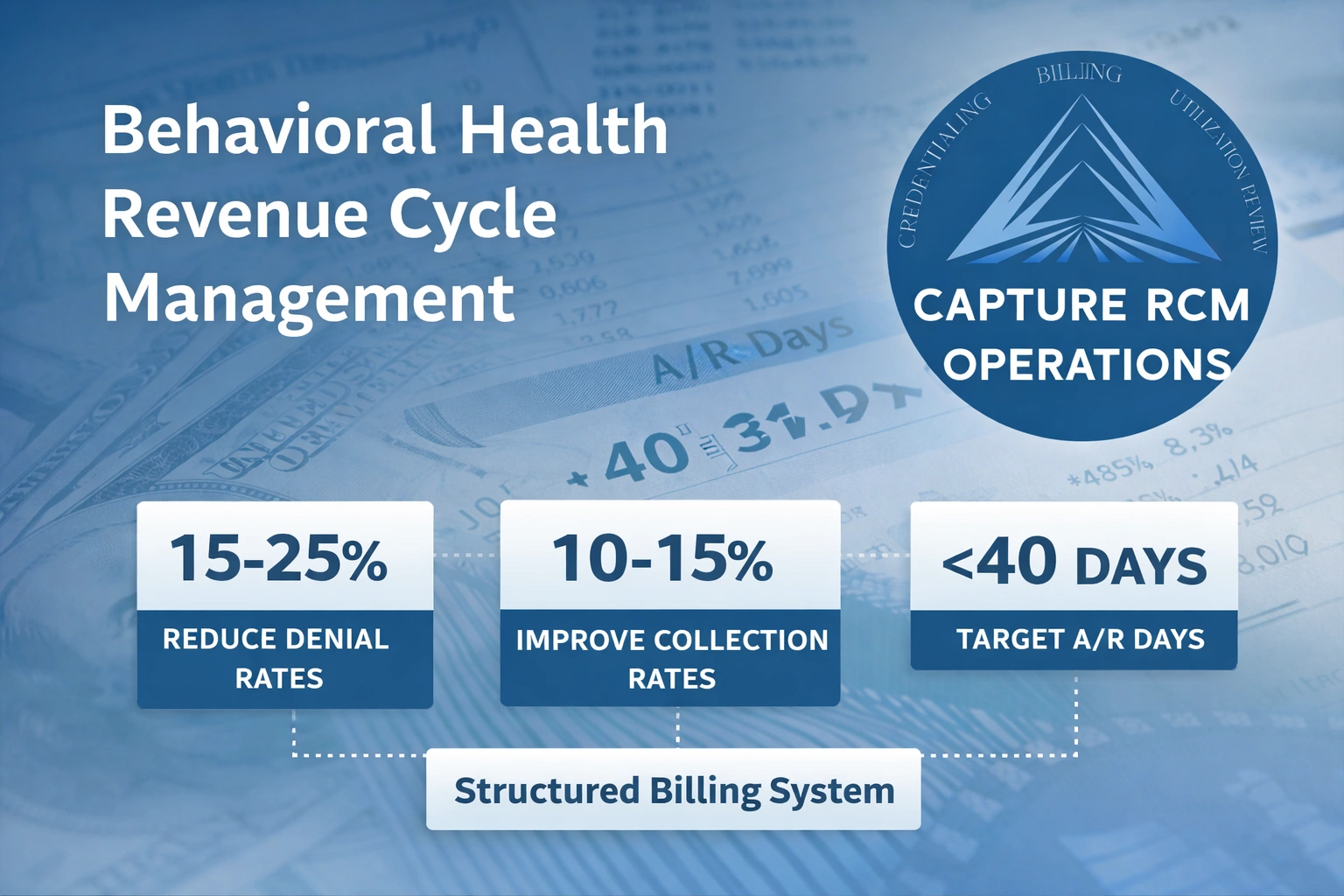
Healthcare revenue cycle benchmarks suggest practices should maintain A/R under 40 days. However, many behavioral health organizations operate closer to 50–60 days, which significantly impacts financial predictability.
For practice owners, the result is constant uncertainty. Payroll, facility expenses, and clinical staffing must be managed while waiting for insurance payments that may arrive weeks or months late.
Without structured billing oversight, these issues continue to compound.
The Solution: Behavioral Health Revenue Cycle Management
Behavioral Health Revenue Cycle Management (RCM) provides a structured framework for managing the financial lifecycle of patient care.
Rather than addressing billing problems individually, RCM organizes every stage of the process into a coordinated operational system.
The revenue cycle begins when a patient schedules an appointment and continues through insurance verification, clinical documentation, claim submission, payment collection, and financial reporting.
A comprehensive RCM framework typically includes:
- Patient eligibility verification
- Authorization management
- Coding accuracy validation
- Claims processing and follow-up
- Denial management
- Financial analytics and reporting
Organizations that implement structured revenue cycle strategies often experience measurable improvements.
Industry studies show healthcare organizations implementing strong RCM systems can reduce denial rates by 15–25% and accelerate reimbursement timelines.
For practice owners, this translates directly into improved cash flow stability.
Step 1: Strengthen Insurance Verification Before Services
One of the most overlooked causes of billing issues is incomplete insurance verification.
If insurance coverage, benefits, or authorization requirements are not confirmed before treatment, claims may be rejected regardless of the care delivered.
Front-end verification processes should include:
- Confirming active insurance coverage
- Reviewing behavioral health benefits
- Identifying authorization requirements
- Documenting payer-specific billing rules
Automated eligibility verification tools can dramatically improve this process.
Healthcare research suggests practices that implement automated verification systems reduce eligibility-related denials by up to 30%.
For practice owners, improving front-end verification reduces the number of claims that must be corrected after submission.
Step 2: Improve Coding Accuracy for Behavioral Health Services
Behavioral health billing requires precise coding practices.
Unlike many medical specialties, behavioral health services rely heavily on time-based CPT codes. These codes require documentation that clearly supports both session duration and clinical intervention.
Examples include:
- 90834 – 45-minute psychotherapy session
- 90837 – 60-minute psychotherapy session
- 90846 / 90847 – family therapy sessions
If documentation does not clearly support the code used, insurers may deny the claim or request additional documentation.
Behavioral Health Revenue Cycle Management systems often include coding validation processes. These processes review claims before submission to ensure documentation aligns with CPT codes.
Organizations implementing coding validation tools often improve first-pass claim acceptance rates by 10–15%.
For practice owners, this reduces the administrative time required to correct rejected claims.
Step 3: Implement Proactive Denial Management
Denied claims represent one of the largest revenue losses in healthcare billing.
Many practices respond to denials individually instead of analyzing the patterns behind them. As a result, the same issues occur repeatedly.
Effective denial management requires a systematic approach.
Key strategies include:
- Tracking denial reasons by payer
- Identifying recurring coding or documentation issues
- Prioritizing recovery of high-value claims
- Adjusting workflows to prevent repeat denials
Healthcare research indicates approximately 65% of denied claims are recoverable when addressed quickly.
Behavioral Health Revenue Cycle Management systems provide denial analytics that help billing teams identify root causes.
Instead of repeatedly correcting claims, practices can implement process improvements that prevent denials from occurring.
Step 4: Monitor Financial Performance Through Revenue Cycle Metrics
Revenue cycle oversight requires clear financial visibility.
Without performance metrics, practice owners often rely on incomplete financial information when evaluating billing performance.
Important revenue cycle indicators include:
- Clean claim rate
- Days in accounts receivable
- Denial rate
- Net collection rate
- Average reimbursement cycle time
High-performing behavioral health organizations typically maintain:
- Clean claim rates above 95%
- A/R below 40 days
- Denial rates below 5–7%
Tracking these metrics regularly helps practice owners identify operational problems early.
For example, if denial rates increase, the billing team can investigate whether payer requirements have changed or documentation errors are occurring.
Revenue cycle analytics provide the insight needed to make informed operational improvements.
Step 5: Align Clinical Documentation With Billing Workflows
Billing inefficiencies often originate from misalignment between clinical documentation and billing requirements.
For example, incomplete progress notes or missing treatment plan updates can prevent claims from being processed successfully.
Behavioral Health Revenue Cycle Management emphasizes collaboration between clinical and administrative teams.
Best practices include:
- Documentation training for clinicians
- Clear treatment plan documentation standards
- Regular chart reviews
- Communication protocols for billing questions
When clinical workflows align with billing requirements, practices experience fewer claim denials and faster reimbursements.
This alignment improves both administrative efficiency and financial stability.
Step 6: Use Revenue Cycle Technology for Operational Visibility
Technology plays a major role in modern revenue cycle management.
Advanced revenue cycle systems provide real-time visibility into billing operations, allowing practice owners to monitor financial performance.
Common revenue cycle technologies include:
- Automated eligibility verification systems
- Claims tracking dashboards
- Denial analytics reporting
- Authorization monitoring platforms
These tools help identify operational bottlenecks quickly.
For example, analytics dashboards may show that unpaid claims are concentrated with a specific insurance payer.
Billing teams can then investigate payer requirements and adjust workflows accordingly.
Organizations adopting revenue cycle analytics often improve collection rates by 10–15% within the first year.
Step 7: Build Financial Infrastructure That Supports Practice Growth
As behavioral health practices expand, billing complexity increases.
New clinicians, payer contracts, and treatment programs create additional administrative demands.
Behavioral Health Revenue Cycle Management provides scalable infrastructure that supports growth without increasing operational chaos.
Structured revenue cycle systems allow practices to:
- Manage higher claim volumes efficiently
- Maintain compliance with payer regulations
- Improve financial forecasting accuracy
- Expand services without increasing administrative burden
For practice owners planning long-term growth, strong revenue cycle infrastructure becomes essential.
Without it, billing complexity can quickly outpace administrative capacity.
Frequently Asked Questions
What is Behavioral Health Revenue Cycle Management?
Behavioral Health Revenue Cycle Management is the process of managing the financial lifecycle of behavioral health services. It includes insurance verification, coding accuracy, claim submission, denial management, and payment collection.
Why do behavioral health practices struggle with billing?
Behavioral health billing involves complex payer requirements, authorization rules, and time-based CPT codes. Without structured workflows, these complexities often lead to claim denials and delayed reimbursements.
What is a healthy accounts receivable benchmark?
Most healthcare organizations aim to maintain accounts receivable below 40 days. Higher A/R levels typically indicate billing inefficiencies or unresolved claims.
How can revenue cycle management improve cash flow?
Revenue cycle management improves cash flow by reducing claim denials, accelerating reimbursement timelines, and ensuring claims are submitted accurately the first time.
Should small behavioral health practices outsource revenue cycle management?
Many small practices outsource revenue cycle management to gain access to specialized billing expertise, advanced analytics tools, and denial management systems.
How long does it take to improve revenue cycle performance?
Many practices begin seeing improvements within 90 to 120 days after implementing structured revenue cycle management systems.
Call to Action
If your practice is struggling with billing inefficiencies, rising A/R aging, or inconsistent cash flow, structured revenue cycle management can bring clarity and stability to your financial operations.
Call (380) 383-6822 or explore our Behavioral Health Revenue Cycle Management services to learn more.