


You didn’t open your doors to become a billing expert.
You opened them to help people stabilize. To reduce crises. To offer real, structured support in moments that matter.
But somewhere along the way, the back end started slipping.
Claims are inconsistent. Reporting feels unclear. Denials seem random. Cash flow is tighter than it should be. And no one quite knows where the leaks are coming from.
If that’s your reality right now, take a breath.
This is more common than you think.
And it’s fixable.
Within the first step of stabilizing your operations is evaluating whether your current billing infrastructure for behavioral health is built for growth—or barely holding things together.
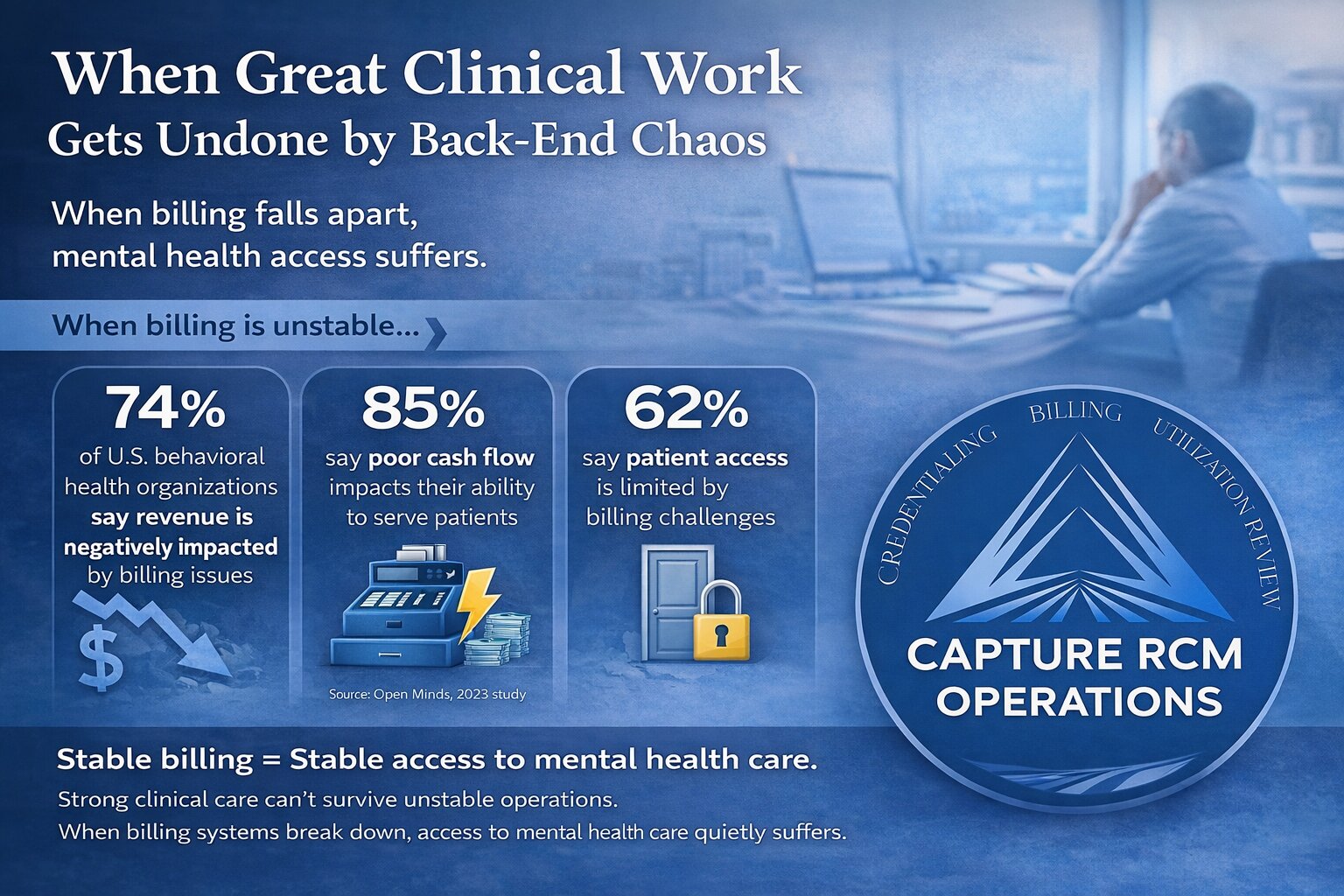
The Hard Truth: Access to Care Depends on Revenue Stability
This part isn’t glamorous.
But it’s real.
If your revenue cycle is unstable, access to care becomes unstable.
- Admissions slow because you’re unsure about reimbursement.
- Expansion plans stall because cash flow isn’t predictable.
- Hiring freezes happen “just until things stabilize.”
- Leadership conversations shift from growth to survival.
And none of that has anything to do with the quality of your clinicians.
Mental health billing services aren’t just administrative support. They’re the financial engine that determines whether your organization can:
- Keep doors open
- Add new programs
- Invest in staff
- Serve higher-acuity populations
When billing is organized, access expands.
When billing is chaotic, access contracts.
That’s not dramatic. It’s operational reality.
How Disorganization Starts (And Why It’s Not a Failure)
Most behavioral health organizations don’t choose chaos.
It creeps in during growth.
You launch quickly because the need is urgent.
You onboard clinicians faster than you build processes.
You assume payer rules are manageable—until they aren’t.
Then small cracks start forming:
- Credentialing timelines aren’t documented.
- Authorizations are tracked in spreadsheets no one owns.
- Denials are worked… sometimes.
- AR reports are pulled reactively instead of routinely.
- Payer follow-ups depend on who has time that week.
Nothing feels catastrophic.
But nothing feels stable either.
Over time, those small gaps compound. Revenue becomes unpredictable. Leadership feels reactive. Anxiety creeps into every decision.
This isn’t incompetence.
It’s what happens when clinical growth outpaces operational structure.
The Hidden Emotional Cost of Billing Instability
Let’s talk about something that rarely gets named.
Billing chaos creates emotional strain inside organizations.
Executive directors start waking up at 3 a.m.
Owners feel embarrassed asking for updated AR.
Clinical supervisors worry about productivity thresholds instead of patient outcomes.
Billing staff feel overwhelmed and unsupported.
It’s heavy.
And because billing sits “behind the scenes,” the stress often goes unspoken.
But the pressure is real.
When you don’t trust your numbers, you can’t plan.
When you can’t plan, everything feels fragile.
That fragility bleeds into culture.
And culture affects care.
Signs Your Billing Structure May Be Limiting Access to Care
If you’re unsure whether your current setup is truly supporting you, here are quiet red flags we see often:
- Clean claim rate isn’t tracked consistently
- Denials aren’t categorized by root cause
- AR over 90 days feels “normal”
- Credentialing delays impact admissions
- Reports are created manually each month
- Payer policy updates are reactive instead of proactive
- Revenue forecasting feels like guesswork
You might still be operating.
You might even be growing.
But growth without structure is fragile.
And fragile systems eventually crack.
Reactive Billing vs. Strategic Billing
There’s a difference between “getting claims out” and running a strategic revenue cycle.
Reactive billing looks like:
- Scrambling when cash dips
- Working old AR in bursts
- Appealing denials without tracking patterns
- Updating processes after payer audits
Strategic billing looks like:
- Daily claim monitoring
- Denial trend analysis
- Authorization tracking systems
- Payer performance reporting
- Clear KPIs leadership can actually use
One feels stressful and inconsistent.
The other feels steady.
Mental health billing services, when done correctly, shift organizations out of survival mode and into operational clarity.
And clarity is powerful.
Why This Work Feels So Complex
Behavioral health billing isn’t simple.
You’re navigating:
- Multiple payer contracts
- Prior authorizations
- Medical necessity documentation requirements
- Frequent audits
- Changing CPT and HCPCS guidance
- Coordination between clinical and administrative teams
It’s layered.
Even experienced internal teams can struggle without strong systems and oversight.
This isn’t about whether your current staff is capable.
It’s about whether they have structure, bandwidth, and expertise to manage complexity at scale.
Without structure, complexity becomes chaos.
With structure, complexity becomes manageable.
What Operational Stability Actually Looks Like
Stability doesn’t mean perfection.
It means predictability.
Here’s what that looks like inside organized behavioral health organizations:
- Clean claims consistently submitted within 24–48 hours
- Denials tracked and categorized weekly
- AR segmented by payer and aging bucket
- Credentialing status visible in a shared system
- Authorization expiration alerts automated
- Revenue projections reviewed monthly
- Clear accountability across departments
Leadership can see what’s collectible.
Owners can forecast growth responsibly.
Clinical teams aren’t pressured by financial confusion.
It feels calm.
It feels controlled.
It feels sustainable.
And that sustainability directly impacts how many people you can serve.
Stabilizing Billing Isn’t Just About Revenue — It’s About Mission
Most organizations don’t talk about billing until something breaks.
But billing is mission protection.
When revenue is stable:
- You can invest in better training.
- You can add new treatment tracks.
- You can hire additional clinicians.
- You can accept more complex cases.
- You can reduce waitlists.
When revenue is unstable:
- Expansion feels risky.
- Admissions tighten.
- Services get scaled back.
Access to care doesn’t disappear overnight.
It narrows quietly.
That’s why structured mental health billing services matter more than many programs initially realize.
They don’t just collect payments.
They protect the future of your organization.
Frequently Asked Questions
How do I know if our billing issues are serious or just normal growing pains?
Some friction is normal during growth. But if AR over 90 days continues to rise, denials aren’t tracked by category, or leadership lacks clear financial reporting, that’s more than growing pains. It’s a structural gap.
The earlier you address it, the easier it is to fix.
Can’t we just hire another internal biller?
Sometimes that helps. Sometimes it adds cost without solving the core issue.
If processes aren’t standardized, reporting isn’t structured, or payer strategy isn’t defined, adding staff may simply multiply inconsistency. Structure should come first—then staffing decisions.
Will fixing billing disrupt our current operations?
If done thoughtfully, stabilization actually reduces disruption.
Strong systems create clarity. Instead of constant emergencies, your team experiences fewer surprises, fewer urgent payer calls, and more predictable workflows.
Short-term adjustment leads to long-term calm.
Is it too late if our AR is already high?
It’s rarely too late.
High AR can be segmented, analyzed, and worked strategically. The key is identifying what’s collectible, what requires appeal, and what should be written off.
Clarity replaces panic.
How quickly can revenue improve with better structure?
Every organization is different. But when clean claims increase and denial management becomes consistent, improvements often begin within one to three billing cycles.
More importantly, forecasting becomes reliable—even before full recovery.
What makes behavioral health billing different from other specialties?
Authorization requirements, documentation scrutiny, and payer policy variability are significantly higher in behavioral health. It requires specialized knowledge and systems built specifically for this level of complexity.
Generalized billing experience isn’t always enough.
If You Feel Behind, You’re Not Alone
Many organizations start with clinical excellence and build operational maturity later.
That’s not shameful.
It’s common.
But staying in reactive mode is exhausting. And it limits how many lives you can impact.
Billing stability isn’t about chasing perfection.
It’s about building a foundation strong enough to support your mission.
And when that foundation is solid, growth feels possible again.
Access expands again.
The pressure lifts.
If your organization is feeling the weight of operational instability, it may be time to strengthen the systems behind your care.
Call 380-383-6822 or visit our mental health billing services to learn more about our Behavioral Health Billing Services.