

Aged receivables aren’t just a lagging indicator—they’re a red flag for hidden inefficiencies. For billing directors in behavioral health, A/R aging represents more than unpaid claims. It signals process breakdowns, cross-department misalignment, and operational stress that puts revenue, staffing, and compliance at risk.
Billing directors and finance leaders may see rising balances in 60-, 90-, or even 120-day buckets. At first, it feels manageable. But over time, aging receivables begin to strain staffing decisions, restrict reinvestment, and slow expansion.
In behavioral health, A/R aging isn’t just a billing issue. It’s a structural vulnerability.
Why Behavioral Health Is Uniquely Exposed to A/R Pressure
Revenue cycles in behavioral health are more complex than many other medical specialties. Several structural realities increase exposure to aging receivables:
- Frequent authorization requirements
- Medical necessity reviews tied to documentation detail
- High claim scrutiny from commercial and Medicaid payers
- Partial payments and clawbacks
- Credentialing delays for new clinicians
- Shifting payer mixes tied to census fluctuations
These factors create more friction points — and every friction point increases the likelihood of delayed payment.
When A/R begins to age, it rarely stems from one single breakdown. It’s usually a compounding systems issue.
What Rising A/R Buckets Really Signal
Aging receivables are not just numbers on a report. They indicate deeper operational gaps, such as:
1. Documentation Inconsistency
Incomplete or delayed clinical documentation slows claim submission and increases denial rates. Behavioral health claims are especially sensitive to narrative and session detail.
2. Authorization Breakdowns
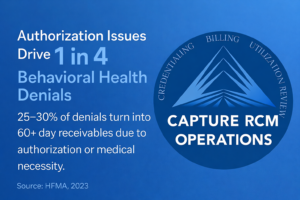
Missed authorizations or retroactive approvals can push otherwise valid claims into extended aging cycles.
3. Weak Denial Recovery Workflows
If denial management isn’t tightly tracked, unresolved claims drift into older buckets where recovery becomes less likely.
4. Credentialing Lag
New providers seeing patients before enrollment is fully complete often create backlogged claims.
5. Payer-Specific Billing Nuances
Behavioral health billing rules vary significantly across commercial, Medicaid, and managed care plans. Without payer-specific tracking, delays accumulate.
A/R aging is rarely random. It’s diagnostic.
The Financial Impact Most Organizations Underestimate
As receivables age, recovery probability drops.
- Claims under 30 days have high collectability.
- Claims beyond 90 days see significantly reduced recovery rates.
- Claims beyond 120 days often require escalation or write-off consideration.
But the financial risk isn’t just in write-offs.
Prolonged A/R aging affects:
- Working capital
- Payroll stability
- Hiring decisions
- Marketing budgets
- Expansion timelines
- Vendor relationships
For multi-location behavioral health organizations, even a modest increase in aging can compound into significant monthly cash flow compression.
Why A/R Aging Becomes Harder to Reverse Over Time
Once aging reaches a certain threshold, organizations often respond reactively:
- Temporary staffing adjustments
- Short-term payment plans
- Write-off increases
- Delayed investments
But without structural billing oversight, the cycle continues.
Behavioral health revenue cycles require coordinated management across:
- Front-end verification
- Authorization tracking
- Charge capture
- Claims submission
- Denial management
- Follow-up cadence
When these functions operate in silos, aging accelerates.
For organizations evaluating whether deeper billing oversight is needed, structured revenue cycle management becomes critical in preventing long-term financial drag.
Practical Indicators It’s Time to Reassess Billing Infrastructure
Billing directors should look closely at A/R performance when:
- 90+ day A/R exceeds 20–25% of total receivables
- Denial rates trend upward quarter over quarter
- Staff report inconsistent payer responses
- Claims submission timelines extend beyond 5–7 days post-service
- Cash collections fluctuate unpredictably month to month
These indicators often precede larger operational constraints.
Stabilizing A/R Before It Slows Growth Further
Improving A/R performance in behavioral health typically involves:
- Standardized authorization workflows
- Real-time denial tracking dashboards
- Payer-specific follow-up protocols
- Clinical documentation feedback loops
- Credentialing timeline alignment
- Defined KPI ownership
When oversight is structured and data-driven, aging trends can reverse — but it requires system-level clarity.
The Bigger Picture
A/R aging is not simply a billing inconvenience. In behavioral health organizations, it reflects the health of the entire revenue infrastructure.
Left unchecked, it constrains growth.
Addressed strategically, it restores financial stability.
For billing leaders, A/R performance is one of the clearest early indicators of whether operational systems are aligned — or quietly drifting.
Tired of Watching Your A/R Climb?
At Capture RCM Operations, we don’t just process claims—we solve problems. We specialize in behavioral health revenue cycle management that gives billing directors clarity, control, and confidence. Our team helps you reduce aging, prevent denials, and create sustainable, scalable billing systems tailored to your clinical model.
Call (380) 383-6822 or visit our RCM services page to see how we can help your behavioral health organization take back control of its revenue cycle.