

Introduction
You didn’t get into this to manage claim codes. You built—or support—a dual diagnosis program to help people heal from the complexity of mental illness, trauma, and substance use.
And the care you offer? It’s human, layered, and mission-driven.
But the billing? It often feels like a system that wasn’t built for any of that.
Instead, it feels like constant denial follow-ups, documentation redos, and workflows that pull clinical teams further away from the work they’re best at.
If that resonates, you’re not imagining things. Behavioral health billing really is different—and this blog is here to explain why, with practical ways to stop the revenue damage it causes.
1. Behavioral Health Is Nuanced—But Payers Want Binary Proof
In behavioral health, progress is rarely a straight line. Clients show up, fall back, stabilize, disappear, return. And still—your team shows up for them.
But to a payer? They want documentation that proves “improvement” in ways that often don’t align with the lived clinical reality.
Common disconnects:
- Notes that reflect client engagement—but not measurable change
- Treatment plans that show compassion—but lack insurer language
- Stability framed as success—when payers want full resolution
Billing Impact:
Payers may deny services that are essential but hard to quantify, like crisis planning, emotion regulation, or trauma-informed care.
What Helps:
- Use clinical templates tailored to behavioral health documentation standards
- Train staff to link therapeutic interventions to functional outcomes (e.g., work attendance, ADLs, emotional regulation)
- Develop internal QA processes that coach, not punish
When documentation bridges both worlds—clinical honesty and payer logic—denials drop, and clinicians don’t feel forced to “fake progress” to get paid.
2. Dual Diagnosis Complexity Often Gets Collapsed in Billing Systems
Clients with both mental health and substance use diagnoses need integrated care. But most EMRs and billing systems still silo them—and many payers do too.
The Result:
- Denied claims for group therapy delivered by an LCSW under a substance use diagnosis
- Problems sequencing dual diagnoses
- Duplicate claim rejections when multiple services occur in the same session
Billing Impact:
Integrated care gets carved into fragments for the sake of claim logic—leading to denied or underpaid services that were clinically appropriate.
What Helps:
- Configure your EMR to distinguish between MH and SUD coding
- Assign correct primary diagnosis based on service type and provider license
- Review payer-specific rules for multi-diagnosis claims
Capture RCM routinely works with programs to build these payer-specific pathways—so your integrated care doesn’t get lost in translation.
3. Documentation Expectations Are a Moving Target
One of the hardest truths for behavioral health teams is this: what worked last quarter might be denied this one.
Recent changes we’ve tracked for clients:
- New requirements for session start/end times on every note
- Shift away from checkbox-style assessments to narrative progress
- Narrower definitions of “medical necessity” for residential or PHP care
- Tighter justification needed for extended lengths of stay
Billing Impact:
Without real-time updates, even experienced clinicians can write “good notes” that still lead to denials.
What Helps:
- Build documentation training into your compliance rhythm—quarterly is ideal
- Partner with billing teams who flag payer-specific changes in real time
- Make audit prep part of your workflow—not just a panic project
Staying current doesn’t mean chasing every change—it means knowing which ones affect your top five payers, and adjusting with intention.
4. Authorization Gaps Are Easy to Miss—and Costly to Fix
Unlike many areas of healthcare, behavioral health often requires constant authorization maintenance. Especially at higher levels of care.
And these are the failures we see most often:
- Auths requested but never confirmed
- Expired mid-treatment and unnoticed
- Documentation didn’t match the requested level of care
- Clinical staff didn’t know they were operating without auth
Billing Impact:
Claims get denied weeks—or months—after services are delivered. And if you’re not tracking that proactively, you’re likely losing revenue without realizing it.
What Helps:
- Build an integrated authorization calendar linked to your EMR or admin dashboard
- Use role-specific alerts for expiring or missing auths
- Train clinical leads on documentation language that supports auth renewals
At Capture RCM, we often find these are “silent failures”—they don’t show up until a denial lands. Tracking them upstream changes everything.
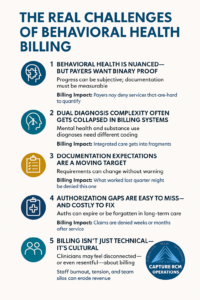
5. Billing Isn’t Just Technical—It’s Cultural
This may be the most overlooked truth of all: behavioral health teams often feel emotionally disconnected—or even resentful—about billing.
Why?
Because billing can feel like the opposite of care.
Clinicians feel forced to reduce humanity into codes.
Admin teams feel blamed for rules they didn’t create.
Leadership feels stuck between margins and mission.
Billing Impact:
Staff burnout. Team tension. Poor documentation. Rework. Avoidable denials. And a system that reinforces the very fragmentation behavioral health seeks to heal.
What Helps:
- Build billing education into onboarding—not just admin roles
- Use shared dashboards so clinical and billing teams work from the same data
- Partner with RCM teams who understand the identity of behavioral health
When billing becomes part of your culture—not the thing everyone avoids—it stops being a threat. It becomes a support system.
Ready for a Billing System That Matches the Way You Actually Provide Care?
Your clients are complex. Your team is mission-aligned. Your treatment model is real.
Now your billing process needs to catch up.
Capture RCM Operations supports dual diagnosis and behavioral health facilities nationwide with billing systems that are:
- Culturally informed
- Clinician-aware
- Payer-specific
- And actually scalable
Explore our Billing Services Or call (380) 383-6822 to speak with a behavioral health billing strategist who understands your program, your pain points, and your potential.
Because billing shouldn’t flatten your care. It should fuel it.
Behavioral Health Billing FAQs
Q: Can we use one code for both SUD and mental health services in a single session?
Not typically. Most payers require services to be billed separately under the correct diagnosis and provider type. Improper bundling often triggers denials or underpayments.
Q: Why do our notes get flagged even when they’re clinically solid?
Clinical value doesn’t always equal payer compliance. Notes must meet specific “medical necessity” language, including function-based goals, measurable outcomes, and clear service justification.
Q: Do we need different contracts for residential or dual diagnosis services?
Sometimes, yes. Some payers require separate credentialing or rate negotiations for higher-acuity or integrated models. We can help you check this before launching or expanding.
Q: Our EMR isn’t built for dual diagnosis. Do we need to switch?
Not necessarily. Many EMRs can be reconfigured or supplemented with workflows to support accurate coding, documentation, and tracking. We’ll help you assess what’s possible without a full overhaul.
Q: What’s the fastest way to reduce our denials right now?
Start by auditing your top 10 denials over the past 90 days. Most will fall into repeatable buckets—documentation, coding, auths. Target those with focused process updates or partner support.