

Introduction: When RCM Fails, Great Care Doesn’t Stand a Chance
You built something good.
Your team is solid. The clinical model is strong. Clients are showing up. Outcomes are there.
But your bank account doesn’t reflect it. Your staff is frustrated. And someone on the team has started asking the question nobody wants to say out loud:
“Is this even working?”
In almost every case we’ve seen at Capture RCM, the problem isn’t the care.
It’s the revenue cycle.
Claims that never get submitted. Denials nobody follows up on. Authorization chaos. Documentation pushed back on already maxed-out clinicians.
This blog isn’t a pitch. It’s a set of stories. Five real examples of good mental health programs sabotaged by bad back-end systems—and what happened when someone finally called it out and decided to fix it.
1. The 90-Day Payment Blackout That Nearly Shut Down a PHP
The Situation:
A promising PHP opened in the Midwest with strong leadership and a solid clinical model. But by the end of the third month, only a fraction of claims had been paid.
Payroll was getting tight. Their CFO was already looking for bridge loans.
What Went Wrong:
The third-party billing team failed to submit the right taxonomy for group services. Claims were rejected, but no one followed up. The leadership team wasn’t alerted until the denials started stacking up. Meanwhile, clinicians kept showing up, not realizing their work wasn’t being reimbursed.
What We Did:
When Capture stepped in, we reconstructed payer enrollments, corrected taxonomy issues, and established a live rejection feed for leadership. We escalated high-dollar denials with direct payer follow-up.
The Outcome:
$276,000 in revenue recovered in the first 30 days. Team morale stabilized. And their expansion plan was back on track by Q2.
2. The Chronic Denial Shrug That Wrecked Trust
The Situation:
A well-regarded trauma therapy group in the Southeast had strong client retention—but payment delays were constant.
Every time they asked their billing vendor about a denial, the answer was the same: “That’s just how insurance is.”
What Went Wrong:
CPT codes for EMDR and telehealth weren’t submitted correctly. Notes were missing payer-required language. Worse—appeals weren’t being filed at all.
What We Did:
We restructured their claim workflows, added payer-specific note guidance for clinicians, and trained staff on denial triggers and proper coding. Then we got aggressive about appeals—submitting them within 24 hours with tailored documentation.
The Outcome:
Denials dropped 43%. Payments were cleaner. Clinicians felt heard. Leadership finally had visibility. The system went from black box to open dashboard—and that changed everything.
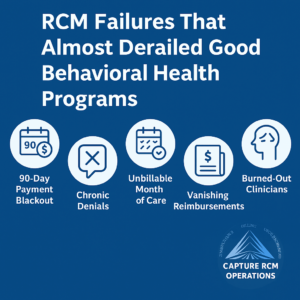
3. The Month of Care They Couldn’t Bill
The Situation:
An Intensive Outpatient Program in California had a killer first month: high attendance, strong outcomes, no missed sessions. But when it came time to bill, 70% of the services couldn’t be submitted.
What Went Wrong:
Authorizations had been requested but never confirmed. Services were delivered anyway—without a green light from payers. The billing team assumed approvals would come through. They didn’t.
What We Did:
Capture built a pre-service authorization process that included active payer confirmation, client-level tracking, and red flags for missing data. We integrated it with their EMR and admin calendar so no session happened without visibility.
The Outcome:
No more “blind delivery.” Every session tracked. Every service pre-approved. The team knew exactly where each client stood—and they never lost a month of care again.
4. The Vanishing Reimbursements That Wrecked the Budget
The Situation:
A respected community mental health center kept coming up short on revenue, despite what looked like strong billing volume. Their finance lead suspected underpayment—but couldn’t prove it.
What Went Wrong:
The billing vendor was posting payments based on expected values—not actual deposits. In some cases, claims were marked “paid” before EFTs were received. Several payments were sent to the wrong NPI or TIN and never recovered.
What We Did:
We rebuilt their reconciliation system using real bank deposits, not just payer EOBs. We aligned NPIs across systems, corrected their EFT registration, and created a true payment-to-claim match.
The Outcome:
They uncovered over $110K in unreconciled revenue. The CFO gained full visibility. Budgeting stopped being a guessing game—and leadership regained control.
5. The Clinical Team That Was Burned Out by Broken Processes
The Situation:
A multi-site outpatient program had a documentation problem—but not because clinicians were lazy. They were exhausted. They were being asked to rewrite notes, chase down missing auths, and call insurance companies between sessions.
What Went Wrong:
The RCM team had offloaded critical tasks to clinical staff without clear workflows. The clinicians were doing three jobs: therapy, documentation QA, and billing support—with no training.
What We Did:
Capture took back the work that belonged in the billing department. We built pre-bill QA into the RCM side, assigned payer communication to admin staff, and shielded the clinical team from rework.
The Outcome:
Clinician satisfaction rose. Turnover dropped. And for the first time, therapy actually felt like the job they were hired to do.
Ready to Stop Losing Revenue You’ve Already Earned?
You built a good program. Don’t let bad backend systems take it down.
Capture RCM Operations partners with behavioral health and Medical Services Billing providers nationwide to fix what most billing vendors overlook.
We don’t make excuses. We make claims move, teams breathe easier, and leadership feel like they actually have control again. Call (380) 383-6822 to talk to someone who won’t tell you “that’s just how insurance works.”
RCM FAQs for Skeptical Program Builders
What if our billing looks “okay” but we still feel behind on revenue?
You might be seeing what we call “ghost billing”—claims that appear submitted but haven’t actually cleared, been paid, or hit your bank account. We can audit for that.
How do I know if our denial rate is normal?
Anything over 10–15% deserves scrutiny. If denials aren’t being tracked, explained, and appealed, you’re probably leaving serious revenue on the table.
Isn’t this just the way insurance works now?
No. Payers are complex, but a good RCM partner knows how to document, submit, and appeal effectively. “That’s just how it is” is not a valid answer—it’s a red flag.
What if we’ve already tried switching RCM teams and it didn’t help?
That happens. Often, vendors aren’t built for behavioral health or don’t offer true end-to-end support. We’ll show you what we do differently before we ever sign a contract.
Can you work with our existing EMR?
Yes. We’re EMR-agnostic and have integrated with nearly every major system in behavioral health and medical services.