

There’s a quiet reality most ABA clinic founders eventually run into—usually right when growth starts to take off.
You hire more staff. Your referral list grows. Parents start emailing daily asking if you’ve got availability. Everything should feel like a win. But instead, your billing is in chaos. Claims are getting denied for codes you thought were standard. Payments are slow. Suddenly, that clean 90-day revenue plan is looking more like wishful thinking.
The problem? It’s not your care. It’s not your clients. It’s not even you.
It’s your billing partner—and their lack of fluency in behavioral health codes.
Misfiled Codes Are a Silent Threat to Every Growth Plan
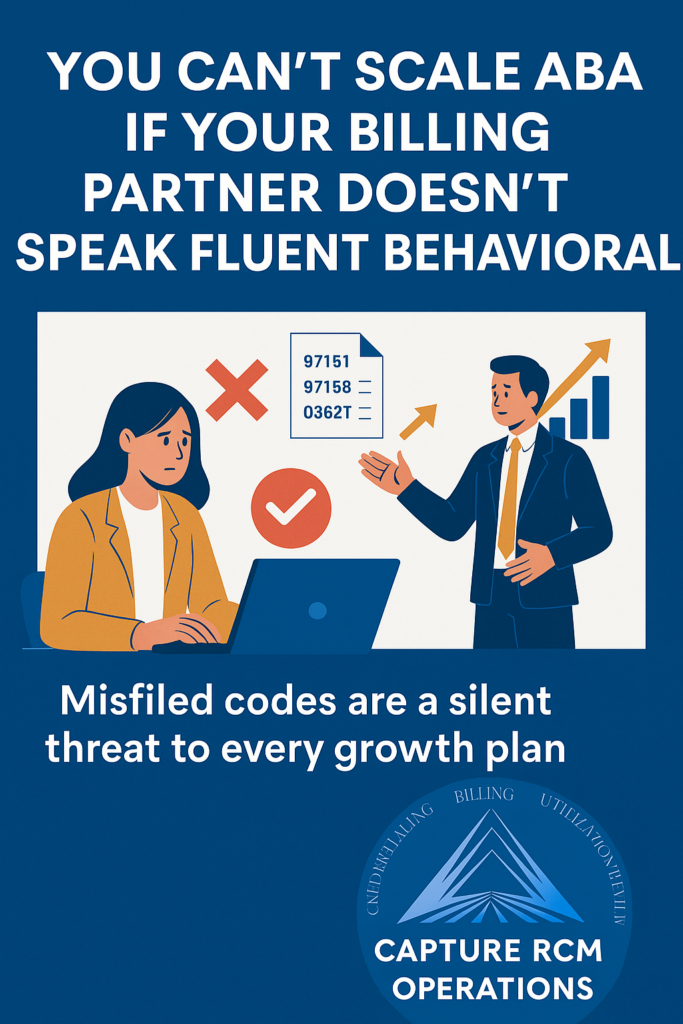
When you’re scaling, every dollar counts. Every claim matters. So when your billing partner uses 97153 without the right modifier, or fails to submit 0362T correctly, it’s not a small error. It’s a structural weakness.
One denial can trigger:
- Delayed cash flow that affects payroll or operations
- Audit flags from Medicaid or MCOs
- Lost trust from staff who keep hearing “we’re fixing billing soon”
And these aren’t isolated events. They start to multiply as you grow. Every new RBT you onboard, every new contract you sign, adds pressure to a billing system that may already be leaking revenue.
It’s death by 1,000 paper cuts.
ABA Coding Isn’t “Complex”—It’s Just Its Own Language
Let’s clear something up. ABA coding isn’t inherently complicated. It’s just different. It follows its own logic. It reflects a different model of care.
But that difference matters.
If your billing partner doesn’t live and breathe codes like:
- 97151 (initial assessment)
- 97153 (direct treatment)
- 97155 (treatment with modifications)
- 0362T (adaptive behavior services with multiple staff)
- H codes (Medicaid-specific services in some states)
…then they’re not equipped to help you scale. They’re stuck at the starting line while you’re trying to run a sprint.
Capture RCM Operations doesn’t “dabble” in ABA. It’s a core focus. Our teams are fluent in behavioral health logic, credentialing patterns, and payer-specific rules nationwide. We know the difference between a CDEI request and a UHC-specific add-on requirement—because we deal with them every day.
When You’re Explaining Codes to Your Biller, You’re Already Losing Time
How many hours have you spent forwarding payer emails, chasing modifier clarifications, or correcting CPT submissions? That’s time you don’t spend on supervision, onboarding, or clinical quality. And if you’re honest, it’s exhausting.
You should be leading a behavioral health company—not running a crash course in RCM for people who promised they “had experience.”
Fluent billing partners don’t wait for you to explain the problem. They flag it first. They bring the solution before you have to ask.
Scaling Isn’t Just About Adding Staff—It’s About Removing Bottlenecks
You’ve got the clinicians. You’ve got the waitlist. You might even have the space. But if your billing backend isn’t built for behavioral logic, your ceiling is lower than you think.
Because what good is doubling your caseload if you can’t get clean, reliable revenue from the first half?
Scaling medical services means building with partners who can hold weight—not collapse under it.
Capture RCM is built to scale with you. Whether you’re expanding to new states, adding private payers, or launching center-based programs, we’ve already built the infrastructure to support you.
ABA Doesn’t Fit Inside a Generic Medical Billing Box
Let’s be blunt: ABA is niche. The documentation standards are different. The clinical model is different. The coding and modifiers are different.
General medical billers who “figure it out as they go” often:
- Submit the wrong code families
- Miss crucial modifiers (like GO, HO, HM)
- Misinterpret supervision requirements
- Underbill or overbill based on outdated logic
- Fail to communicate with clinical teams in behavioral terms
You don’t have time to be their educator. You need a partner who already knows the terrain.
Frequently Asked Questions (FAQ)
Why is it so important that a billing partner specialize in ABA?
Because ABA billing isn’t like general therapy billing. The codes, modifiers, session lengths, and supervision models require precise understanding. Mistakes can trigger denials, audits, or even payer sanctions. A specialist knows how to bill correctly the first time.
Can’t we just train our internal admin team on ABA billing?
You can—but that comes with high risk. ABA billing isn’t just about learning codes. It’s about keeping up with policy shifts, payer quirks, and state-by-state Medicaid differences. Most internal teams don’t have the capacity to handle that while managing day-to-day operations.
How does Capture RCM handle payers across different states?
We operate nationally and maintain active knowledge of state-specific Medicaid plans and private payer policies. Whether you’re in Ohio, Texas, or California, we tailor your billing approach to the compliance rules and trends in your region.
What’s the biggest mistake you see new ABA clinics make with billing?
Outsourcing too early to a non-specialized RCM vendor. Founders assume all billing teams can “figure it out,” only to spend months untangling denied claims and underpaid CPT codes. Choosing the right partner early saves time, money, and sanity.
How fast can we onboard with Capture RCM?
Most practices are fully onboarded in under 30 days. We handle payer updates, credentialing checks, and system setup while aligning with your clinical operations to minimize disruption.
Let’s Talk Before the Next Denial Hits Your Inbox
📞 Call us at (380) 383-6822 or click here to start the conversation.
If you’re scaling ABA medical services, don’t let a generic billing partner drag you down. Capture RCM Operations understands behavioral health. We’re ready when you are.